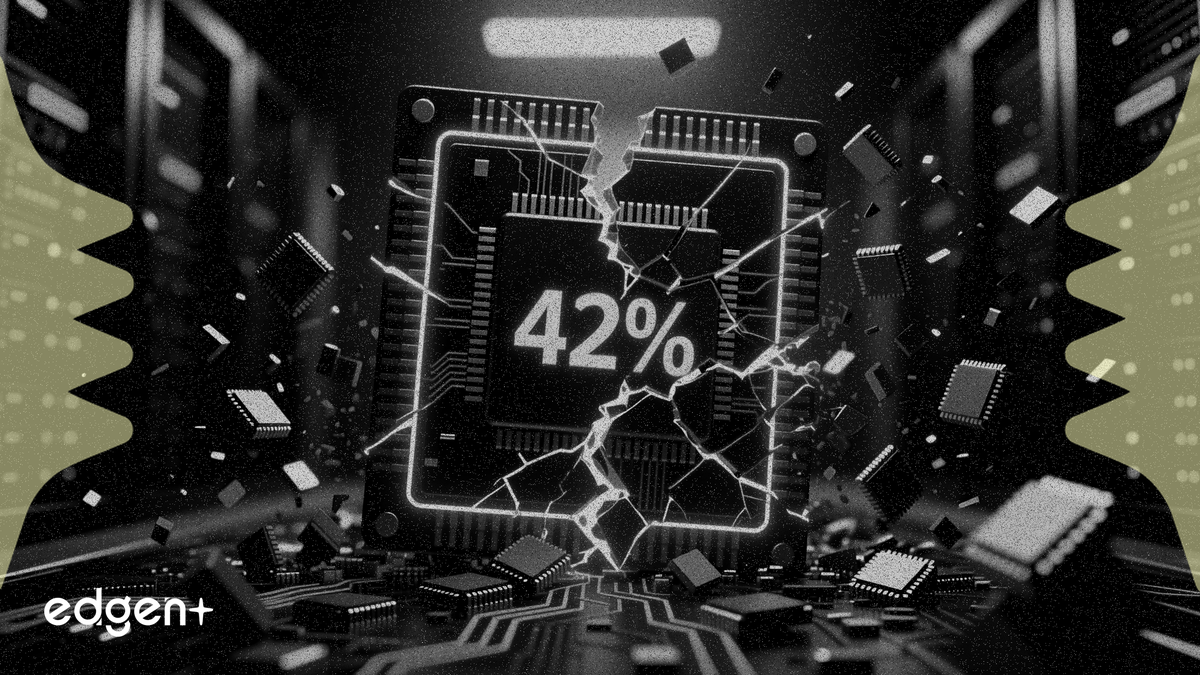

A 3x leveraged South Korea ETF erased nearly half its value in one day after a Broadcom guidance miss and a hot payrolls report shattered the memory-chip narrative.
The Direxion Daily MSCI South Korea Bull 3X Shares (KORU) crashed 41.89% to $610 on June 5, turning $10,000 into roughly $5,811 in a single session.
"The fund did exactly what the prospectus said it would do — it is a 3x daily-reset product that compounded a 14% drop in the underlying index into a 42% collapse," said Austin Smith, a senior markets analyst at 24/7 Wall St.
The parent index, the MSCI Korea 25/50, fell 14% as Samsung Electronics dropped 6% and SK Hynix lost 10%, together accounting for roughly 42% of the index weight. The KOSPI declined about 6%, triggering a circuit breaker on KOSPI 200 futures, while foreign investors pulled an estimated $1.21 billion from Korean equities. The CBOE Volatility Index had closed at 15.40 on June 4, its lowest reading before the crash and in the 16th percentile of the prior 12 months.
The collapse leaves KORU still up 236% year to date from a $181.55 start, but the fund now trades at $610 after a 44% weekly decline from $1,090 on May 29. The forward question is whether Korean memory-chip pricing power can hold against a customer base that just heard Broadcom's CEO warn that diversification is coming.
The catalyst arrived in two steps. On June 3, Broadcom reported fiscal Q2 with Q3 AI semiconductor revenue guidance of $16 billion against consensus near $17.2 billion, a roughly 7% miss. CEO Hock Tan said Google would likely use multiple chip suppliers and that the AI mix was diluting gross margins. Broadcom shares fell about 20% from June 3 to June 5, dropping from $479 to $386.
Step two came June 5 when May nonfarm payrolls printed 172,000 versus 80,000 expected. The 2-year Treasury yield surged to 4.16%, a 16-month high. The Nasdaq 100 fell 5% in its worst session in over a year, and the PHLX Semiconductor Index dropped roughly 10%. Micron Technology, the closest US analog to SK Hynix in high-bandwidth memory, fell about 13% to $864 — selling off harder than the broader semiconductor sector, signaling the market was repricing the memory pricing curve itself.
The arithmetic behind the leverage
KORU is contractually built to deliver 3x the daily return of the MSCI Korea 25/50 Index through swap agreements. Three times the underlying index's 14.11% decline accounts for most of the 41.89% loss, with the remainder coming from path-dependency as swap counterparties rebalanced into weakness. The fund does not own a diversified basket of 600 names — it owns a derivative on a basket where two memory companies drive nearly half the variance.
The 10-year Treasury yield sat at 4.47% on June 4 after a May 19 peak at 4.67%, while the 10Y-2Y spread compressed from 54 basis points on May 18 to 38 basis points on June 5, the lowest level in 12 months. A hot payrolls number into a guidance miss into the most leveraged corner of the Korean memory complex punished the complacency priced into the market.
What to watch next
Micron Technology reports fiscal Q3 on June 24 after the close, with company-confirmed revenue guidance of $18.70 billion plus or minus $400 million. If Micron trims its second-half outlook or hedges on HBM average selling prices, the read-through to Samsung and SK Hynix is direct. If it reaffirms a tight supply picture into 2027, the Broadcom miss begins to look like an idiosyncratic customer story rather than a demand-curve break.
Three other indicators bear watching. Samsung's qualification status for HBM3e shipments into NVIDIA's Blackwell platform — where SK Hynix is already in the supply chain — could reorder the Korean weighting trade overnight. The Korean won, trading at 0.00064852 USD per KRW as of June 6, becomes the next pressure point if foreign outflows continue. And the 2-year Treasury yield, which drove the macro overlay, needs to unwind back below 4% for Korean memory to get room to breathe.
This article is for informational purposes only and does not constitute investment advice.