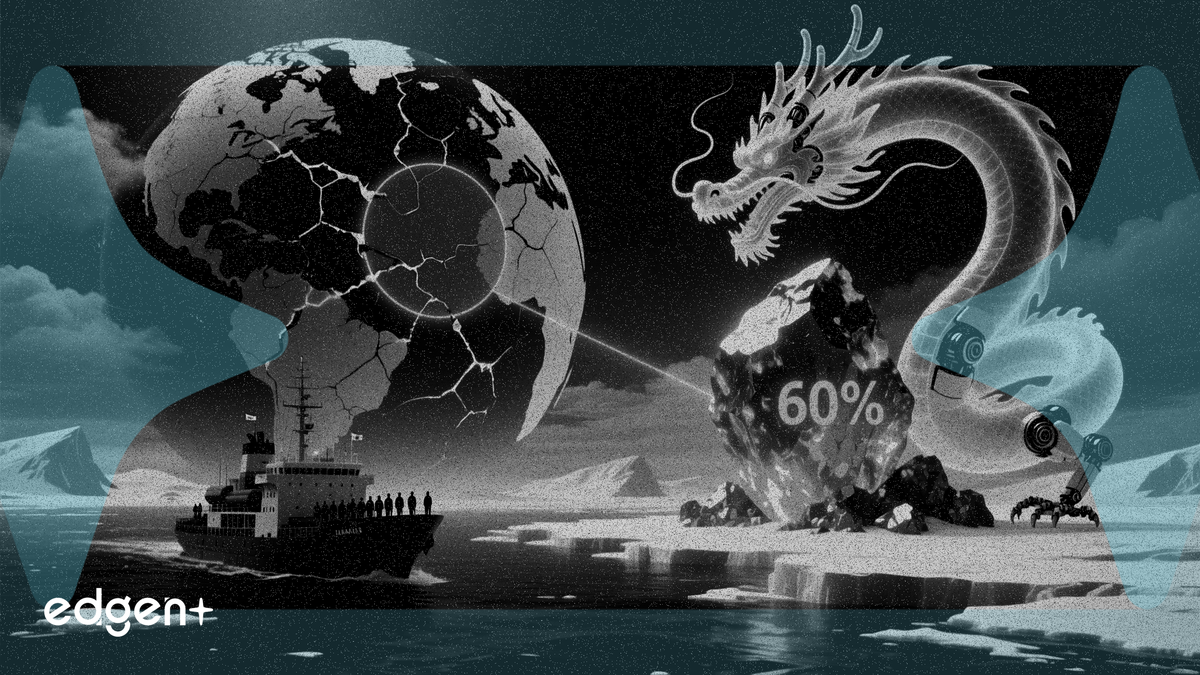
Japan's summer mission to Greenland marks the latest front in the global race to secure rare earth supply chains outside China's dominance.
Japan will dispatch a delegation to Greenland this summer to evaluate potential rare earth extraction sites, Nikkei reported Sunday, as the world's third-largest economy seeks to diversify critical mineral supply chains away from China.
"Greenland's mineral wealth has become a strategic prize as nations compete for supply chains essential to the energy transition," said Takeshi Yamamoto, a senior analyst at the Japan Economic Research Institute who tracks resource security policy.
The delegation includes officials from the Ministry of Economy, Trade and Industry, representatives from trading houses and the Japan Organization for Metals and Energy Security. They plan to hold talks with Greenlandic local government officials during the visit, Nikkei said.
China controls about 60 percent of global rare earth mining and roughly 90 percent of processing, according to the U.S. Geological Survey, giving Beijing outsized leverage over materials essential for electric vehicles, wind turbines and defense systems. Japan imports nearly all of its rare earth needs and has identified supply chain resilience as a national security priority.
Greenland holds some of the world's largest undeveloped deposits of rare earth elements, including neodymium, praseodymium and dysprosium — metals critical for permanent magnets used in EV motors and military hardware. The U.S. Geological Survey estimates the island's Kvanefjeld deposit alone contains more than 1 million metric tons of rare earth oxides.
The Arctic island's strategic significance has drawn global attention. Earlier this year, President Donald Trump said the U.S. was considering acquiring Greenland, a semiautonomous Danish territory, prompting diplomatic discussions among NATO allies. Denmark has rejected any sale but signaled openness to greater U.S. investment in Greenland's resources.
Rare Earths as a Geopolitical Flashpoint
The Japan-Greenland initiative mirrors a broader pivot among Western allies to reduce reliance on Chinese rare earths. The U.S. has invested more than $700 million in domestic processing capacity through the Defense Production Act, while the European Union designated rare earths as a critical raw material under its 2023 Critical Raw Materials Act.
Japan's move also carries implications for rare earth prices. The benchmark price for neodymium-praseodymium oxide — a key magnet metal — has risen 23 percent over the past 12 months to about $78 per kilogram, according to data from Asian Metal, as demand from EV manufacturers outpaces new mine supply.
What's at Stake for Markets
For investors, the Greenland initiative reflects intensifying competition that could benefit mining companies with Arctic exposure. Japanese trading houses such as Mitsubishi Corp. and Mitsui & Co., which have long experience in resource development, could emerge as key partners in any extraction project.
The timeline for commercial production remains uncertain. Greenland's government has tightened environmental regulations for uranium and rare earth mining, and any new project would face years of permitting and feasibility studies. Japan's delegation is expected to assess both the geological potential and the regulatory environment during its summer visit.
The last time a major economy pursued Arctic rare earth development at this scale was in 2021, when the U.S. backed the Tanbreez project in southern Greenland through a strategic partnership with Critical Metals Corp. That project has yet to reach production, underscoring the long lead times typical of Arctic mining ventures.
This article is for informational purposes only and does not constitute investment advice.