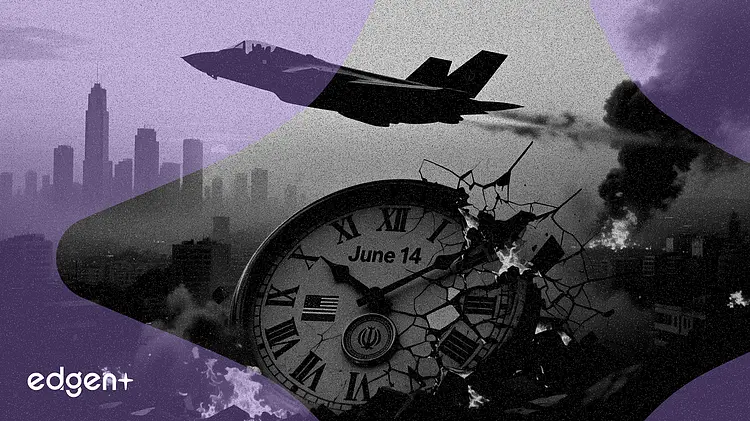
Israel launched a strike on Beirut's southern suburbs June 14 in an attempt to derail the US-Iran peace deal hours before its scheduled signing, a US diplomat involved in the negotiations said.
Israel struck Beirut's southern suburbs on June 14 in what a US diplomat described as an attempt to sabotage the Trump administration's agreement with Iran, threatening to unravel a deal that would reopen the Strait of Hormuz to global oil shipments.
"Israel is clearly trying to destroy the president's agreement and drag the US back into war," a US diplomat involved in the Iran negotiations told Fox News, speaking on condition of anonymity.
A senior Israeli official denied responsibility for the attack, saying Hezbollah had been striking Israeli civilians over the past three days. The strike came as Trump said on Truth Social that the US and Iran would sign an agreement on June 14, with the Strait of Hormuz — which handles about 21% of global oil trade — set to reopen immediately after.
The attack risks collapsing a deal that would end months of conflict that has disrupted energy markets, pushed crude prices higher and forced countries including India to diversify supply chains away from the Persian Gulf. Brent crude futures have priced in a sustained risk premium since Iran's blockade of the strait earlier this year.
Strait of Hormuz Remains Flashpoint
Iran has blockaded the waterway since early in the conflict, demanding vessels obtain permission from its armed forces before transiting and establishing a new body to collect tolls. The US responded with its own blockade of Iranian ports. On June 14, US Central Command said Iran launched multiple one-way attack drones targeting commercial ships in the strait, all of which were shot down by US forces.
Iranian Foreign Minister Abbas Araghchi said on state television that the tentative agreement showed Iran had emerged stronger from the conflict, adding that "the administration of Strait of Hormuz will no longer be the same as before." Trump has insisted Iran remaining in control of the waterway is unacceptable, and his social media post on June 14 made no mention of tolls or other arrangements.
Supply Chain Fallout Spreads Beyond Oil
The crisis has already forced supply chain adjustments across Asia. India's Union Minister for Chemicals and Fertilisers JP Nadda said the government has diversified fertilizer imports to Indonesia, Australia, Russia and China — countries outside the Strait of Hormuz route — and secured sufficient stocks for the ongoing Kharif season. The pharmaceutical sector has also been affected, though Nadda assured there would be no shortage of medicines or medical devices.
Pakistan, acting as a key mediator, said a deal was closer "than ever before." Prime Minister Shehbaz Sharif said Islamabad was preparing for an electronic signing on June 15, followed by technical-level talks. Iran's foreign ministry spokesperson Esmaeil Baghaei cautioned that the signing was not expected on Sunday, though he said "the possibility of this happening in the coming days cannot be ruled out."
The last major disruption to Strait of Hormuz traffic came in 2019, when attacks on Saudi Aramco facilities temporarily knocked out about 5.7 million barrels per day of production, sending crude prices up 15% in a single session. The current blockade has been far more prolonged, with Iran maintaining restrictions since early in the conflict and the US imposing a parallel naval blockade on Iranian ports.
If the deal collapses, oil markets face renewed supply uncertainty at a time when the World Bank has already lowered its global growth forecast for 2026, warning that prolonged disruption to energy supplies could sharply slow economic expansion. Gold has risen as a safe haven, and the US dollar index has strengthened as investors price in extended geopolitical risk.
This article is for informational purposes only and does not constitute investment advice.