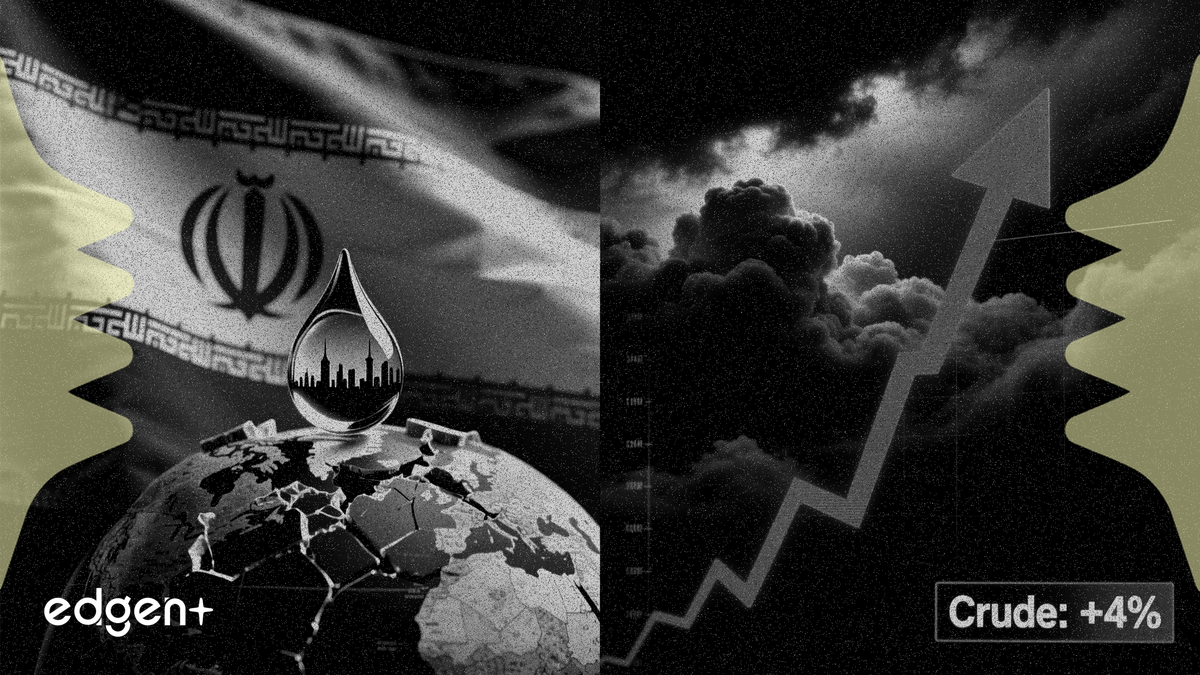
Iran's top security lawmaker conditioned any nuclear deal on ending all active fronts, including Lebanon, as the US-Iran ceasefire unravels and crude prices stay elevated.
Iran's parliament demanded a halt to all front-line wars as a precondition for US negotiations, hardening its stance just as a drone strike on Kuwait's main airport killed one person and tested an already-fraying ceasefire.
"Stopping all front-line wars is the primary content of Iran-US negotiations," Ebrahim Azizi, chairman of the Iranian Parliament's National Security and Foreign Policy Committee, said in a statement Wednesday. "Iran will not allow the US and Israel to undermine the unity of the resistance front."
The remarks came hours after Iranian drones struck Kuwait International Airport, killing an Indian national and wounding 63 others, according to Kuwait's Defense Ministry. The US military said it launched retaliatory strikes on an Iranian ground control station on Qeshm Island in the Strait of Hormuz, while Iran's Revolutionary Guard acknowledged targeting the US Navy's 5th Fleet headquarters in Bahrain. Kuwait expelled two Iranian diplomats in response.
The Strait of Hormuz handles about 21% of global oil trade, and Iran's continued grip on the waterway — combined with the US blockade of Iranian ports — has kept global fuel prices elevated through the war's fourth month. Any escalation risks pushing crude higher, with Brent already pricing in a sustained risk premium.
Azizi's demand ties the nuclear talks directly to Israel's widening offensive in Lebanon, where Israeli forces have pushed deeper than at any point in over 25 years and Hezbollah has responded with rocket and drone attacks. A regional official involved in the mediation told the Associated Press that Iran had stopped communicating with ceasefire mediators Tuesday, insisting a Lebanon ceasefire must be enforced before broader negotiations resume.
President Donald Trump denied reports that talks had stalled, calling them "false and erroneous" in a social media post, and said discussions had continued as recently as Wednesday. But the fighting has exposed a rift between Washington and Jerusalem. Trump confirmed he called Israeli Prime Minister Benjamin Netanyahu "crazy" during a phone call this week, telling The New York Post he was "a little bit perturbed" that Israel's fight with Hezbollah was holding back Iran negotiations.
Strait of Hormuz and the Oil Premium
The war, which began Feb. 28 with US and Israeli strikes on Iran, has already reshaped energy markets. Iran's paramilitary Revolutionary Guard maintains operational control over the Strait of Hormuz, through which about 21 million barrels of oil and petroleum products pass daily — roughly a fifth of global consumption. The US Navy's 5th Fleet, based in Bahrain, continues to patrol the waterway, and both sides have traded near-daily strikes since a fragile ceasefire was reached in March.
The last time Iran directly threatened to close the strait was during the 2019-2020 tanker war, when attacks on Saudi Aramco facilities at Abqaiq and Khurais temporarily knocked out 5.7 million barrels per day of production and sent crude prices spiking 15% in a single session. While no formal closure has been attempted this cycle, the persistent threat has kept the risk premium embedded in futures curves.
This article is for informational purposes only and does not constitute investment advice.