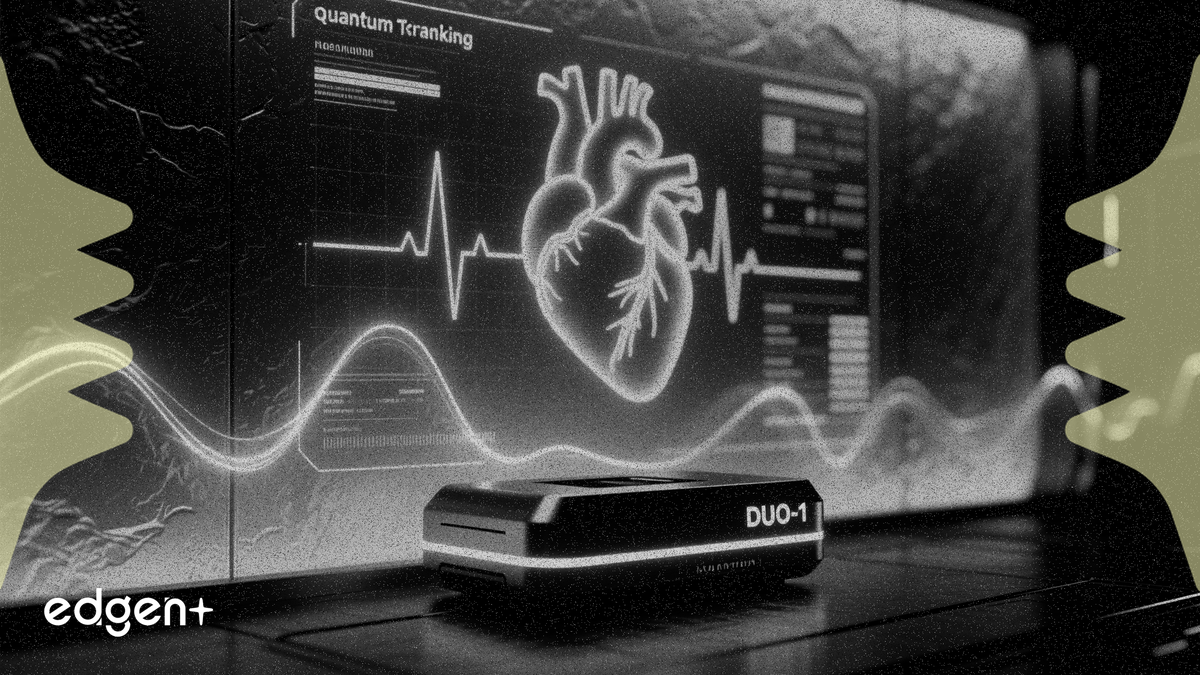
A new quantum-secure sensor from Inturai Ventures promises to give military and civilian operators the ability to detect human presence and vital signs through solid barriers.
Inturai Ventures Corp. (CSE: URAI) announced on April 15 the release of its proprietary DUO-1 sensing devices, a quantum-secure system capable of seeing through walls to track human activity and even heartbeats. The move marks the company’s strategic transition from technology development to deploying hardware for the defence and civilian sectors.
"The DUO-1 represents a pivotal shift from theoretical quantum research to tangible, field-ready hardware," a company spokesperson said. "We are providing a capability that was previously confined to science fiction, with profound implications for safety and security."
The device uses a proprietary technology named Dual-Origin Observation (DUO-1). While the company has not disclosed detailed specifications, its "quantum-secure" nature suggests the data it transmits is protected against decryption by future quantum computers, a key concern for government and military clients. This release moves the product from a conceptual phase to an order-ready reality.
For investors, the successful commercialization of the DUO-1 could be highly disruptive for the security and surveillance industries, valued in the tens of billions of dollars. The announcement signals a potential turning point for Inturai, opening the door to significant government and commercial contracts that could substantially impact the company's valuation.
A New Paradigm in Sensing Technology
Existing through-wall detection systems often rely on microwave or radar-based motion sensing, which can be prone to false positives and typically cannot provide detailed information about a subject's physiological state. Inturai’s DUO-1 device appears to leapfrog these limitations by detecting not just movement but the subtle electrical signature of a human heartbeat, providing unambiguous confirmation of human presence.
This capability offers a significant tactical advantage in military and law enforcement scenarios. The ability to ascertain the number of individuals in a room, their locations, and their status (e.g., calm or agitated) before breaching a structure could dramatically improve operational success rates and reduce risk to personnel. The quantum-secure communication protocol adds a layer of resilience, ensuring that sensitive surveillance data cannot be intercepted and exploited by adversaries.
Dual-Market Strategy Targets Defense and Civilian Sectors
Inturai is pursuing a dual-market strategy, aiming to capture opportunities in both government and commercial applications. In the defense sector, the DUO-1 is a natural fit for special forces, intelligence agencies, and urban warfare units. The potential for large-scale government contracts is a key driver of the bullish outlook on the company.
Beyond defense, the civilian applications are extensive. Search and rescue teams could use the device to locate survivors in collapsed buildings by detecting heartbeats beneath rubble. In healthcare, it could be used for unobtrusive monitoring of elderly or vulnerable individuals in their homes, detecting falls or changes in vital signs without the privacy concerns of cameras. High-security facilities could also use the technology to prevent unauthorized access.
The successful deployment of DUO-1 in these markets could establish Inturai as a leader in a new category of advanced sensing technology. The market will be closely watching for initial purchase orders and partnerships, which will serve as critical validation for the technology and the company's commercial strategy. Inturai's stock (CSE: URAI) is expected to attract significant investor interest as it moves to capitalize on this technological breakthrough.
This article is for informational purposes only and does not constitute investment advice.