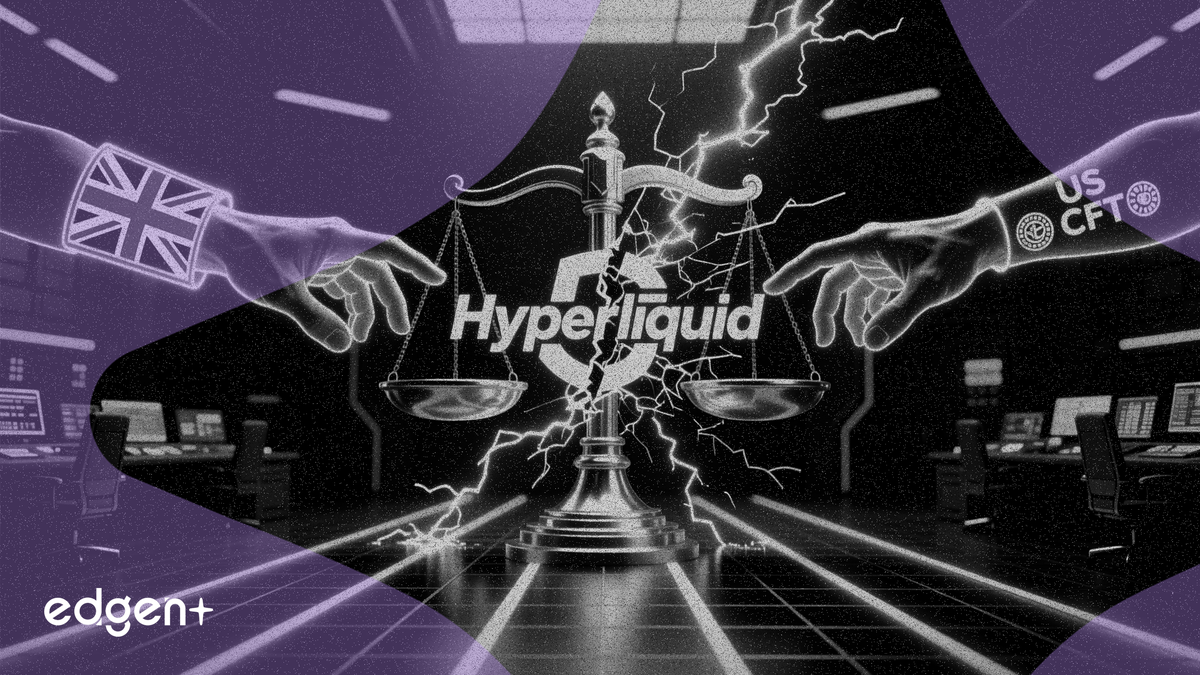
Hyperliquid, one of crypto's largest decentralized perpetual futures venues, faces mounting regulatory pressure from both the UK and US as authorities chart divergent approaches to the $255 million revenue platform.
The UK Financial Conduct Authority on May 21 listed Hyperliquid and Hyper Foundation as unauthorized entities that "may be providing or promoting financial services or products" without permission, warning users to "avoid dealing" with the platform, according to a notice on the regulator's website.
"Crypto perps have grown into one of the dominant mechanisms for expressing directional views on digital assets," Matthew Pinnock, COO of Altura DeFi, said. Volumes on venues such as Hyperliquid have made it "impossible" for traditional market participants to treat them "as peripheral," he added.
By May 20, Hyperliquid had generated $255 million in year-to-date revenue, while its HYPE token surged 101% over the same period. The platform ranks among the largest decentralized perps venues by trading activity. The FCA's warning drew limited attention until this week, when it began surfacing more prominently in search results.
The regulatory divergence between the UK's warning and the US's recent approval of regulated perps products creates five possible paths for Hyperliquid: compliance with UK requirements, restriction of UK user access, a US listing application, a shift to offshore-only operations, or a restructuring of its token model to address regulatory classification questions.
The UK Warning and Its Implications
The FCA notice named Hyperliquid, Hyper Foundation, the protocol's app, and its social channels. The regulator said these entities may be offering financial services in the UK without authorization. The warning remains active on the FCA's website and applies to any UK-based user accessing the platform.
Hyperliquid operates as a decentralized venue for perpetual futures — derivatives that let traders use leverage and hold positions without an expiry date. Unlike traditional futures traded on regulated exchanges such as CME, perps rely on periodic funding payments to keep prices aligned with spot markets. The UK's action targets this specific product category, which the FCA has previously flagged as high-risk for retail investors.
US Regulators Take a Different Path
While the UK issued a warning, US regulators moved in the opposite direction. On May 29, the Commodity Futures Trading Commission approved KalshiEX LLC to list a Bitcoin perpetual futures contract — the first affirmative US regulatory framework for crypto perps. The CFTC also issued a policy statement setting expectations for future perpetual contract submissions and provided no-action relief enabling Coinbase Financial Markets to intermediate customer access to foreign-listed perpetuals.
CME Group CEO Terry Duffy criticized the approach, calling crypto perps a "disaster waiting to happen" and questioning the CFTC's approval process for what he called a "novel and complex" product. Intercontinental Exchange CEO Jeffrey Sprecher said the NYSE parent was studying Hyperliquid's model and asking regulators why traditional venues could not offer similar products.
The Five Paths Forward
Industry observers see five potential outcomes for Hyperliquid as regulatory pressure builds. The platform could pursue compliance with UK financial regulations, a process that would require registration with the FCA and adherence to its marketing and consumer protection rules. Alternatively, it could restrict access for UK-based users, following the approach taken by other offshore crypto platforms after similar warnings.
A third path involves seeking US listing approval through the CFTC's newly established framework for digital commodity perpetuals. The fourth option is a shift to fully offshore operations, accepting the loss of UK and US market access. The fifth and most complex path would involve restructuring the HYPE token model to address how regulators classify the platform's governance and economic mechanisms.
"Regulators are watching the growing role perpetual futures play in price discovery," Pinnock said, with platforms such as Hyperliquid allowing traders to express views on assets "often well before traditional markets provide similar access." The key test, he added, will be whether liquidation systems, margin rules, and market surveillance can hold up "when conditions turn sharply."
As of June 5, HYPE traded at $59.10, down 7.58% over 24 hours, according to CoinGecko data. The token's decline reflects broader market weakness across crypto assets, with Bitcoin falling 4.6% to $60,598 and Ether dropping 11.33% to $1,562.86 during the same period.
This article is for informational purposes only and does not constitute investment advice.