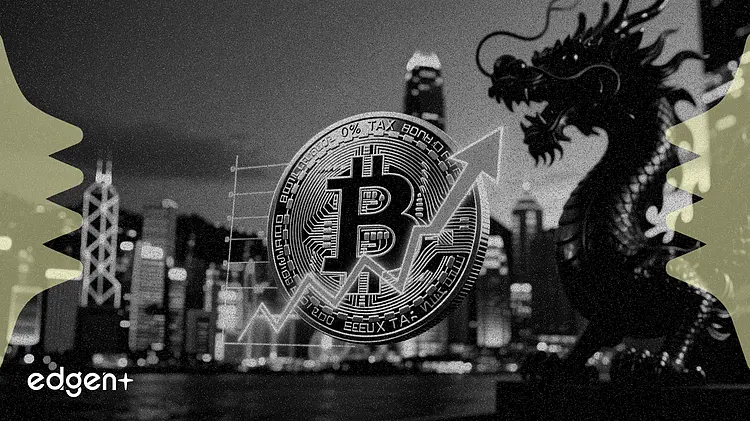
Hong Kong on Wednesday announced a 0% capital gains tax on Bitcoin and digital asset holdings for institutional investors, a policy shift that positions the city as Asia's most tax-competitive jurisdiction for crypto and intensifies the regional race for capital and talent.
"The Inland Revenue Ordinance has been amended to exclude digital assets from the definition of 'chargeable assets' for capital gains purposes, effective immediately," Christopher Hui, Secretary for Financial Services and the Treasury, said in a statement. "This removes tax uncertainty for professional investors and aligns Hong Kong with international best practices."
The exemption applies to gains realized by institutional investors, licensed asset managers, and corporate treasury vehicles holding digital assets for investment purposes. Retail traders remain subject to existing profits tax rules if the Inland Revenue Department deems their activity to constitute trading rather than investment — a distinction determined by frequency, volume, and intent. The policy does not extend to stamp duty or goods and services tax on crypto transactions.
Hong Kong's move comes as Asian jurisdictions compete to attract crypto businesses following years of regulatory tightening in the US and Europe. Singapore taxes corporate crypto gains at 17% under its normal income tax regime, while Japan's National Tax Authority currently treats most crypto gains as "miscellaneous income" subject to progressive rates reaching 55% at the top bracket — though proposed reforms target a flat 20% rate. Dubai offers 0% personal income tax but requires physical presence and regulatory licensing through the Virtual Assets Regulatory Authority.
The Regional Tax Arms Race
The policy creates a clear arbitrage for institutional capital. A Hong Kong-based crypto fund manager pays 0% on long-term holdings, compared with 17% in Singapore and up to 55% in Japan under current rules. The Hong Kong Monetary Authority has also signaled it will fast-track licensing applications for virtual asset managers that commit to maintaining local office and compliance headcount, according to a person familiar with the matter who declined to be named because the discussions are private.
The competitive pressure is already visible in Tokyo. Japan's Cryptoasset Business Association has been explicit in its position papers that competing Asian hubs tax retail crypto gains at 0% to 15%, and has pushed for a flat 20% settlement tax identical to the rate applied to equities under the Financial Instruments and Exchange Act. Japan's proposed reform would also reclassify large-cap tokens like Bitcoin and Ethereum as financial instruments, making spot and derivative ETFs legally viable — a structural shift that could unlock billions in institutional inflows.
What Hong Kong's Policy Leaves Unresolved
The 0% capital gains tax applies narrowly to investment holdings, not to trading income, staking rewards, or DeFi yields. A proprietary trading firm earning revenue from market-making or arbitrage would still face Hong Kong's 16.5% profits tax. Staking and lending income — common in crypto-native strategies — fall under ordinary income rules, creating a bifurcated regime where the tax treatment depends on the activity rather than the asset.
Hong Kong Exchanges and Clearing has not yet listed any spot crypto ETFs, though the Securities and Futures Commission has said it is reviewing applications. The absence of regulated ETF products limits the channel through which most institutional capital enters crypto markets — a gap that the US, with $30 billion-plus in spot Bitcoin ETF assets under management, and Japan, where SBI Holdings has filed for crypto ETF products, have already begun to fill.
The policy's impact will depend on execution. Hong Kong must demonstrate that its licensing regime for virtual asset service providers — mandatory under the Anti-Money Laundering Ordinance since June 2023 — can process applications efficiently enough to meet institutional demand. As of May 2026, fewer than 10 platforms have received full licenses, with dozens still in the "deemed licensed" pipeline.
This article is for informational purposes only and does not constitute investment advice.