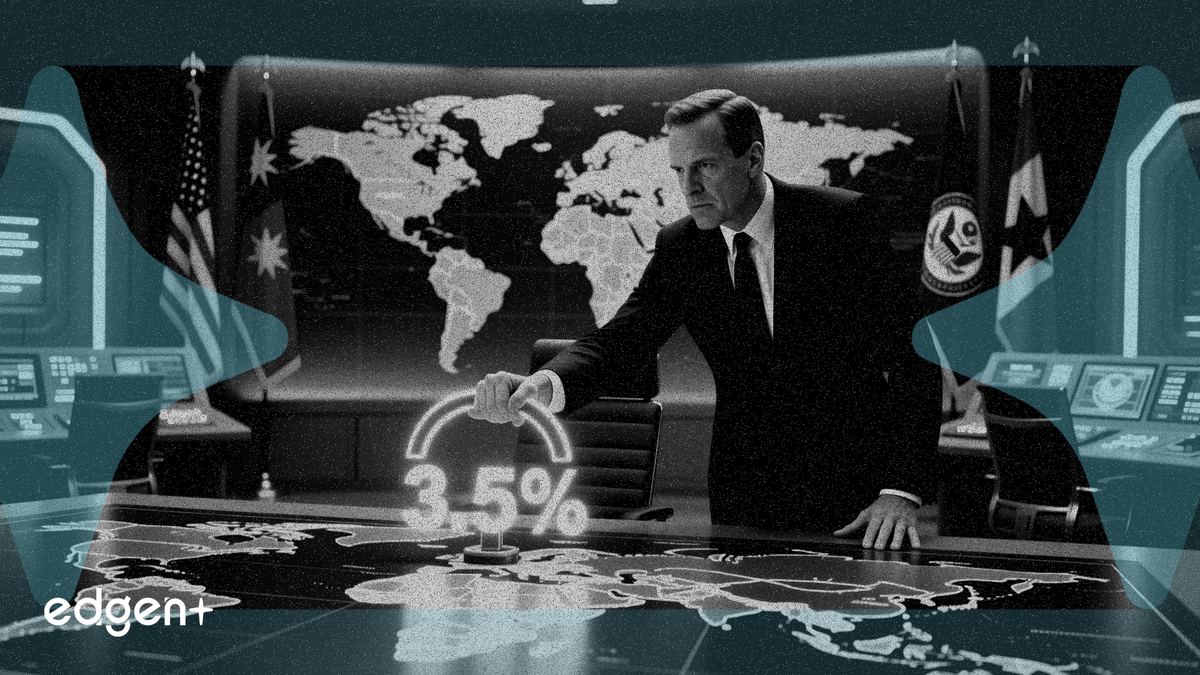
Defense Secretary Pete Hegseth called on Asian allies to boost military spending to 3.5% of GDP while striking a notably softer tone toward Beijing, signaling a shift in US regional strategy after President Donald Trump's summit with Chinese leader Xi Jinping.
SINGAPORE — Defense Secretary Pete Hegseth urged America's Asian allies to increase military spending to 3.5% of gross domestic product for deterrence against China, while moderating his confrontational rhetoric toward Beijing in a speech that omitted any mention of Taiwan or the Chinese Communist Party.
"The era of the US subsidizing the defense of wealthy nations is over. We need partners, not protectorates," Hegseth said Saturday at the Shangri-La Dialogue, an annual security conference in Singapore organized by the International Institute for Strategic Studies. Countries that meet the spending benchmark would receive "expedited arms sales, deep industrial-base collaboration, expanded intelligence sharing," he said, while those that do not "carry their own weight" would be treated less favorably.
None of Washington's major Asian partners currently meet the 3.5% target. Singapore and South Korea come closest at roughly 2.8% to 3% and 2.8% of GDP, respectively. Japan is approaching 2% under its ongoing defense push, while Australia spends about 2%. The threshold mirrors Trump's push for NATO members to adopt a 5% target by 2027, reflecting a broader administration effort to shift more defense costs onto allies.
The speech marked a departure from Hegseth's address at last year's forum, where he repeatedly referred to "Communist China" as a threat and warned against any Chinese invasion of Taiwan. This year, he said US-China relations are "better than they have been in many years," citing Trump's summit with Xi in Beijing two weeks ago that both sides hailed as a success. When asked about Taiwan during a Q&A session, Hegseth said any decision on future arms sales rests with Trump and that "there has been no change in our status."
Allies Push Back on Spending Target
The 3.5% benchmark drew immediate pushback from regional defense officials who said the figure fails to account for differing economic circumstances. Philippine Defense Secretary Gilberto Teodoro told reporters the target is "especially difficult for agricultural economies" that must also invest in infrastructure, education and health care across an archipelago of 7,600 islands. Malaysia's Defense Minister Mohamed Khaled Nordin said during a roundtable that "every country faces different circumstances, priorities, as well as constraints," warning that sharply increasing defense spending could come at the expense of development.
The spending demand comes as regional confidence in US leadership erodes. A survey by the ISEAS-Yusof Ishak Institute conducted from January to February found that US leadership under Trump now ranks as the top geopolitical concern among Southeast Asian thought leaders, surpassing worries over South China Sea tensions — the biggest concern in last year's survey. The IISS, in its annual assessment of Asia-Pacific security published Friday, said Trump's "transactional approach to alliances and partnerships has created uncertainty for US allies around the world."
Senator Tammy Duckworth, an Illinois Democrat attending the conference, told reporters she worries the administration is being "distracted into wars that they've started in other parts of the world at the expense of our commitment here in the Indo-Pacific." She added that "it seems like our president is entering into policies where he's doing what Beijing wants him to do."
China Sends Lowest-Level Delegation in Two Decades
China responded to Hegseth's moderated tone with cautious optimism but sent its lowest-level delegation since senior Chinese military officers began attending the forum nearly 20 years ago. Major General Meng Xiangqing, a professor at Beijing's National Defense University, said China "anticipates China and the US meeting each other halfway, translating the two leaders' consensus into concrete action." Retired Senior Colonel Zhou Bo of Tsinghua University said Hegseth's speech was "more moderate" than last year's and noted the significance of Trump and Xi agreeing to build a "constructive, strategic partnership" — the first time, Zhou said, the US has "officially recognized the equal strengths of China as a peer power."
Still, analysts said the pathway to avoiding conflict remains unclear. Ankit Panda, senior fellow at the Carnegie Endowment for International Peace who attended the speech, said Hegseth did not offer a clear vision on how the US expects to arrive at "what he's called a decent peace with China," especially when "so much of the secretary's speech leans into themes like lethality, dominance." Vietnam's President To Lam warned in a keynote address Friday that one of the biggest risks is "unchecked competition" where "might makes it right."
The last time the US shifted its regional posture toward China in a comparable manner — following the 2017 Trump-Xi Mar-a-Lago summit — bilateral trade grew briefly before tariffs escalated to 25% on $250 billion of Chinese goods by 2019, reducing bilateral trade flows by roughly 15% over 18 months, according to Census Bureau data. The current trajectory suggests a similar pattern of diplomatic engagement followed by transactional friction, with defense spending demands adding a new dimension to the competition.
This article is for informational purposes only and does not constitute investment advice.