Hedge funds are rotating into energy at their fastest pace in a decade as Iranian supply risk, AI-driven power demand, and California's policy squeeze converge on oil and gas prices.
Hedge funds have pushed net energy exposure to its highest since 2015, betting that Iranian supply risk, surging AI power demand, and California's energy squeeze will lift oil and gas prices through year-end. Goldman Sachs' Hedge Fund Trend Monitor, based on 991 funds with $5.4 trillion in gross equity exposure, shows energy net overweight at a decade high, with accumulation spread broadly across subsectors.
"The energy complex is drawing capital from three directions at once — geopolitics, electrification, and policy," said Omar Tariq, an energy analyst covering commodities. Morgan Stanley raised its price target on Energy Transfer LP to $25 from $23 on Aug. 18, implying about 17 percent upside, while one hedge fund favorite carries a projected 65 percent gain.
Energy Transfer, held by 34 hedge funds in the first quarter, up from 30, reported second-quarter revenue up 164 percent year over year and adjusted EBITDA up 31 percent, prompting management to lift full-year 2026 guidance to $18.8 billion to $19.1 billion from $18.2 billion to $18.6 billion. Natural gas supplies about 43 percent of U.S. electricity, a share expected to climb as data centers drive power demand, and the company has signed long-term agreements to supply data-center projects, with two customers adding a combined 100 MMcf/d to existing contracts in Texas.
Iran, AI, and California Tighten the Supply Picture
The bull case rests on three converging forces. Iranian supply risk adds a geopolitical premium to crude benchmarks, while the AI buildout creates structural demand for natural gas to power data centers — a dynamic that has pushed Energy Transfer's NGL transport volumes up 13 percent and exports up 25 percent year over year in the second quarter. California's energy policy squeeze, meanwhile, tightens domestic supply at a time when Europe faces an energy crisis from the phase-out of Russian natural gas and recent hot weather.
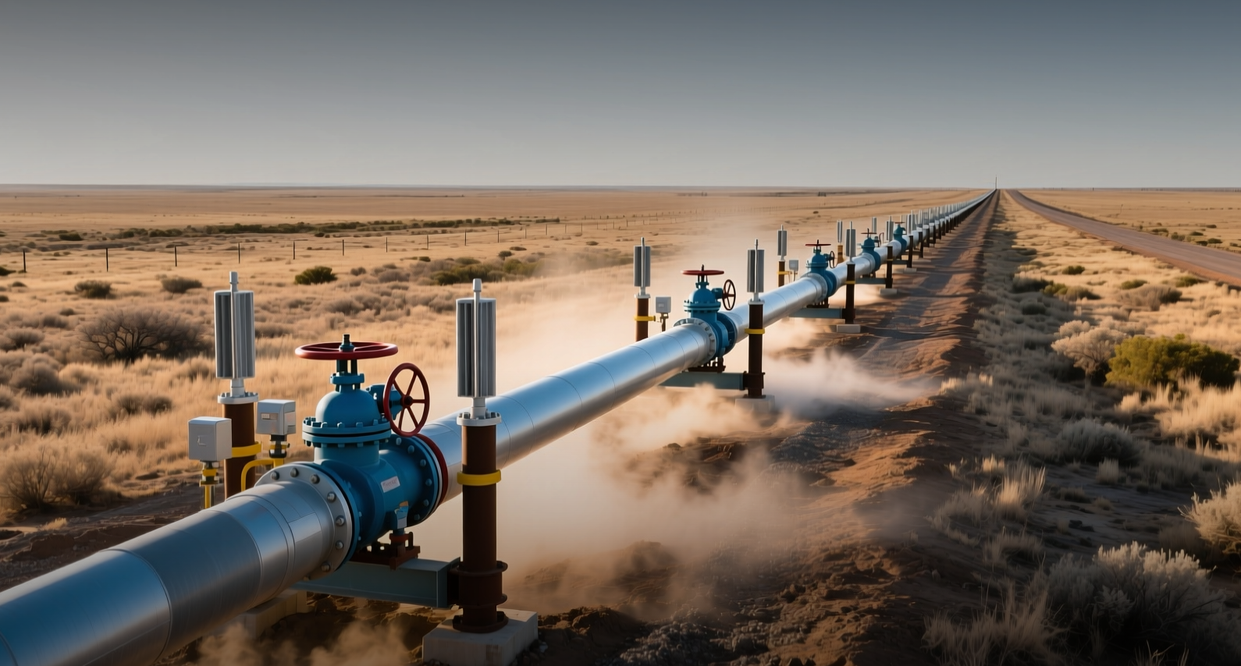
Energy Transfer's Hugh Brinson Pipeline came online ahead of schedule, with full phase 1 capacity expected by Sept. 1, moving Permian Basin gas to access points across Texas. The company's 6.35 percent dividend yield, raised for a 19th consecutive quarter, adds to its appeal, with management targeting 3 percent to 5 percent annual distribution growth.
Risks Loom Despite the Bullish Setup
The trade carries execution risk. Energy Transfer plans $5.6 billion to $5.9 billion in growth capital in 2026, and its proposed gas pipeline to power a planned Oracle data center has been delayed nearly six months by state and federal certification obstacles, with cancellation possible if progress stalls. The last time energy net overweight reached current levels, in 2015, crude prices collapsed within months as OPEC defended market share — a reminder that crowded positioning can unwind quickly.
For investors, the rotation suggests relative return opportunities are building in energy after years of underperformance. If Iranian supply is disrupted or AI power demand accelerates faster than expected, hedge fund favorites with fee-based infrastructure and high yields could outperform. If regulatory delays and commodity volatility bite, the decade-high positioning leaves little room for error.