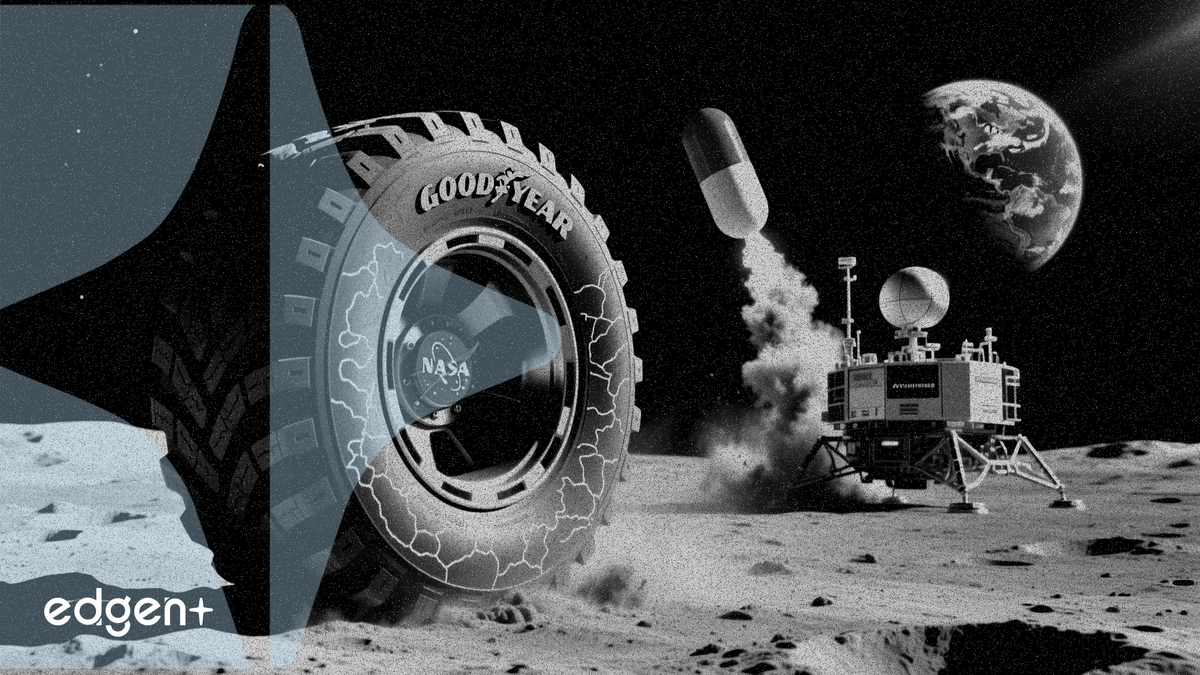
Goodyear is returning to the Moon after more than five decades, this time with tires built for sustained human exploration under NASA's Artemis program.
Goodyear Tire & Rubber Co. will supply advanced lunar tires for Lunar Outpost's Pegasus Lunar Terrain Vehicle, supporting NASA's Artemis missions expected to begin in 2028, the company said June 3.
"Going to the Moon has been a lifelong dream, and partnering with Goodyear brings us one step closer to making the Pegasus rover a reality," Justin Cyrus, chief executive officer and founder of Lunar Outpost, said. The Golden, Colorado-based company was selected by NASA in 2024 to develop the LTV for the Artemis IV mission.
The Pegasus rover draws design heritage from the Lunar Roving Vehicle used during the Apollo program in the early 1970s. General Motors, which built the batteries for the original LRV, is providing battery technology for the new rover through its Michigan-based operations. Goodyear's tires must withstand the Moon's extreme temperature swings — ranging from minus 280 degrees Fahrenheit in shadow to plus 260 degrees in sunlight — and abrasive lunar regolith that shredded tire materials during earlier Apollo traverses.
A $1.5 Billion Lunar Mobility Market Takes Shape
The Artemis program represents the first sustained human presence on the Moon since Apollo 17 in 1972. NASA has awarded multiple contracts for lunar infrastructure, including the Pegasus LTV, with a total addressable market for lunar mobility estimated at $1.5 billion through the early 2030s, according to space industry consultancy Northern Sky Research. The Pegasus vehicle is designed to carry two astronauts and support up to 30-day surface missions, compared with the Apollo LRV's maximum three-day range.
Goodyear's return to lunar tires follows decades of off-planet research. The company developed airless tire technology for military and robotics applications that shares design principles with the lunar variant. The tires use a spring-like structure rather than pneumatic air pressure, eliminating the risk of punctures in the vacuum of space.
Competitive Landscape and Investor Implications
The contract places Goodyear in a small group of companies supplying hardware for NASA's lunar surface operations. Honeywell International Inc. and Lockheed Martin Corp. have secured separate Artemis-related contracts for life support and crew modules. For Goodyear, the program offers a potential new revenue stream in the emerging space economy, though financial terms of the Pegasus tire contract were not disclosed.
Goodyear shares trade at 8.2 times forward earnings, below the S&P 500 auto parts sector average of 12 times, according to Bloomberg data. The lunar contract, while unlikely to move near-term revenue meaningfully, strengthens the company's narrative as an innovator in advanced materials and could support multiple expansion if Goodyear secures follow-on contracts for later Artemis missions. NASA has indicated it plans to award a second LTV contract for Artemis V and beyond, with a request for proposals expected in 2027.
This article is for informational purposes only and does not constitute investment advice.