
Key Takeaways:
- Goldman Sachs cut its Q4 Brent forecast to $80 from $90 a barrel
- Morgan Stanley and Citi also lowered price targets after the US-Iran deal
- Brent crude fell 4.8% to $83.17, erasing much of the war premium
Key Takeaways:
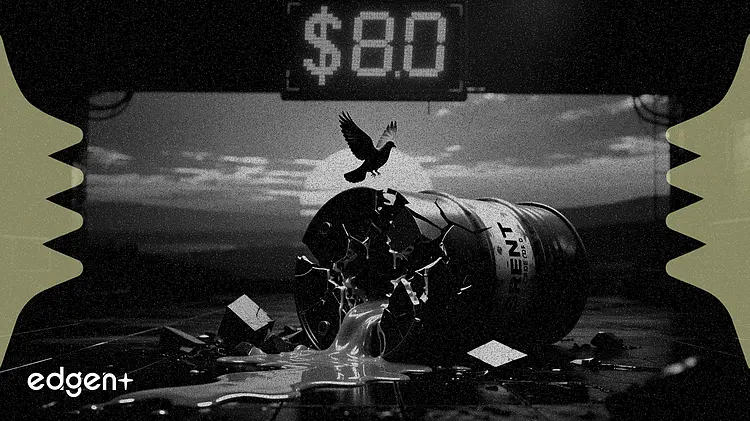
The tentative US-Iran peace deal has already been priced into crude markets, with Goldman Sachs becoming the latest major bank to slash its Brent forecast to align with current trading levels.
Goldman Sachs cut its fourth-quarter Brent crude price forecast to $80 a barrel from $90, and lowered its 2027 average estimate to $75 from $80, according to a report published Tuesday. The revision follows a preliminary agreement between Washington and Tehran that is expected to reopen the Strait of Hormuz within 30 days, restoring the flow of roughly 20 million barrels of oil that transit the chokepoint daily.
"The global economy adjusted very flexibly to the largest oil production shock in history," the bank's commodity analysts wrote in the note, adding that risks to oil price assumptions in the event of a finalized peace deal are now two-sided.
Brent crude fell 4.8% to $83.17 a barrel Monday, its lowest since early March, after Iran confirmed the deal set to be signed Friday in Switzerland. West Texas Intermediate traded at $80.23. The declines erased much of the war premium that had pushed Brent above $100 a barrel just weeks ago, when the conflict disrupted tanker traffic through the Strait of Hormuz and sent energy costs soaring across the global economy.
The selloff in crude rippled through financial markets. The S&P 500 rose 1.7% Monday, the Dow Jones Industrial Average climbed 468 points to a record, and the Nasdaq composite jumped 3.1%, as investors bet that lower oil prices would ease inflationary pressure and reduce the need for central bank tightening. The yield on the 10-year Treasury slipped to 4.47%, while traders cut their bets on a Federal Reserve rate hike this year to 57% from 71% a week ago, according to CME Group data.
Wall Street races to reprice crude
Morgan Stanley also lowered its Brent forecasts, now seeing the benchmark averaging $80 a barrel in the fourth quarter and $90 in the third, down from a prior third-quarter estimate of $100. Citi was the most bearish among the three, forecasting Brent at $75 in the third quarter, $70 in the fourth, and $65 for 2027 — down sharply from an earlier 2027 projection of $80.
The coordinated downgrades reflect a rapid reassessment of geopolitical risk. Goldman's analysts said they expect tanker traffic through the Strait of Hormuz to recover fully by the end of July, while Morgan Stanley noted that much remains to be negotiated and key risks persist, but called the preliminary deal "a key step towards a de-escalation of the conflict and higher oil exports."
What's at stake for the broader economy
The drop in crude prices offers relief to households and businesses that have faced elevated costs for fuel, food, and fertilizer since the war with Iran began. United Airlines rose 3.9% Monday, and Royal Caribbean Group gained 6.6%, as lower fuel bills boosted airline and cruise line stocks.
But the deal does not include a final agreement on Iran's nuclear program, with those negotiations expected to continue over the next 60 days. Even if the Strait of Hormuz reopens Friday as planned, it will likely take months for the energy industry to return to full capacity. The uncertainty leaves room for renewed volatility — a scenario that could quickly reverse the recent slide in prices if talks falter.
This article is for informational purposes only and does not constitute investment advice.
