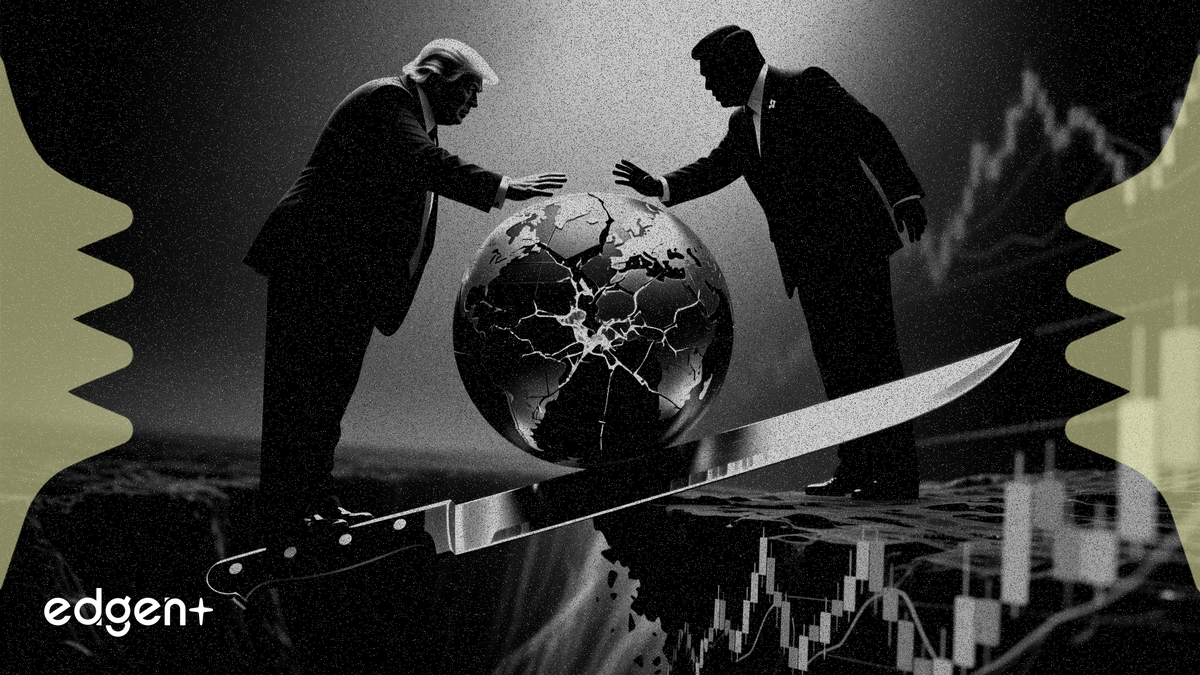
Investor uncertainty is palpable as U.S. and Chinese leaders meet to navigate a fragile economic truce.

U.S. stock futures and global indexes were mixed on May 13 ahead of a high-stakes summit between Presidents Donald Trump and Xi Jinping, with investors weighing the potential for progress against a backdrop of deeply entrenched conflicts over trade, technology, and Taiwan.
"On both sides there is a consensus that U.S.-China stability is important,” said Henrietta Levin, senior fellow for the Freeman Chair in China Studies at the Center for Strategic and International Studies. “Once you get past the question of stability, the ‘what’s next’ in the relationship gets a little more complicated, and so for that reason, the most likely thing to come out of the meeting is very little.”
The market is in a holding pattern, reflecting the cautious sentiment. The lead-up to the talks saw a fragile trade truce established in October, where China agreed to purchase U.S. soybeans and the U.S. more than halved some tariffs that had reached as high as 145 percent. However, tensions remain, with China implementing new export permit rules for rare earths and the U.S. maintaining restrictions on advanced semiconductor technology.
The outcome of the discussions could inject significant volatility into markets. A positive result could see an extension of the current trade truce, while a breakdown in talks could see a return to escalating tariffs and renewed pressure on global supply chains, impacting everything from technology to energy prices.
The trade war, a defining feature of Trump's first term, saw an aggressive escalation with tariffs reaching as high as 145 percent before both sides agreed to a truce last October. That agreement, which paused the punitive measures and saw China commit to buying American soybeans, is now hanging in the balance. "It’s a fragile truce,” said Wendy Cutler, vice president of the Asia Society and a former U.S. trade negotiator, noting a lack of the intensive engagement that characterized past summits.
While a comprehensive trade agreement could be announced, Fudan University professor Zhao Minghao suggested it would not signify an end to the conflict. "This doesn’t mean the war is over, and the agreement will have conditions," Zhao said. The White House has floated the idea of a new "Board of Trade" to maintain dialogue, but concrete resolutions to foundational issues remain elusive.
A core point of friction is the U.S. restriction on exporting advanced computer chips and related manufacturing technology to China. This has pushed Beijing to accelerate its drive for domestic self-reliance. "China’s attitude has changed subtly, it seems more focused on advancing its domestic chip industry rather than continuing to rely on advanced chips from the United States,” Zhao noted. The restrictions have put American companies like Nvidia in a difficult position, caught between a lucrative market and government policy.
Taiwan remains the most sensitive geopolitical issue. Chinese Foreign Minister Wang Yi recently described the self-ruled island as the “biggest risk” in U.S.-China ties. Beijing, which views Taiwan as a renegade province, has increased military drills around the island. While the U.S. maintains a policy of "strategic ambiguity," the possibility of "reciprocal restraint"—such as reduced U.S. arms sales in exchange for fewer Chinese military exercises—has been floated as a potential, if unlikely, path to de-escalation.
The agenda is further complicated by the ongoing conflict in Iran. The U.S. is pressuring China, a major buyer of Iranian oil, to use its economic leverage to influence Tehran. U.S. Treasury Secretary Scott Bessent recently called on China to "step up with some diplomacy" to get Iran to open the Strait of Hormuz, accusing Beijing of "funding the largest state sponsor of terrorism" by purchasing its energy.
However, analysts are skeptical of China's willingness to intervene. "I don’t think China has any interest in solving the problems the U.S. has created for itself in the Middle East,” Levin said. This places another complex issue on the table, where the economic interests of China clash directly with the geopolitical objectives of the United States.
This article is for informational purposes only and does not constitute investment advice.