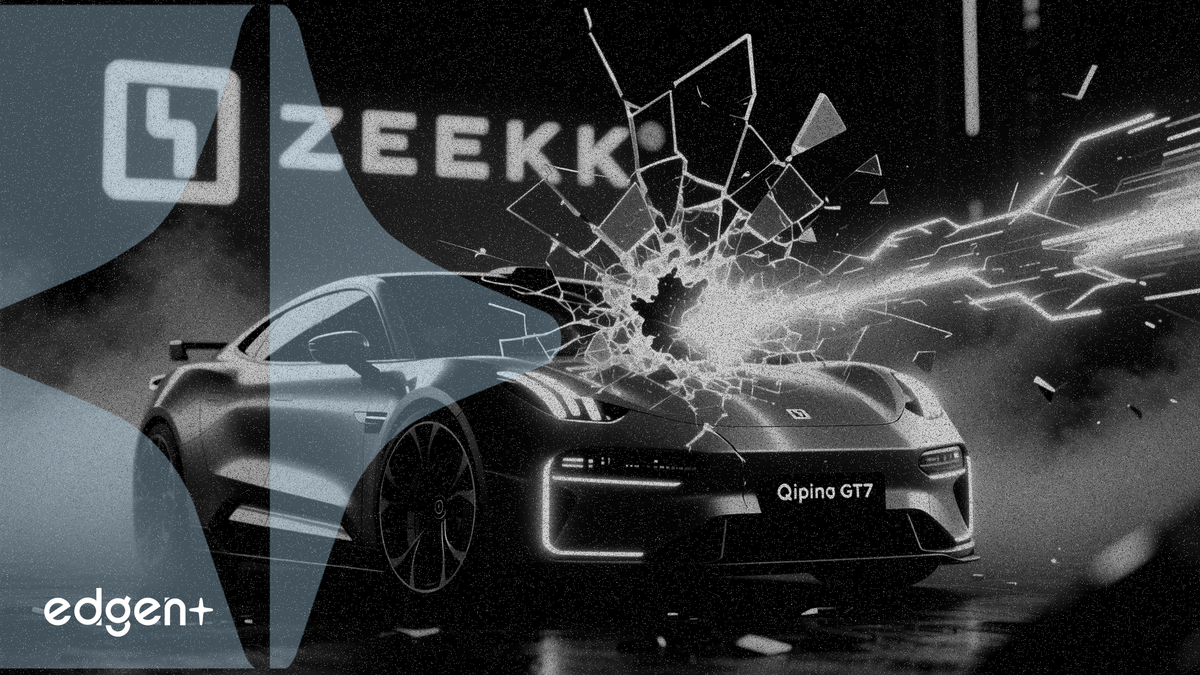
GAC and Huawei's new joint venture, Qijing, is betting that a deeper integration of tech and manufacturing can produce a winner in China's crowded EV market, with its first model, the GT7, launching in June.
GAC Group’s new joint venture with Huawei, Qijing, is making its debut with a single, high-stakes bet: the GT7. The all-electric shooting brake is the first vehicle to bundle Huawei's three next-generation platforms—ADS 5.0 for autonomous driving, the HarmonySpace smart cockpit, and the Qiankun digital chassis—aiming to outmaneuver established rivals like Zeekr in China's premium EV segment.
The pressure for the new brand is immense, with executives framing the launch in stark terms. "GT7 must succeed, success is the only way to survive," Wang Kai, head of the Qijing project group at Huawei's intelligent vehicle unit, said in an interview at the Beijing Auto Show.
Set for a June launch and July deliveries, the GT7 boasts specifications to match its ambition. A three-motor powertrain enables a 0-100 km/h acceleration in just 2.98 seconds. The vehicle is built on an 800-volt architecture featuring a custom CATL Qilin battery with 6C supercharging. It is also the first model to feature Huawei’s new 896-line LiDAR, a critical component of an autonomous driving system that has already secured an L3-level road test permit in Guangzhou.
For both parent companies, the GT7 is a critical test. GAC, which posted a net loss of nearly 8.8 billion yuan in 2025, is counting on the Qijing brand to spearhead its high-end electric transformation. For Huawei, the project's success would validate its "Qiankun" deep-partnership model, where it goes far beyond being a simple component supplier, as it competes with its other automotive collaborations.
More Than a Supplier
Unlike typical supplier relationships, the Qijing project involves what executives call a complete fusion of teams. Huawei has embedded hundreds of its own R&D, marketing, and sales staff permanently within Qijing's operations, transferring its own internal product development (IPD) and marketing (IPMS) methodologies to the new company.
"This is not about having a consultant come in and point fingers," Wang told reporters. He stressed that every embedded Huawei employee is responsible for the final results. This co-development approach allows for deeper integration than simply installing off-the-shelf parts. For example, Qijing's team pushed to make the HUAWEI SOUND AI high-frequency tweeter, a static component in other cars, into an interactive, moving part that physically reacts to voice commands and driving scenarios, aiming to create a sense of "companionship."
The collaboration wasn't without friction. Engineers from GAC, confident in their chassis tuning expertise, and Huawei's software algorithm teams initially clashed over control of the vehicle's digital chassis. The final solution designates Huawei's software as the "cerebellum," managing millisecond-level torque vectoring, while GAC's hardware, including a double-wishbone front and multi-link rear suspension tuned by a team with McLaren and Aston Martin experience, acts as the "limbs."
A Bet on Level 3 Autonomy
The GT7's most significant differentiator may be its readiness for true autonomous driving. The vehicle was designed from the ground up with a full-link redundant architecture, meaning eight critical systems—including perception, computing, braking, steering, and power—all have backups. If a primary component fails, a secondary system can take over and safely bring the car to a stop.
This built-in redundancy is what allowed the GT7 to secure an L3 road-test permit in Guangzhou, where it has accumulated over 100,000 kilometers of testing. Qijing Product General Manager Xuan Wei confirmed the company is now pushing for L3 certification from China's Ministry of Industry and Information Technology and plans to be in the first batch of vehicles approved for Shenzhen's recently announced L3 pilot program.
While rivals like the Zeekr 001, Nio ET5T, and the upcoming Xiaomi SU7 are formidable, Qijing is betting that few have invested in the same level of L3-ready hardware. "L3 and L4 are not a technical problem for Huawei Qiankun," said Qijing CEO Liu Jiaming, suggesting the main hurdles are regulatory. If he is correct, the GT7 could be upgraded to higher levels of autonomy via over-the-air updates, while competitors might be forced to wait for a full hardware refresh. The success of this strategy, and the brand itself, now depends on the final pricing and market reception this summer.
This article is for informational purposes only and does not constitute investment advice.