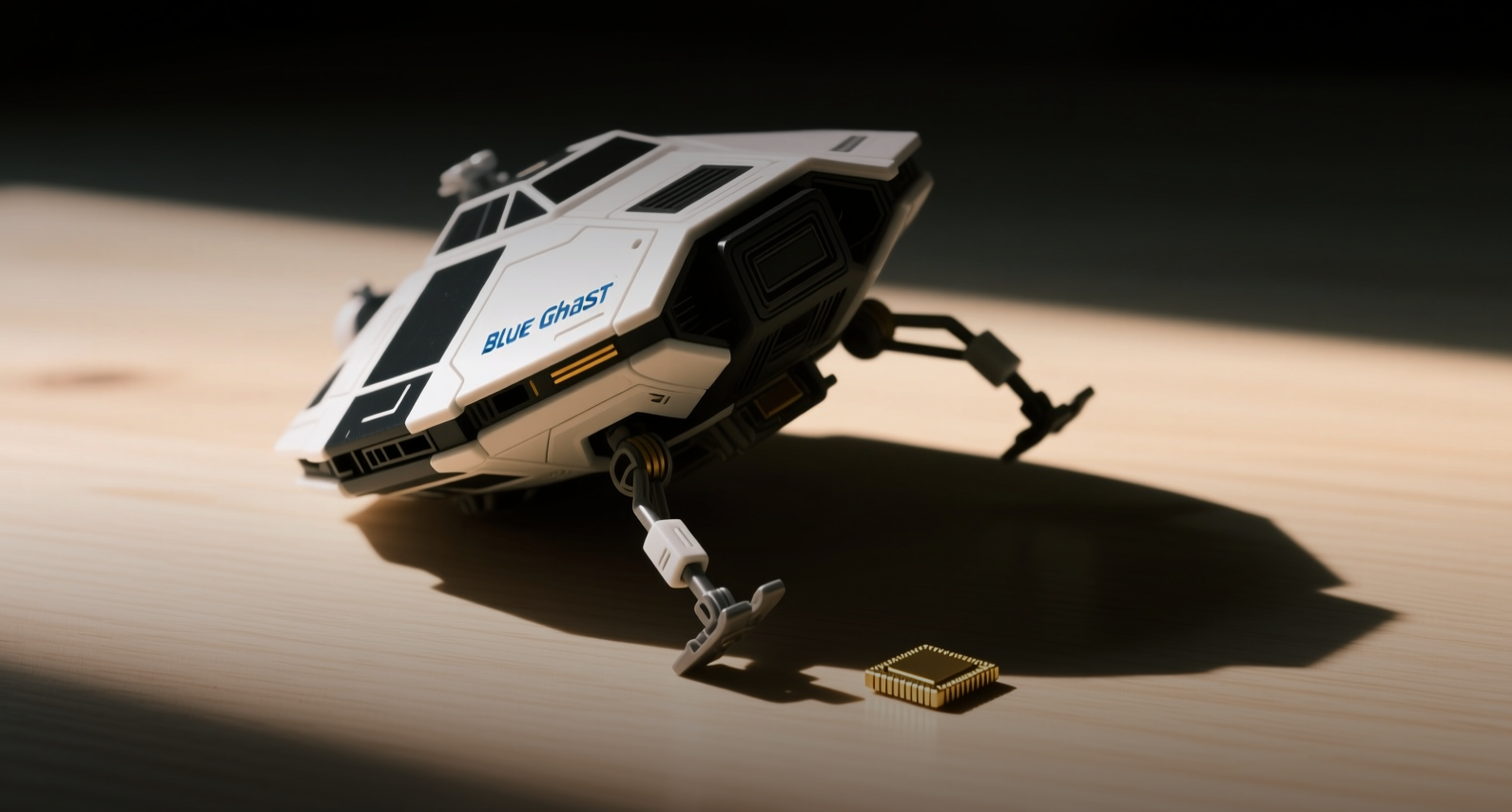
Space-ng's vision navigation software, proven during Blue Ghost Mission 1's autonomous lunar descent, gives Firefly an in-house AI navigation stack for Moon, Mars, and defense missions.
Firefly Aerospace Inc. acquired Space-ng Inc., an AI-powered vision navigation company, in a deal that brings proven spacecraft software in-house after the technology enabled two hazard avoidance maneuvers during Blue Ghost Mission 1's lunar landing. The terms were not disclosed.
"Space-ng's vision navigation technology proved itself in the most critical moments of our descent, allowing Blue Ghost to autonomously perform two hazard avoidance maneuvers and safely touch down on the Moon for the first time in commercial space history," said Jason Kim, chief executive officer of Firefly Aerospace. "This acquisition represents a strategic investment in both the experienced team and technologies from Space-ng that will continue to play an important role in advancing autonomous space operations."
Firefly shares fell about 8% on the announcement, extending a pattern of cautious investor reactions to the company's acquisition strategy. The stock's prior deal-related moves averaged a negative 3.9%, including a 14.1% drop after closing the SciTec national security software acquisition in November and a 6.3% gain on the initial $855 million SciTec announcement in October. Short interest stood at 8.74% of the float as of late May, according to exchange data.
The acquisition gives Firefly control over the navigation stack that guided Blue Ghost to a precise touchdown in Mare Crisium during the first commercial lunar landing. Space-ng's technology suite includes high-resolution spacecraft cameras and AI compute hardware that enable space domain awareness, onboard optical navigation, rendezvous and proximity operations, and docking without GPS or GNSS — capabilities Firefly plans to integrate across its Blue Ghost landers and Elytra orbital vehicles.
A bet on repeatable lunar access
Firefly's mission manifest includes three additional lunar missions under NASA's Commercial Lunar Payload Services initiative, another mission supporting NASA MoonFall, and a space domain awareness mission for the Defense Innovation Unit. The company plans to use Space-ng technology as the software foundation for regular, repeatable access to the Moon and beyond.
Space-ng was founded in 2024 as a spinoff of Farm-ng, an agricultural robotics company that began in 2020 providing AI-powered vision navigation for farming. The Littleton, Colorado-based team brings expertise in artificial intelligence, computer vision, autonomous systems, and flight software. Co-founder and Chief Executive Officer Ethan Rublee will join Firefly as chief engineer of software, overseeing the company's spacecraft software suite.
"Blue Ghost Mission 1 demonstrated what's possible with Space-ng's modern approach to simulation, perception, autonomy, and flight software," Rublee said. "This acquisition allows us to scale Space-ng's products and apply them across Firefly's exciting vehicle line and mission roadmap."
J.P. Morgan Securities LLC served as exclusive financial advisor to Firefly. The company will continue offering Space-ng's vision navigation and autonomous guidance capabilities to government and commercial customers under the Firefly Aerospace brand.
The deal shows Firefly's strategy of building an integrated space technology stack through acquisitions, following the SciTec purchase that added national security and big-data analytics. With Space-ng, Firefly gains an AI-first software team that has already demonstrated its technology in the most demanding environment — a lunar landing where failure means crashing into the surface. The question for investors is whether the company can execute on its expanded mission manifest and convert its technology wins into recurring revenue.
This article is for informational purposes only and does not constitute investment advice.