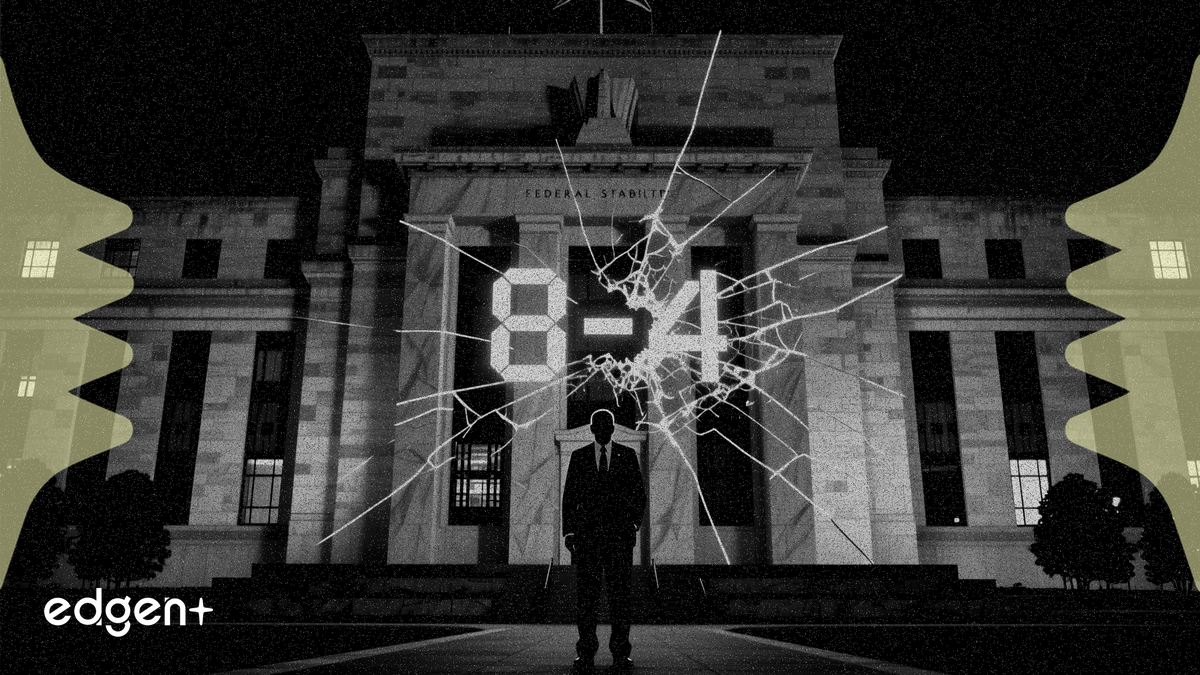
The Federal Reserve’s latest interest rate decision was overshadowed by a deep policy split and a stunning announcement from its outgoing chair.
The Federal Reserve held its benchmark interest rate steady at 3.50-3.75 percent Wednesday, but a deeply divided 8-4 vote and a hawkish shift in language sent U.S. Treasury yields to one-month highs.
"I worry that these attacks are battering the institution and putting at risk the thing that really matters to the public, which is the ability to conduct monetary policy without taking into consideration political factors," Jerome Powell said in his final press conference as chair, explaining his decision to remain on the board as a governor.
The hawkish surprise roiled markets, with the 2-year Treasury yield jumping to 3.928 percent and the U.S. Dollar Index climbing to 98.92. The policy statement also dropped its long-standing characterization of inflation as “somewhat elevated,” a change traders interpreted as a more aggressive stance as the Fed’s preferred inflation gauge is set to hit 3.5 percent.
With markets now pricing out any rate cuts in 2026 and a 55 percent chance of a hike by April 2027, the focus shifts to the Fed's June 16-17 meeting, which is expected to be the first under new leadership, and whether incoming Chair Kevin Warsh can unite a fractured committee.
A Fractured Committee
The 8-4 decision was the most divided vote at the central bank since 1992, revealing a growing chasm between officials. Fed Governor Stephen Miran dissented in favor of a rate cut, continuing his dovish stance. More significantly, three regional bank presidents—Cleveland’s Beth Hammack, Minneapolis’s Neel Kashkari, and Dallas’s Lorie Logan—dissented because they opposed retaining language in the policy statement that signaled an "easing bias," suggesting the next move would be a cut. Their opposition indicates a growing belief that persistent inflation may require holding rates higher for longer, or even raising them.
Powell's Unprecedented Move
Adding to the drama, Jerome Powell announced he will stay on the Fed's board as a governor after his term as chair expires on May 15. The move, the first time a chair has done so since 1948, is a direct response to what Powell described as "unprecedented" legal and political attacks on the central bank's independence. "Jerome 'Too Late' Powell wants to stay at the Fed because he can't get a job anywhere else," former President Donald Trump said on his Truth Social platform, highlighting the political pressures Powell cited.
The Fed's hawkish tilt comes as policymakers navigate a complex global backdrop. The ongoing conflict in the Middle East has pushed the price of Brent crude to around $118 a barrel, feeding into higher energy costs and complicating the inflation outlook. While the U.S. labor market has remained resilient, the combination of sticky inflation and geopolitical uncertainty raises the risk of a stagflationary environment, further constraining the Fed's policy options heading into a leadership transition.
This article is for informational purposes only and does not constitute investment advice.