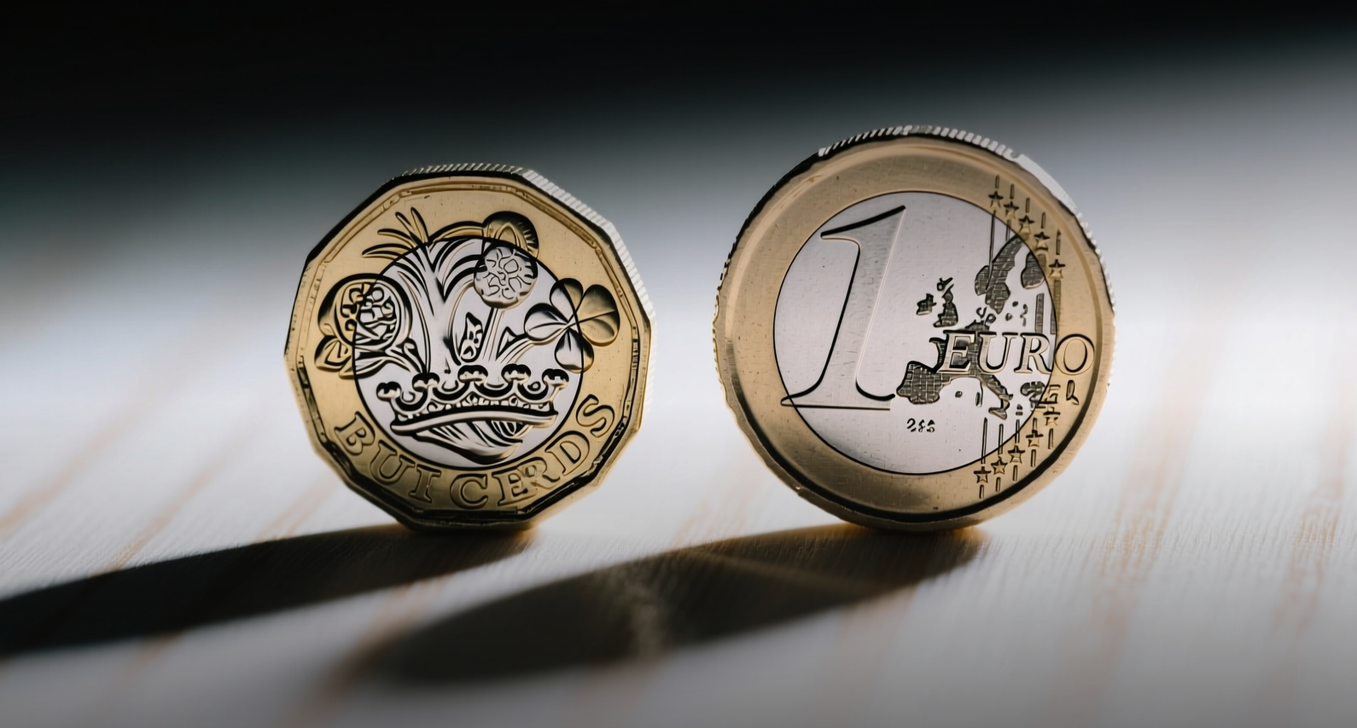
Markets are repricing the relative monetary policy outlook for the Bank of England and the European Central Bank, driving EUR/GBP to its highest level in two months.
The Bank of England held its key rate at 3.75% on Thursday, while the ECB hiked to 2.25% a week earlier — a policy divergence that has narrowed the rate gap and pushed EUR/GBP up 0.3% to its highest level since April.
"The market is pricing a fading belief that the BoE will need to deliver significantly more tightening than the ECB," said James Smith, economist at ING. "If the Iran deal holds and energy prices stay at current levels, inflation is expected to peak at 3.5 percent later this year, comfortably below the 4 percent threshold that BoE research indicated would trigger a persistent bout of price pressure."
The BoE's Monetary Policy Committee voted 7-2 to hold, with Megan Greene and Huw Pill preferring a quarter-point hike. UK inflation eased to 2.8 percent in May, below expectations, though the central bank warned it will rise later this year as higher energy costs pass through. The ECB raised its key rate by 25 basis points to 2.25 percent last week — its first hike since 2023 — citing war-driven inflationary pressures. The euro rose 0.3 percent to $1.146, while sterling dropped 0.54 percent to $1.322, its weakest level in more than two months.
The narrowing rate differential reflects a fundamental reassessment of the two economies' inflation trajectories. The US-Iran peace deal has pushed oil prices lower, reducing the risk of a sustained energy shock that would force the BoE into aggressive tightening. Markets now see the next BoE move as a cut — potentially in 2027, according to ING — while the ECB's hiking cycle may have further to run if euro-area inflation remains sticky.
Rate Differentials Drive the Trade
The BoE's current rate of 3.75 percent is the lowest since June 2023, after two 25-basis-point cuts in August and November last year. The ECB, by contrast, had not raised rates since 2023 until last week's 25-basis-point hike. The gap between the two policy rates has narrowed from 175 basis points at the start of the year to 150 basis points now, making euro-denominated assets relatively more attractive.
The last time the BoE held rates with a 7-2 split was in September 2024, when two members also voted for a hike. Sterling weakened 1.2 percent over the following month as markets interpreted the split as a sign the tightening cycle had peaked. A similar pattern is emerging now, with the pound down 0.54 percent against the dollar and 0.3 percent against the euro since Thursday's decision.
Cross-Asset Transmission
The repricing extends beyond EUR/GBP. The US Dollar Index rose 0.36 percent to 100.71, its highest since May 2025, after the Federal Reserve held rates at 3.50 percent to 3.75 percent in Kevin Warsh's first meeting as chair. Nearly half of Fed officials now expect at least one rate increase before the end of the year, with traders fully pricing a hike by October, according to LSEG data.
The Bank of Japan raised its benchmark rate to 1 percent this week — the highest since 1995 — while the Swiss National Bank held at zero percent. The global divergence in monetary policy is creating cross-currents in currency markets, with the yen weakening to 160.90 per dollar, its lowest level since July 2024.
What Happens Next
The BoE's next meeting is scheduled for August. If the US-Iran ceasefire holds and the Strait of Hormuz fully reopens, falling oil prices should help offset the inflation spike expected later this year, said David Bharier, head of research at the British Chambers of Commerce. That would reduce pressure on the BoE to hike and could accelerate the timeline for a cut.
For EUR/GBP, the direction depends on whether the ECB follows last week's hike with further tightening. The central bank raised its inflation forecast to 3 percent for this year and cut its growth outlook to 0.8 percent, suggesting a delicate balancing act. If the ECB pauses, the rate differential could stabilize; if it hikes again, the euro has further room to run against the pound.
This article is for informational purposes only and does not constitute investment advice.