
The ECB's first rate hike in nearly three years failed to lift the euro as hotter US inflation data stole the spotlight.
The ECB's first rate hike in nearly three years failed to lift the euro as hotter US inflation data stole the spotlight.
The ECB's first rate hike in nearly three years failed to lift the euro as hotter US inflation data stole the spotlight.
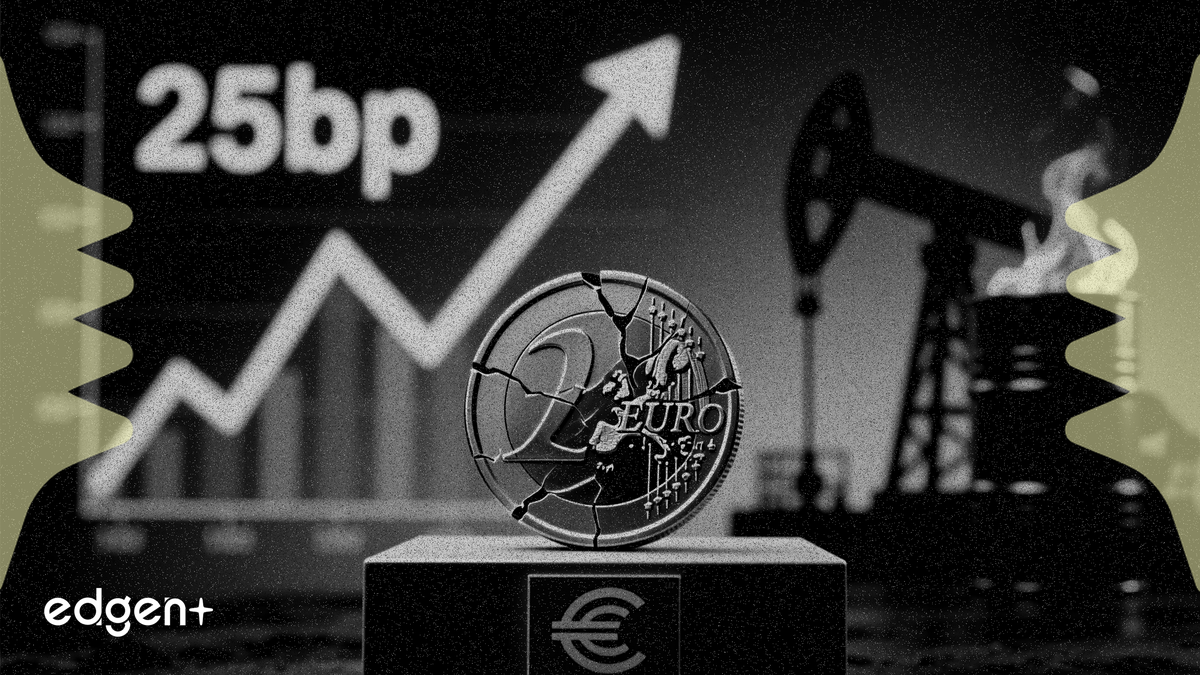
The European Central Bank raised rates for the first time since 2023 on Thursday, delivering a 25-basis-point hike to counter Iran war inflation, but the euro failed to hold gains as hotter US inflation data shifted focus back to the Federal Reserve.
"The decision to raise rates is robust across a range of scenarios mapping out how the shock might evolve," the ECB said in a statement, as it lifted the deposit rate to 2.25% from 2%. ECB President Christine Lagarde rejected characterizations of the move as an "insurance hike," telling a press conference the Governing Council would monitor further consequences of the energy shock.
The euro traded at $1.0820 after briefly rising on the decision, as traders refocused on US data showing inflation running above consensus. The 25-basis-point increase had been fully priced in by money markets, limiting the scope for euro gains. Eurozone inflation is projected at 3% this year, well above the ECB's 2% target, while growth was revised down to 0.8% for 2026. The benchmark 10-year German Bund yield rose 4 basis points to 2.45% as the rate path steepened.
The hike marks the first by a major central bank in response to the Iran conflict and comes ahead of policy decisions next week from the Federal Reserve, Bank of Japan and Bank of England. Markets price two additional ECB increases over the coming year, with the next as soon as September, though economists are split on whether tightening into weak growth risks a policy error.
The ECB's new baseline projections show inflation averaging 3% in 2026, 2.3% in 2027 and 2% in 2028, bringing the outlook closer to the "adverse" scenario the bank published in March. Core inflation, which strips out energy and food, is seen at 2.5% this year and next before easing to 2.2% in 2028. Growth forecasts for 2026 and 2027 were each trimmed by 10 basis points, reflecting the war's impact on commodity markets, real incomes and confidence.
The last time the ECB raised rates was September 2023, when it took the deposit rate to 4% at the peak of its previous tightening cycle. That cycle ended after 10 consecutive increases as inflation receded from double-digit highs. The current hiking cycle begins from a far lower starting point — the deposit rate had been at 2% since a series of cuts in 2024 and 2025 — and faces a more complex backdrop of supply-driven inflation and stagnating growth.
Rate Differentials Widen as US Data Surprises
The euro's inability to rally on the ECB hike reflects a widening rate differential favoring the dollar. US consumer price data released Thursday came in above consensus estimates, reinforcing expectations that the Federal Reserve will maintain a hawkish stance when it meets next week. According to CME FedWatch data, markets now price a lower probability of Fed rate cuts this year compared with before the CPI release. The dollar index rose 0.3% on the day, adding pressure on the euro.
"The ECB is tightening into an economy already paying a high price for the Iran conflict," said Paul Donovan, chief economist at UBS Global Wealth Management, who called the move a policy error rooted in an "unhelpful 2022 mindset." Holger Schmieding at Berenberg also described it as a mistake, arguing that "the inevitable temporary surge in prices seems unlikely to turn into a protracted inflation problem."
ECB Chief Economist Philip Lane has argued the opposite — that the Iran-related shock may be broader in scope than the Ukraine crisis because it affects global energy markets rather than primarily Europe. Deutsche Bank's Mark Wall said the balance of risks supports "one more hike in September and that's it," reflecting a view that the tightening cycle will be shallower than the 2022-2023 campaign. A Reuters analysis of earnings call transcripts showed just 40% of euro zone companies outside the financial sector had raised prices or planned to do so, roughly half the share seen during the Ukraine energy shock.
The Governing Council said it remains "well positioned to navigate the uncertainty caused by the war" and will follow a data-dependent, meeting-by-meeting approach. It is not pre-committing to a particular rate path. The next policy decision is scheduled for July 23, though sources told Reuters that some governors are already eyeing a pause after Thursday's move.
This article is for informational purposes only and does not constitute investment advice.
