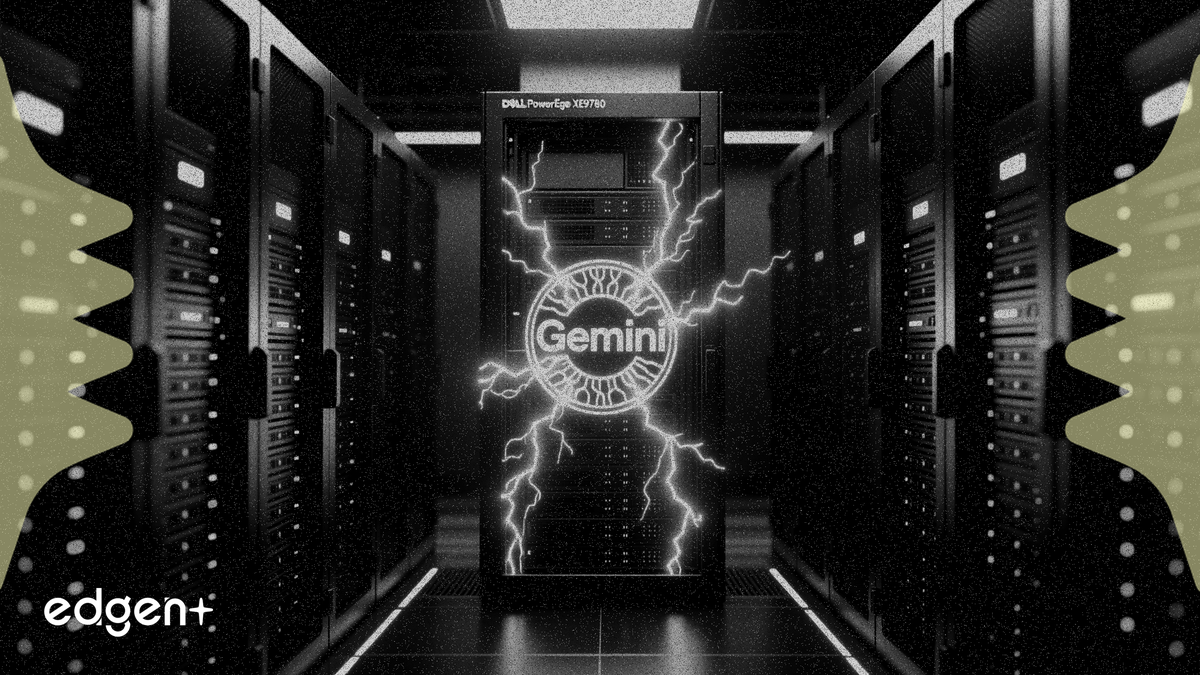
Dell Technologies will integrate Google's efficient Gemini 3 Flash AI model directly onto its high-performance PowerEdge XE9780 servers, a move aimed at accelerating on-premise AI adoption for enterprise clients and challenging Nvidia's dominance in the data center.
"Google and Dell are collaborating to launch the Gemini 3 Flash model on Dell PowerEdge XE9780 servers through Google Distributed Cloud," Dell said in a statement reported by Cailian Press on May 19.
The partnership makes Google's lightweight and cost-effective Flash model available outside of the public cloud, running on Dell's specialized AI hardware. Gemini 3 Flash is known for its speed and efficiency in tasks like code generation, making it suitable for enterprise applications where performance and security are critical. Pricing and specific availability dates for the integrated solution were not yet disclosed.
The collaboration positions Dell to capture a larger share of the enterprise AI hardware market, estimated to be worth hundreds of billions, by offering a pre-validated, on-premise solution. For Google, it extends the reach of its Gemini models into private data centers, creating a new revenue stream and a direct challenge to the near-monopoly of Nvidia's GPU-based systems.
The integration of Google's AI software with Dell's server hardware addresses a growing demand from enterprises to run AI workloads in their own secure, on-premise environments. By using Google Distributed Cloud, which extends Google Cloud infrastructure to the edge and private data centers, customers can deploy Gemini models with the same tools and APIs they use in the public cloud, but with greater control over their data.
This partnership represents a significant step in the trend of co-optimizing AI models and the hardware they run on. While Nvidia has long dominated the AI space with its powerful but costly H100 and B200 GPUs, this Dell-Google solution provides an alternative focused on efficiency and total cost of ownership.
Gemini 3 Flash: Built for Enterprise Scale
Unveiled at Google I/O, the Gemini 3 Flash model is designed for high-volume, high-frequency tasks where speed and cost are paramount. Unlike larger models that require massive computational resources, Flash offers a balance of performance and efficiency. Early tests show its strength in areas like high-quality code generation and creative content, making it a versatile tool for developers and businesses looking to build AI-powered applications without the steep hardware costs associated with top-tier GPUs from competitors like Nvidia or AMD.
The PowerEdge XE9780 is one of Dell's flagship servers designed for AI and high-performance computing (HPC). By validating Gemini 3 Flash for this platform, Dell and Google are providing customers with a turnkey solution that reduces the complexity of deploying and managing AI infrastructure. This could significantly lower the barrier to entry for companies wanting to leverage advanced AI capabilities securely within their own firewalls. The move is likely to be viewed positively by the market, potentially boosting Dell's server sales and strengthening Google's position as a key player in enterprise AI.
This article is for informational purposes only and does not constitute investment advice.