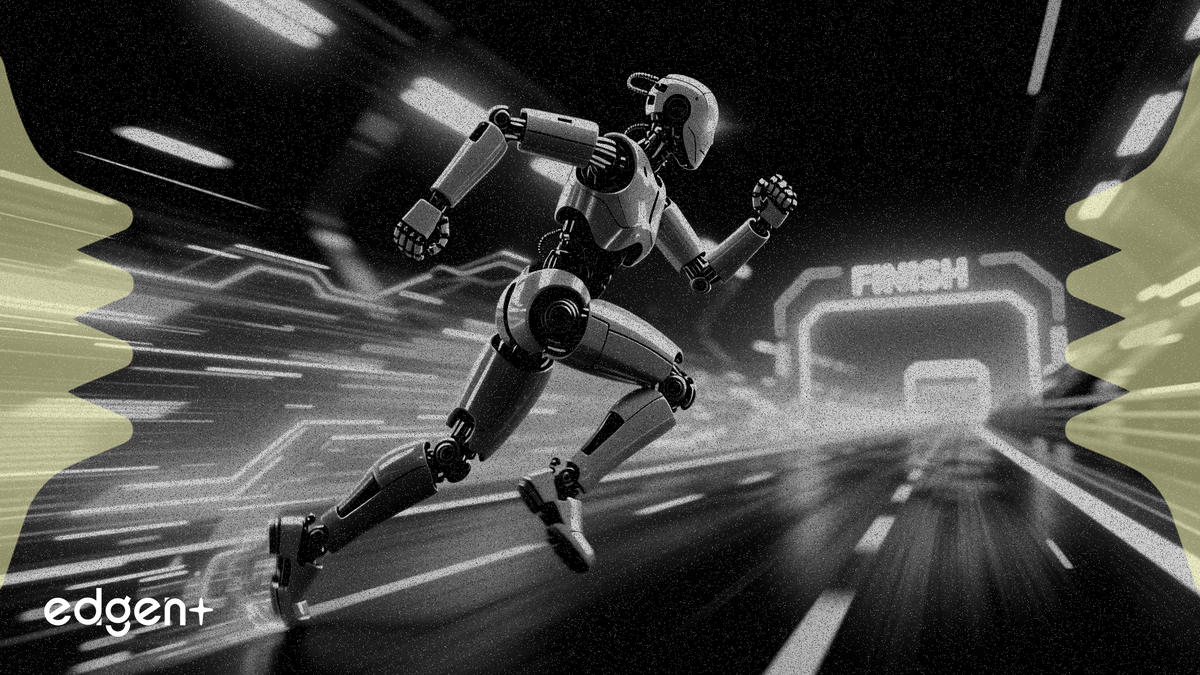
A Chinese humanoid robot just ran a half-marathon 17 minutes faster than the first human finisher, a feat that shows the country's robotics industry is learning to run far faster than its competitors.
A humanoid robot developed by China’s Glory autonomously completed a 21-kilometer half-marathon in just 50 minutes and 26 seconds, a nearly two-hour improvement from the previous year that highlights the country's accelerating progress in robotics.
The event, which saw participation grow from 21 robots to over 300 in one year, was specifically designed to reward autonomous navigation, with rules penalizing remote-controlled entries. The award was effectively prepared for robots that can see the road and make their own decisions, according to the organizing committee's rules which applied a 1.2x time penalty to remote-controlled units.
The winning robot, named "Lightning," finished nearly 17 minutes ahead of the first human runner. A year ago, the best robot time was 2 hours and 40 minutes and required a human guide. This year, roughly 40 percent of the 100-plus teams, including international entries from Germany and France, chose fully autonomous navigation, up from almost none the previous year.
This rapid improvement signals a "pre-iPhone moment" for the industry, where costs are falling dramatically. With unit costs projected to drop from a range of $100,000-$150,000 to below $10,000 by 2028, the race for dominance is shifting from the marathon course to the factory floor, where China's manufacturing base provides a vast field for deployment.
From Race Track to Factory Floor
While the marathon achievement is a milestone, the industry's main event is in manufacturing. The race was held in a controlled environment with a pre-planned route. Factories, by contrast, are unpredictable. Workers change paths, parts may be misplaced, and floor conditions can vary, presenting a different kind of challenge that requires adaptability and reliability for a full eight-hour shift.
Several Chinese industrial giants are already testing the waters. CATL, a major battery manufacturer, is using humanoid robots for transport and assembly in its Luoyang factory. Automaker BYD is conducting joint tests with robotics firm Ubtech, while GAC and SAIC have also begun deploying robots in their manufacturing bases for tasks deemed dangerous, dirty, or dull.
China's 80 Percent Share of the Market
The scale of the marathon event, with over 300 robots from 26 brands, offers a snapshot of China's burgeoning robotics industry. The country's dominance is built on a mature supply chain forged by the consumer electronics and electric vehicle industries. Core components like servo motors and linear actuators, which account for about 63% of the global supply chain, are readily available from Chinese suppliers at a cost estimated to be 2.2 times lower than in the United States.
This advantage is reflected in production forecasts. Of the 17,000 humanoid robots expected to ship globally in 2025, Chinese firms are projected to contribute about 14,000, or more than 80 percent. This trajectory mirrors the rise of China's EV industry, where companies like BYD leveraged supply chain control and economies of scale to overtake global leaders. The cost curve for humanoid robots is following a similar path to that of lithium-ion batteries a decade ago.
The Final Hurdles Before Mass Adoption
Despite the rapid progress, several obstacles remain before humanoid robots are widely deployed. The cost and time required to adapt a robot to a new factory environment is a major friction point. Ensuring a robot can operate for a full eight-hour shift without failure is another unproven challenge, with current pilot programs showing continuous work times of four to six hours.
Furthermore, a legal and standards vacuum persists. No clear regulations exist to determine liability if an autonomous robot causes an accident, a key concern for enterprises. Finally, the human element presents a subtle but significant barrier. Factory workers have reported feeling uneasy around the robots, whose movements and decision-making can seem unpredictable, affecting team collaboration and morale.
This article is for informational purposes only and does not constitute investment advice.