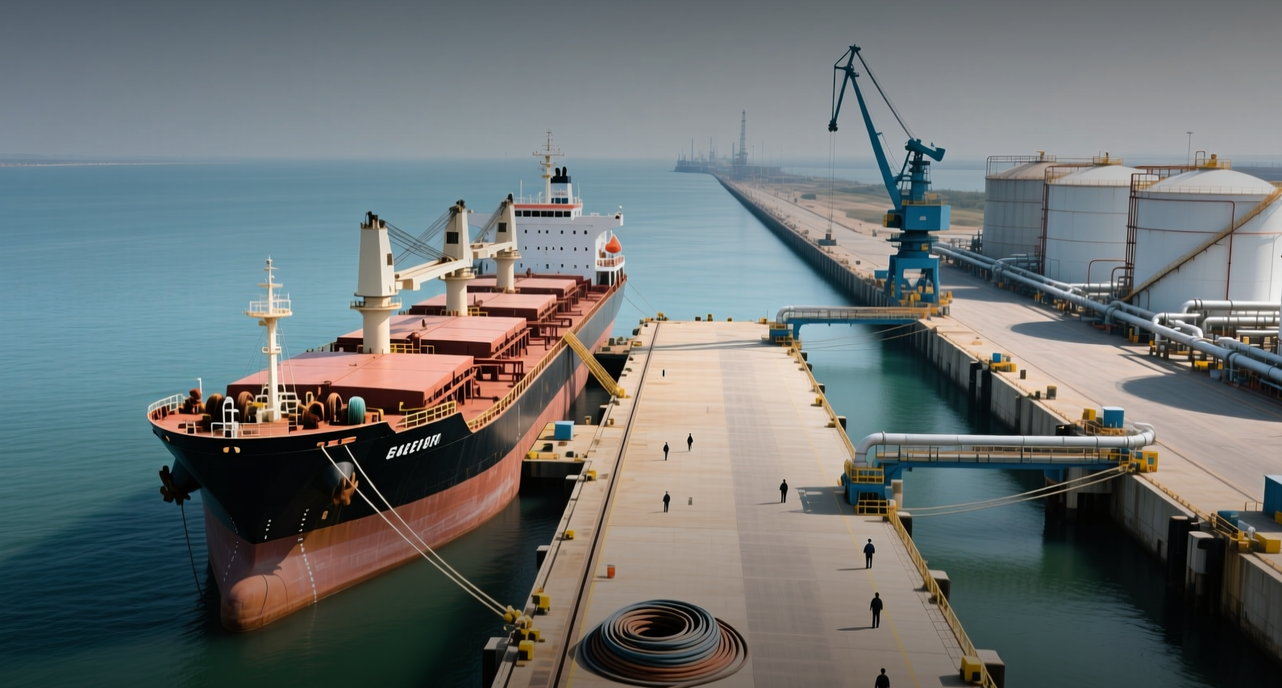
China's decision to stop buying crude and start selling it from its own reserves is the reason a war that removed a fifth of the world's energy supply did not produce a $150 barrel. S&P Global Ratings credited Beijing with having "kind of saved the day," saying the country's import cuts and stockpile releases helped the world avoid what the agency called a "doomsday scenario" after the Strait of Hormuz closure choked off roughly 20% of global energy supply.
"China kind of saved the day," S&P Global Ratings said in its assessment of the market, crediting Beijing's decision to slash imports after the war broke out and draw down its strategic stockpiles with keeping a lid on global oil prices and shielding its own economy.
The scale of the offset shows up in the refining data. China's refiners cut processing rates by 18% in June from a year earlier, pushing throughput to the lowest level since March 2020, according to Reuters. The world's largest crude importer simultaneously reduced crude imports and fuel exports to safeguard supply and insulate itself from soaring prices. Chinese diesel consumption fell an estimated 10% in May from a year earlier, gasoline demand dropped 5% and petrochemical feedstock use slumped 17%, according to International Energy Agency estimates. Global oil demand fell nearly 5% in the second quarter of 2026 from a year earlier to 99.1 million barrels a day, with the declines concentrated in Asia and Europe.
Brent crude traded above $90 a barrel after renewed U.S.-Iran hostilities, the highest in more than a month, and briefly surpassed $100 on Wednesday — the first time since early July — while West Texas Intermediate jumped to $95. Both benchmarks remain well below the $120-plus peak reached in April, when the war's first phase was priced in. The gap between those two levels is the measure of China's contribution: a 20% supply loss that produced a 30% rise in Brent rather than the triple-digit spiral the market feared.
The offset is now running into its own limits. Strategic and commercial reserves cushioned the initial loss of Middle Eastern barrels, but those buffers have eroded over months of disruption, leaving the world with far fewer shock absorbers than it had in February. The renewed conflict has also spread to the Red Sea, where an Iran-backed Houthi blockade against Saudi vessels at Bab el-Mandeb is forcing crude bound for Asia to divert through the Suez Canal and around Africa — adding at least four weeks to a typical tanker voyage and more than doubling sailing times while raising freight and insurance costs.
Refined products are where the squeeze actually bites
Crude's contained move understates the damage further downstream. Since the war began, benchmark European diesel prices and U.S. gasoline prices have gained around 65%, against a 30% rise in Brent, and diesel refining margins have surged to record levels. The average U.S. gasoline price is well over $4 a gallon and more than $1 higher than a year ago, according to AAA, while diesel is nearing $6 a gallon. Americans have spent an extra $101 billion on gasoline and diesel since the war started, according to a Brown University tracker.
That divergence matters for monetary policy. Central banks typically look through energy spikes on the assumption they are temporary, but a sustained run of higher diesel costs feeds into trucking, shipping, construction and factory input prices, raising the risk that energy inflation spreads into core. Several Federal Reserve officials have said they are prepared to raise rates if inflation does not show signs of slowing, with the Producer Price Index and Consumer Price Index due before next week's rate decision.
The next test is whether China can keep cutting
The last time oil inventories were this thin relative to demand, in 2022, the release of coordinated strategic reserves by IEA members knocked roughly $10 a barrel off Brent within six weeks. This time the buffer is smaller and the disruption is larger. Goldman Sachs has warned of potential $120 per barrel prices if attacks on shipping intensify and more energy infrastructure goes offline, while Bank of America raised its oil forecast after the renewed hostilities. Oxford Economics projects prices averaging around $85 a barrel for the rest of the year before easing to $65 by the end of 2027, and now assumes simmering U.S.-Iran tensions and below-normal Hormuz traffic through at least the end of 2027.
The variable that decides which forecast wins is the same one that has decided the market for six months. China can only draw down stockpiles once, and its refiners can only suppress runs for so long before fuel shortages at home force them back into the market. Sinopec research now expects Chinese oil demand to fall 8.9% in 2026, a projection that, if it holds, extends the offset — and if it reverses, removes it. World Bank chief economist Indermit Gill told Reuters the conflict could ultimately cut 2026 global growth to as low as 1.3%, from 2.9% last year, which is the cost of the demand destruction doing the work that supply cannot.
This article is for informational purposes only and does not constitute investment advice.