
Beijing's last-minute revision to its carbon accounting erased a statistical gap equivalent to Germany's entire annual CO2 output.
Beijing's last-minute revision to its carbon accounting erased a statistical gap equivalent to Germany's entire annual CO2 output.
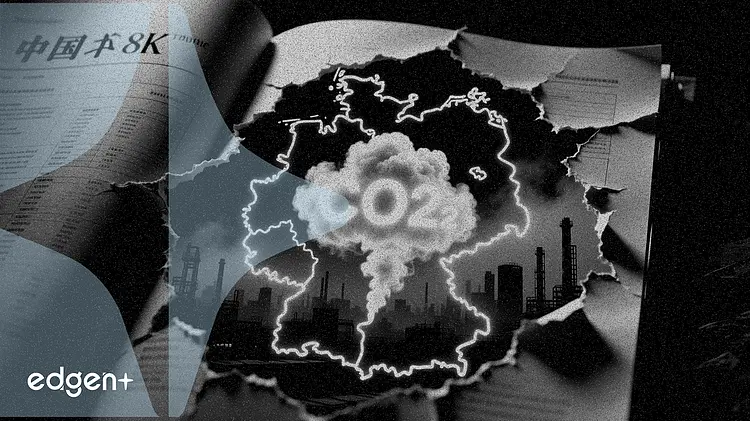
Beijing's last-minute revision to its carbon accounting erased a statistical gap equivalent to Germany's entire annual CO2 output.
China reported a 17.7% cut in carbon intensity from 2020 to 2025, narrowly missing its 18% target — but only after retroactively redefining which emissions count, analysis by the Centre for Research on Energy and Clean Air shows.
"The redefinition effectively halves the rate of growth in China's CO2 emissions over the past five years," said Lauri Myllyvirta, lead analyst at CREA, in a report published by Carbon Brief.
Earlier official figures had indicated a reduction of just 12.4% over the same period. The gap — equivalent to the total annual emissions of South Korea or Germany — was closed by excluding certain emissions from chemical production and plastics manufacturing, both booming industrial sectors. A footnote in China's latest statistical communiqué indicated the methodological shift, Myllyvirta said. Previously, Beijing factored in all fossil-fuel consumption when calculating carbon intensity; the new calculus retrospectively cherry-picks which emissions to count.
The revision undermines confidence in China's climate pledges just as the European Union prepares to expand its Carbon Border Adjustment Mechanism, which could impose tariffs on imports from jurisdictions with opaque emissions accounting. China's Ministry of Ecology and Environment acknowledged as recently as September 2023 that "controlling carbon emission intensity is challenging."
Trade Exposure Worth 200 Billion Euros
The methodological change follows years of Beijing insisting it would meet its Copenhagen and Paris commitments through economic efficiency gains rather than absolute emissions cuts. President Xi Jinping said in 2022 that climate goals "shouldn't come at the expense of energy and food security" — a statement that foreshadowed the trade-offs now visible in the data.
The EU imported roughly 200 billion euros of goods from China in 2024, much of it in sectors like steel, chemicals, and plastics that would face CBAM scrutiny. If Brussels determines China's emissions data is unreliable, it could apply default emissions factors that would raise the cost of Chinese exports by an estimated 15% to 25% for covered products, according to trade models cited by the European Commission. The previous round of EU carbon border measures, applied to cement and electricity in October 2023, pushed Chinese steel exporters to restructure supply chains toward Southeast Asian transshipment hubs, according to S&P Global data. A similar dynamic could now unfold across chemicals and plastics, sectors where China accounts for roughly 30% of global production capacity.
Carbon Market Integrity at Risk
China's domestic carbon market, launched in 2021, now covers more than 5 billion metric tons of CO2 annually — the world's largest by volume. If the underlying emissions baseline is unreliable, the integrity of offsets and allowances traded on that market comes into question. The last time a major emitter revised its methodology — India's 2019 recalculation of its forest carbon sink — it added roughly 15% to reported sequestration capacity, drawing criticism from climate scientists. China's revision moves in the opposite direction, reducing reported emissions growth, but the transparency concern is the same.
For investors, the implications extend beyond compliance markets. Chinese green bond issuance reached $85 billion in 2024, much of it tied to projects that claim verified emissions reductions. A methodology change that retroactively alters the baseline could trigger revaluation of those instruments, particularly among international investors who rely on third-party verification standards such as the Climate Bonds Initiative.
The next test of China's emissions data credibility will come when the EU publishes its CBAM implementing regulations later this year, which will specify how non-EU countries' carbon prices are calculated. If China's methodology is deemed non-compliant, Chinese exporters could face additional costs of $10 billion to $15 billion annually, based on current trade flows and carbon price trajectories, according to estimates from the Bruegel think tank. Chinese export-oriented stocks in carbon-intensive sectors could face headwinds as CBAM costs materialize, while demand for third-party carbon offset verification services is likely to rise as trading partners seek independent validation of emissions data.
This article is for informational purposes only and does not constitute investment advice.
