
The chipmaker's two-year outlook implies a business quadrupling in size, built on custom accelerators for Google, OpenAI, Anthropic and Meta plus the Ethernet networking that links their clusters.
The chipmaker's two-year outlook implies a business quadrupling in size, built on custom accelerators for Google, OpenAI, Anthropic and Meta plus the Ethernet networking that links their clusters.
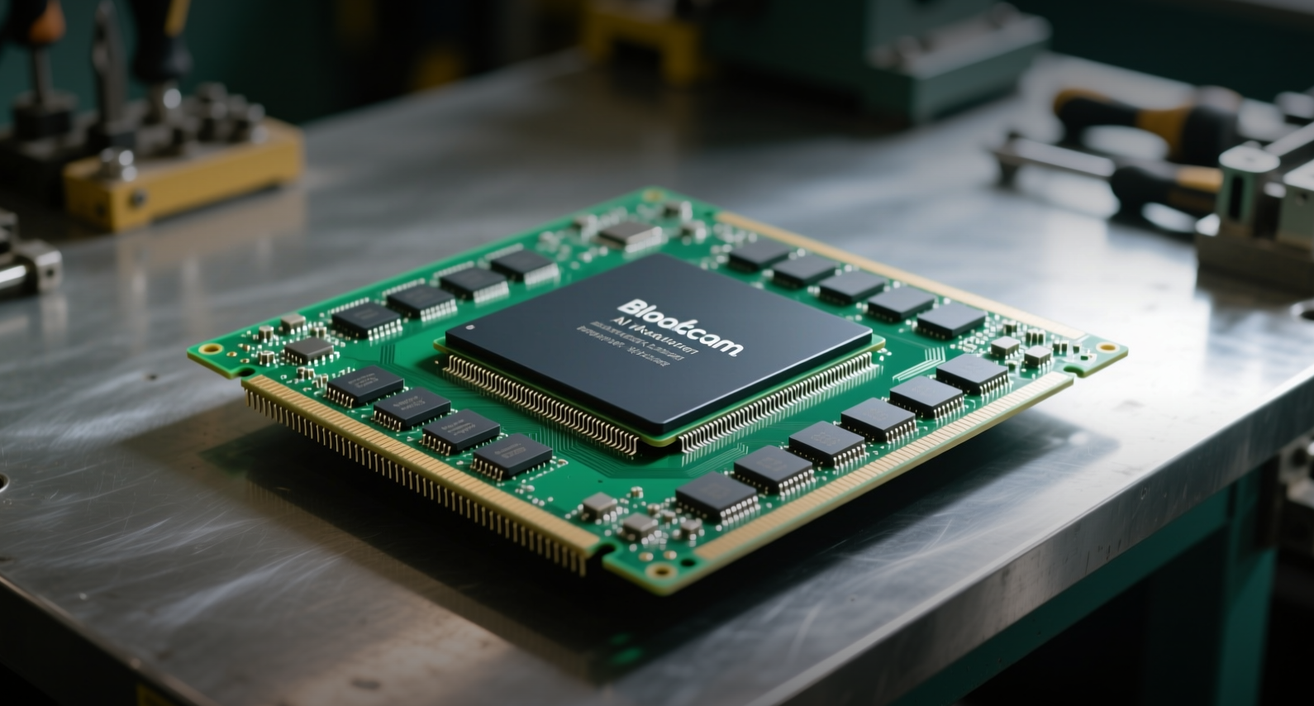
Broadcom Inc. is betting that hyperscalers will keep shifting AI workloads off merchant GPUs and onto purpose-built silicon, guiding AI semiconductor revenue to roughly $115 billion in fiscal 2027 and $230 billion in fiscal 2028 — a business that would quadruple in two years from the $58 billion expected this fiscal year. The Palo Alto, California-based chipmaker reported fiscal third-quarter AI semiconductor revenue of $16.7 billion, up 221 percent from a year earlier, and forecast $21.7 billion for the current quarter, growth of 236 percent.
"Demand for our custom AI accelerators and networking continues to be very strong," Chief Executive Hock Tan said on the Sept. 2 earnings call. He added that Anthropic is on track to become Broadcom's largest XPU customer in 2027 and sustain that position in 2028, joining Google, OpenAI and Meta among the buyers of its application-specific accelerators.
The guidance rests on a model that differs sharply from Nvidia Corp.'s merchant-GPU business. Broadcom designs custom accelerators to order for a small group of hyperscale customers — Google's TPU line under an arrangement running to 2031, and the inference silicon behind OpenAI's "Jalapeño" processor — rather than selling chips off a catalogue. The economics favor specialization once a workload is stable and deployed at gigawatt scale, because a purpose-built inference chip cuts per-token cost and power draw versus a general-purpose part. Broadcom's AI semiconductor revenue also includes networking gear such as the Tomahawk 6 Ethernet switch, which accounted for roughly 40 percent of the segment last quarter; management expects that share to settle near 30 percent over time as clusters scale out.
The numbers behind the outlook were strong across the board. Total revenue reached $29.591 billion, up 86 percent year over year, with non-GAAP diluted earnings per share of $3.32, up 96 percent. Semiconductor Solutions produced $20.8 billion, up 127 percent, and now supplies 70 percent of consolidated revenue. Free cash flow hit a record $13.7 billion, equal to 46 percent of revenue. The stock still fell 2.74 percent to $357.16 in the session after the report, as fourth-quarter revenue guidance of about $34.8 billion came in roughly $230 million below the $35.03 billion consensus — a miss of less than 1 percent that overshadowed the beat on a stock priced for perfection.
The raised outlook is the clearest signal yet that AI infrastructure spending is broadening beyond Nvidia's GPUs. Broadcom does not frame its XPUs as a direct Nvidia replacement; rather, it argues that as inference becomes a continuous, daily workload across ChatGPT, Gemini and Claude, the largest model labs will route the most stable, highest-volume tasks to specialized silicon to control cost per million tokens and compute per watt. That logic has drawn Google, Meta, OpenAI and Anthropic into multi-year custom-chip roadmaps even as they keep buying merchant GPUs for training.
The competitive field is tightening. Alphabet Inc. expanded its custom-chip collaboration with Marvell Technology Inc. this year, a sign that hyperscalers will not hand a single supplier their entire architecture. Broadcom's answer is breadth: it participates whether customers build custom XPUs with it or run merchant GPU clusters, because its Ethernet networking and optical interconnect products serve both. J.P. Morgan analyst Harlan Sur said on the call that the Tomahawk 6 ramp has been the fastest of any Broadcom switching family and is nearly sold out for next year, with Charlie Kawwas, president of Semiconductor Solutions, confirming the chip is deployed across essentially all AI hyperscalers building XPUs with the company.
The same concentration that drives Broadcom's growth is its main vulnerability. A business built on custom orders from a handful of buyers grows spectacularly while those buyers keep spending and stops abruptly if any pause. Data center capacity constraints, grid interconnection freezes and any cooling in AI capital expenditure all reach Broadcom through customer order books rather than through demand for its own products. Management also flagged gross margin guidance down to 73 percent from 78 percent a year earlier, driven by rising memory costs.
Wall Street largely looked past the near-term guidance miss. Macquarie upgraded the stock to Outperform with a $490 price target, while Citi, BNP Paribas and others raised targets, leaving the average consensus near $510. Broadcom shares, trading at roughly 19 times forward earnings — a discount to Nvidia — closed near $358 on Sept. 4 after stabilizing. Whether the $230 billion fiscal 2028 target is reachable now depends less on Broadcom's own execution than on whether Google, OpenAI, Anthropic and Meta can bring gigawatt-scale projects online on schedule, and how much of that capacity Broadcom ultimately captures.
This article is for informational purposes only and does not constitute investment advice.
