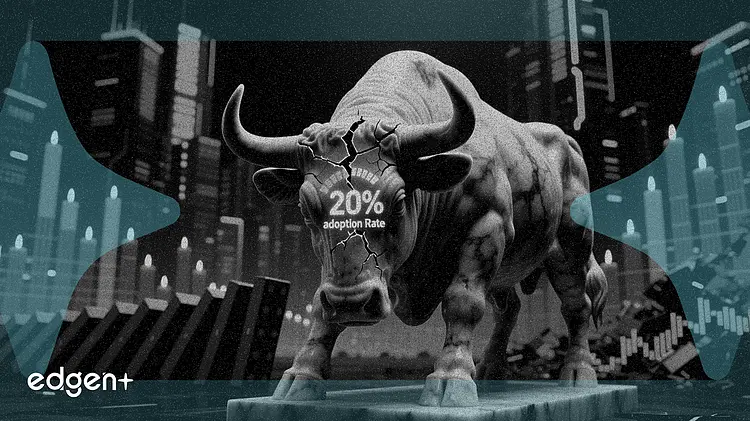
Ray Dalio sees the artificial-intelligence market following the classic pattern of technology bubbles that eventually burst when investors attempt to convert paper wealth into cash.
Bridgewater Associates founder Ray Dalio said the booming artificial-intelligence market shows signs of a bubble that will eventually burst as investors attempt to convert paper wealth into cash, comparing the cycle to past technology booms.
"All great technology changes produce bubbles," Dalio, the billionaire founder of Bridgewater Associates, said June 3 in a Bloomberg Television interview. "Nobody can get it exactly right. You have to either spend a ton of money to capture your market share and don't worry about whether it's too much or not, or you don't spend enough money and you lose your market share."
Dalio described the mechanism of a bubble burst as "the conversion of paper wealth into real money," adding that while AI is a "great technology," the current market is "following that path." His warning comes as Bridgewater's own research shows fewer than 20 percent of US firms report using AI in any business function over a two-week period, with adoption concentrated in information, technology and professional services, according to Census Bureau data cited by the hedge fund.
The warning from one of the world's most prominent macro investors could accelerate a rotation out of AI and tech stocks, which have driven much of the S&P 500's gains over the past two years. Bridgewater also flagged that the lack of AI-driven economic cooling may complicate the Federal Reserve's efforts to manage inflation in a tight labor market, even as over 90 percent of AI-using firms reported no employment effect from the technology.
The Mechanics of an AI Bubble
Dalio's framework draws on decades of observing technology cycles. The pattern — massive capital deployment, speculative pricing, and eventual reckoning — mirrors the dot-com era, when companies spent heavily on internet infrastructure before the 2000 crash. Today, AI companies are locked in a spending arms race: invest aggressively or lose market share, with little middle ground.
Morgan Stanley warned separately June 3 that AI "chipflation" is spreading from data centers into the broader economy, as demand for Nvidia Corp. graphics processing units and data center infrastructure drives up costs across supply chains. The bank's analysis suggests the capital intensity of AI buildouts is creating inflationary pressure that extends beyond the technology sector.
Adoption Reality vs. Market Hype
Bridgewater's own data paints a picture of an industry still in early innings. Fewer than one in five US businesses use AI in any capacity, and among those that do, the vast majority report no change to headcount. The hedge fund identified two near-term risks to its outlook: an escalation of the Iran conflict and cost pressures from companies' AI capital investments.
The disconnect between market pricing and actual adoption creates the conditions Dalio describes. AI infrastructure companies trade at valuations that imply rapid, widespread deployment, while enterprise adoption data suggests a slower, more uneven trajectory. Nvidia, the bellwether of the AI trade, trades at elevated multiples relative to historical semiconductor valuations. If enterprise AI adoption follows the gradual path Bridgewater's data suggests, current valuations may prove difficult to sustain without a catalyst for faster deployment.
This article is for informational purposes only and does not constitute investment advice.