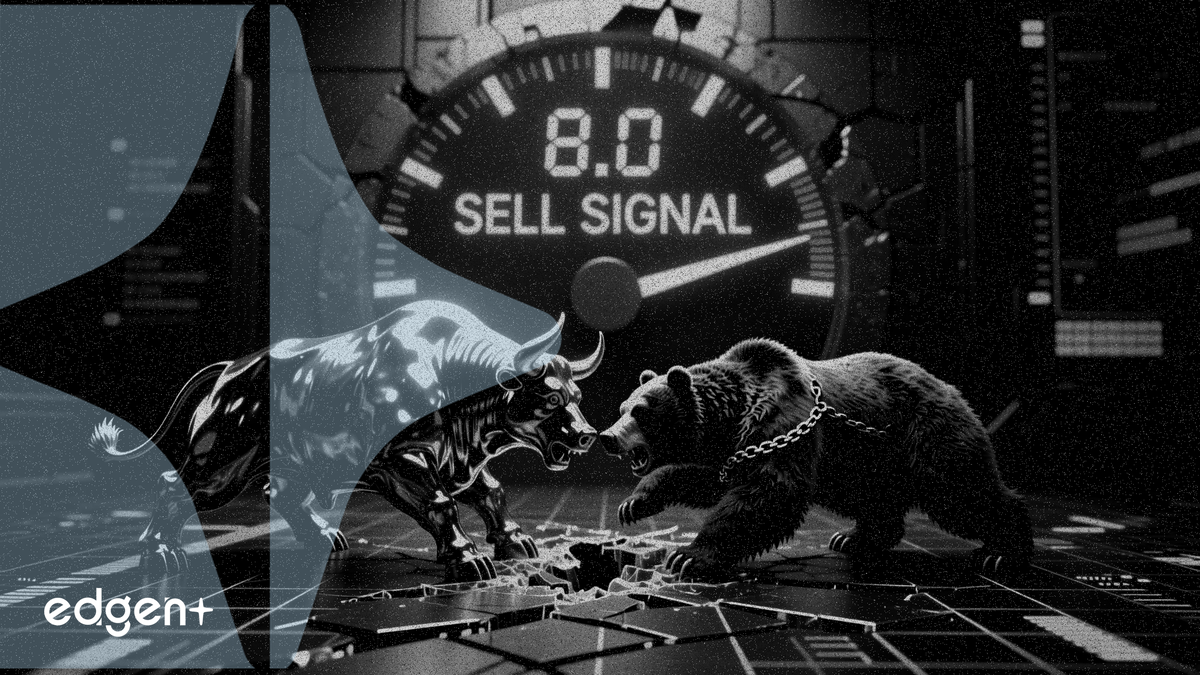
Bank of America Corp.’s key market sentiment gauge has hit its highest level since November 2021, triggering a contrarian sell signal for global equities as investor optimism reaches euphoric levels and cash holdings dwindle.
"Current market conditions show strong price momentum, retail frenzy, and low volatility, which are characteristic features of a bubble," Michael Hartnett, chief investment strategist at Bank of America, wrote in the firm's "The Flow Show" report.
The bank's Bull & Bear Indicator rose from 7.8 to 8.0, crossing the threshold that has historically preceded market pullbacks. The move was driven by fund managers’ record monthly increase in equity allocation and a drop in cash levels to 3.9 percent, a separate sell signal. Data from BofA’s $4.5 trillion private client business showed equity holdings at a record 65.7 percent, while cash fell to an all-time low of 9.9 percent.
The signal suggests risk assets face short-term pullback pressure, with market concentration in the top 10 artificial intelligence-related stocks reaching 48 percent, a level exceeding prior bubbles. Historically, the signal has been followed by global equity declines of 2 to 3 percent over the subsequent two to three months.
A pronounced divergence in capital flows highlights the market's concentrated bullishness. Technology stocks attracted $9 billion in the past week, the largest single-week inflow since October 2025. In contrast, emerging market equities saw a $7.9 billion outflow, marking their sixth consecutive week of withdrawals, the longest streak since November 2024. European stocks also suffered their sixth straight week of outflows, losing $2.3 billion.
The flight to perceived safety and specific growth themes was also evident in fixed income and crypto markets. U.S. Treasuries absorbed $10.8 billion, the largest inflow in nine weeks, as investors sought haven assets. Meanwhile, cryptocurrencies experienced a $1.5 billion outflow, the most significant weekly withdrawal since February 2026.
This extreme positioning has pushed the Bull & Bear Indicator into "extreme bullish" territory for the first time since the post-pandemic rally. The indicator's track record shows that while not a guarantee of a downturn, it has served as a reliable warning that investor sentiment has become overly optimistic and vulnerable to a reversal. Hartnett noted that bull capitulation is "almost complete," suggesting early June could be ripe for profit-taking, with the direction of bond yields set to determine the scale of any potential pullback.
This article is for informational purposes only and does not constitute investment advice.