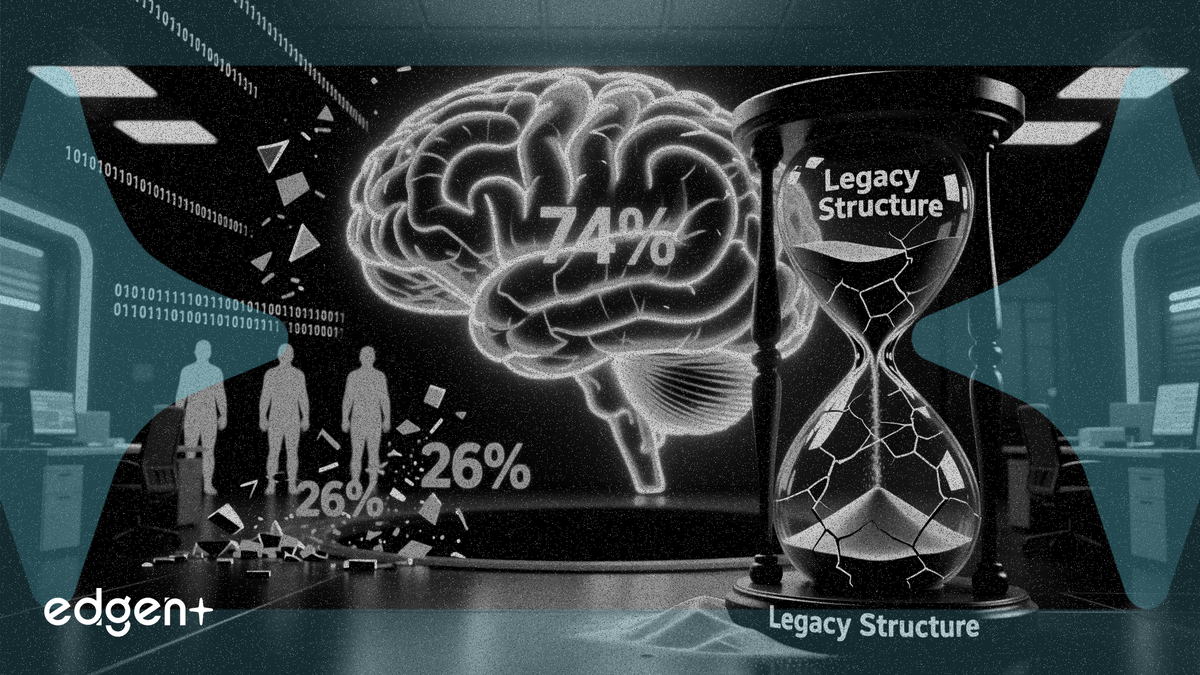
AI adoption among non-managerial white-collar workers surged 23 percentage points in a year, yet most companies have not redesigned workflows to capture the productivity gains.
Three of every four non-managerial white-collar workers now use artificial intelligence regularly, yet most organizations have failed to restructure workflows around the technology, according to Boston Consulting Group's fourth annual AI at Work survey.
"Individual usage alone won't deliver the type of organisation-wide transformation that's possible," Melanie Silva, managing director of Google Australia and New Zealand, said in a separate report on AI adoption.
The BCG survey found that 74% of rank-and-file white-collar employees count themselves as regular AI users, up from 51% a year earlier. Nearly half of all respondents now spend more time managing and directing AI tools than performing the work itself. Yet the productivity uplift remains elusive: most enterprises struggle to convert efficiency gains into measurable value, BCG said, because they bolt AI onto existing processes rather than reimagining how work gets done.
The gap between individual adoption and organizational restructuring carries real financial consequences. Commonwealth Bank of Australia Chief Executive Matt Comyn warned that AI can generate "an enormous amount of volume, noise and waste" without proper oversight, while Coles CEO Leah Weckert called the cost-benefit balance "an emerging issue" as AI becomes embedded across operations. Peter Tonagh, executive chairman of Quantium, said companies are deploying tools without redesigning workflows. "Most organisations are not yet reimagining the way in which the work gets done," Tonagh said.
The Employee-Led Adoption Gap
More than half of AI users adopted the technology on their own initiative, with only 25% encouraged by leadership, according to research cited by the Australian Financial Review. This bottom-up pattern creates governance blind spots: employees frequently access AI tools through personal accounts that employers cannot monitor, introducing data privacy and compliance risks that human resources departments are only beginning to address.
The talent shortage compounds the problem. Across Asia-Pacific, 74% of organizations have deployed or are piloting AI programs, yet only 21% believe they can effectively recruit and retain sufficient AI talent — trailing the global average of 24%, according to a separate Aon survey of more than 2,300 business leaders. The region's HR data maturity, at 42% versus 38% globally, has not translated into workforce agility.
The Psychological Toll of Uneven Adoption
The disconnect between rapid tool adoption and slow organizational change is creating new workplace stress. Stephanie McNamara, author of a proposed clinical construct called Artificial Intelligence Replacement Dysfunction, or AIRD, described it as "psychological distress and negative mental health effects that workers are going to be faced with when faced with a threat or reality of AI-induced job displacement." She warned that risk emerges "when AI shifts from being just a tool to help workers do their job to being a substitute for independent thinking."
Despite these concerns, 63% of workers expressed interest in AI training, and 45% said their roles would be more meaningful if routine tasks were automated. The appetite for change exists — but organizations have not matched it with structured reskilling programs, governance frameworks, or workflow redesign.
For investors, the survey data points to a two-speed market. Companies that successfully restructure around AI — redesigning workflows, investing in governance, and reskilling workforces — stand to capture disproportionate productivity gains. Those that simply layer AI onto existing processes risk rising costs without offsetting revenue growth. The divergence favors AI infrastructure providers such as Nvidia Corp. and Microsoft Corp., whose enterprise tools benefit from expanding seat counts, while labor-intensive sectors face mounting margin pressure from both wage inflation and the cost of uncoordinated AI deployment.
This article is for informational purposes only and does not constitute investment advice.