

ASML's monopoly on EUV lithography makes it the single most essential supplier in the AI chip supply chain.
ASML's monopoly on EUV lithography makes it the single most essential supplier in the AI chip supply chain.
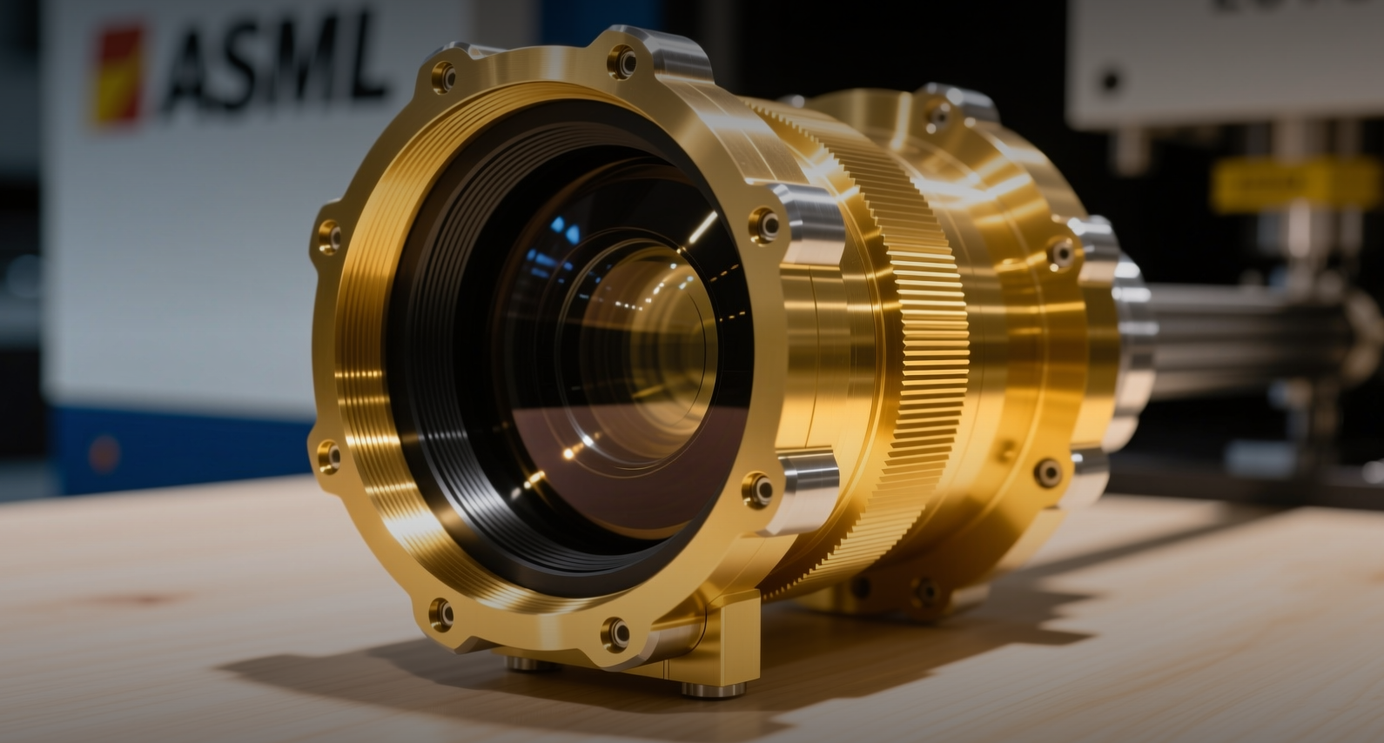
ASML's monopoly on EUV lithography makes it the single most essential supplier in the AI chip supply chain.
Every advanced AI processor — from Nvidia's H100 to AMD's Instinct series — passes through an ASML machine before reaching a data center. The Dutch company's extreme ultraviolet lithography systems, which cost $200 million to $400 million each and require multiple planes to ship, are the only tools capable of etching the sub-3nm circuitry that powers today's most demanding AI workloads.
"AI is no longer just a demand driver for our customers — it is becoming a productivity tool inside our own operations," ASML Chief Executive Christophe Fouquet said, citing the company's collaboration with Mistral AI to deploy generative AI across engineering workflows and customer support.
ASML's dominance rests on two product tiers. Its low-NA EUV systems handle current-generation 3nm and 5nm chips, while the newer high-NA EUV systems — essential for sub-2nm nodes — are already being installed at IBM's Albany research facility and at TSMC's fabs. The company's gross margin expanded to 52.8% in 2025 from 48.6% in 2020, reflecting pricing power that comes from being the sole supplier of a manufacturing necessity. Revenue grew at an 18% compound annual rate over that period, with EPS compounding at 24%.
From 2025 to 2028, analysts project ASML's revenue and EPS will grow at CAGRs of 18% and 27%, respectively, as AI chipmakers race to install next-generation lithography. The company's shares have gained 67.6% year to date, though that trails the broader semiconductor equipment index. At current levels, ASML trades at a premium that reflects its impenetrable moat — no competitor offers an alternative to EUV.
The AI Demand Cycle Broadens Beyond Logic
AI's appetite for compute is no longer limited to logic chips. High-bandwidth memory from SK Hynix and Samsung, networking processors from Broadcom, and advanced packaging substrates all require EUV lithography for their most advanced layers. This creates a wider and more durable demand cycle than previous semiconductor upswings tied to single end-markets such as smartphones or PCs.
ASML is also integrating AI into its own operations. The company's partnership with Mistral AI targets faster problem-solving in engineering design and customer service, potentially shortening the time between order and installation for its multi-million-dollar systems.
Geopolitics Casts a Shadow on 19% of Sales
China accounted for 19% of ASML's net system sales in the most recent period. The MATCH Act, introduced in the US Congress in April, would extend existing export controls to older deep ultraviolet immersion machines — the same tools China currently can buy. If passed, the bill would eliminate a meaningful revenue stream. Fouquet has described the affected machines as "gear first shipped about a decade ago," but the financial impact would be material. Dutch Trade Minister Sjoerd Sjoerdsma visited Washington this week to lobby against the bill, calling the stakes for the Netherlands "very high."
IBM's Sub-Nanometer Roadmap Depends on ASML
IBM's recent unveiling of a 0.7nm NanoStack architecture — packing nearly 100 billion transistors on a fingernail-sized die — shows the industry's reliance on ASML's high-NA EUV tools. The Albany research consortium, which includes ASML, Lam Research, and Tokyo Electron, is already installing the next-generation lithography system that IBM called "essential for the future of logic scaling." IBM expects NanoStack to reach commercial production within five years, a timeline that depends entirely on ASML's ability to deliver and support these tools at scale.
The Investor Takeaway
ASML remains the most direct way to bet on semiconductor manufacturing without picking individual chip winners. The company's revenue is tied to aggregate foundry and memory capital expenditure, which is projected to exceed $200 billion annually by 2028 as AI-driven demand accelerates. With a 52.8% gross margin and a 27% projected EPS CAGR, ASML offers a combination of monopoly pricing power and volume growth. The primary risk is geopolitical: any escalation in US-China export controls could trim 15% to 20% of revenue, though the long-term AI demand trajectory remains intact.
This article is for informational purposes only and does not constitute investment advice.
