

Anthropic's Fable 5 and Mythos 5 have claimed the top spot on the global AI model intelligence leaderboard, widening the US-China capability gap from 8% to 13% as compute resource disparities deepen.
Anthropic's Fable 5 and Mythos 5 have claimed the top spot on the global AI model intelligence leaderboard, widening the US-China capability gap from 8% to 13% as compute resource disparities deepen.
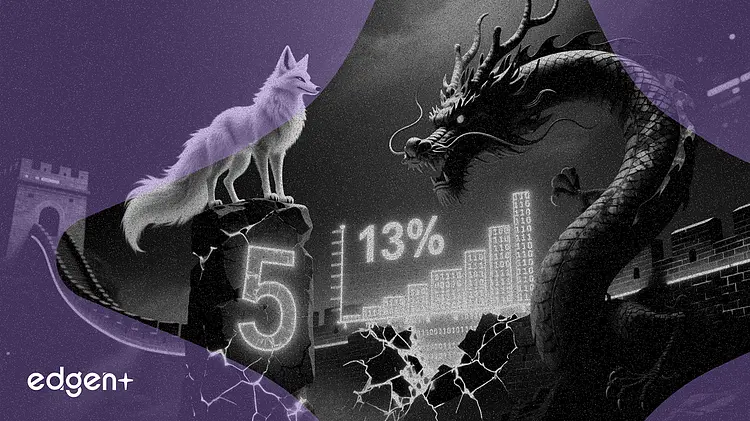
Anthropic's Fable 5 and Mythos 5 have claimed the top spot on the global AI model intelligence leaderboard, widening the US-China capability gap from 8% to 13% as compute resource disparities deepen, according to a Jefferies report.
"The gap in computing resources stems from US AI laboratories having greater access to advanced AI chips, including Nvidia's Blackwell series," Jefferies analysts wrote in a note. The broker said the intelligence gap may expand further as Nvidia prepares to ship its next-generation Rubin chips in the second half of 2026.
Fable 5, launched June 9 and suspended globally within three days after a US Commerce Department directive, features anti-distillation capabilities designed to prevent rivals from replicating its performance through model extraction. The technology has been placed under US export controls, making it harder for Chinese open-source models to close the gap through distillation — a technique where a smaller model learns from a larger one's outputs.
The ranking shift comes as Anthropic doubled the API price of Fable 5 compared with its predecessor Opus 4.8. From March to June, average API pricing in the US rose 89%, partly driven by higher hardware costs. In China, API pricing fell 2% month-over-month in June after MINIMAX-W cut prices by 33%, extending a trend of price compression that Jefferies called its "biggest concern" for Chinese AI labs.
The Compute Divide Widens
The disparity in computing resources is structural. US AI labs have preferential access to Nvidia's Blackwell architecture, while Chinese companies rely on Huawei's "Logic Folding" technology to develop domestic alternatives at potentially higher costs. Although some Chinese AI models are trained overseas using Nvidia chips, the number of advanced US AI chips accessible to Chinese companies is expected to remain far below that of their US peers.
Memory costs are rising sharply, compounding the hardware expense challenge. Jefferies noted that to achieve an acceptable return on investment in AI, API pricing must rise while token consumption continues to surge — making the price war among Chinese AI laboratories unsustainable.
The US government's decision to suspend Fable 5 and Mythos 5 — citing a potential jailbreak vulnerability that could enable cybersecurity exploits — adds another layer of uncertainty. Anthropic said it disagrees that "a narrow potential jailbreak should be cause for recalling a commercial model deployed to hundreds of millions of people" and warned that applying the same standard across the industry "would essentially halt all new model deployments for all frontier model providers."
What It Means for Investors
Despite the widening gap, Jefferies considers the current performance of Chinese AI models sufficient for commercialization. The bigger risk is margin compression: US API pricing is rising to reflect hardware costs while Chinese labs compete on price, squeezing profitability just as capital expenditure requirements climb.
Nvidia stands to benefit from the compute divergence as US labs scale their Blackwell and Rubin deployments. The company's data center revenue, which reached $30.8 billion in its most recent quarter, could see further upside as the US-China AI arms race accelerates demand for premium chips. Chinese AI infrastructure plays face a more challenging outlook, with rising hardware costs and falling API prices creating a margin squeeze that Jefferies said is "unhealthy."
This article is for informational purposes only and does not constitute investment advice.
