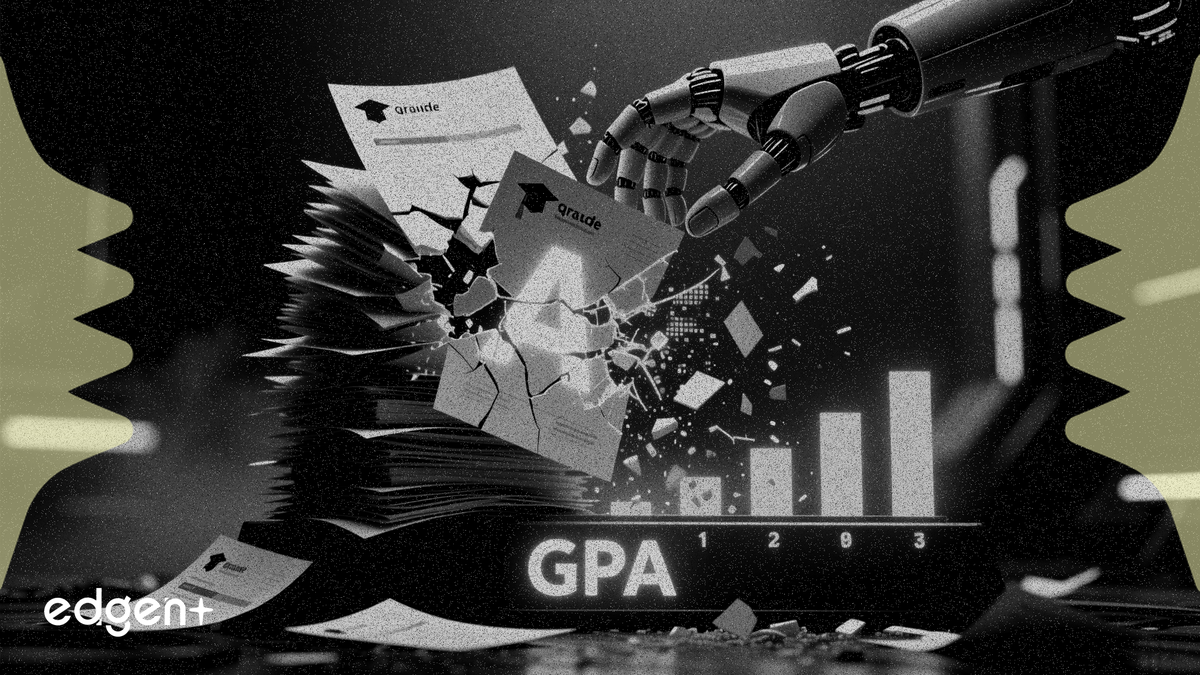
La prolifération des outils d'IA générative comme ChatGPT est directement liée à une augmentation de 30 % des mentions « A » dans certains cours universitaires, selon une nouvelle étude qui remet en question la valeur des relevés de notes académiques pour les recruteurs en entreprise.
« Les résultats suggèrent que les étudiants se sont appuyés sur l'IA générative pour mieux réussir leurs études, et non que ces classes d'étudiants apprennent davantage », explique Igor Chirikov, chercheur senior au Center for Studies in Higher Education de Berkeley et auteur du rapport.
Les recherches de Chirikov, analysant plus d'un demi-million de notes dans une grande université publique du Texas entre 2018 et 2025, ont révélé que l'augmentation des notes était concentrée dans les cours comportant de nombreux travaux de rédaction et de codage. L'étude a noté une divergence significative des mentions « A » entre les cours exposés à l'IA et les autres classes, débutant après l'arrivée de ChatGPT fin 2022.
Ces conclusions intensifient une crise croissante pour les employeurs qui utilisent de plus en plus la moyenne générale (GPA) pour filtrer un flot de candidats débutants. Alors que l'IA rend les meilleures notes plus courantes, le GPA devient un signal moins fiable des connaissances ou des capacités réelles d'un candidat, forçant potentiellement les entreprises à adopter des évaluations de recrutement plus coûteuses et complexes.
Les employeurs relèvent la barre, les notes perdent leur sens
Cette tendance survient à un moment difficile pour les responsables du recrutement. Alors que le marché de l'emploi se refroidit, les entreprises augmentent leurs standards tout en cherchant des moyens efficaces de filtrer de vastes bassins de candidats. Selon l'Association nationale des collèges et des employeurs, 42 % des employeurs utilisent désormais le GPA pour présélectionner les candidats, contre 37 % en 2023.
Certaines entreprises, dont Barclays et Morgan Stanley, imposent des minimums de GPA explicites pour certains stages. La demande pour des notes élevées s'intensifie, les données du site de carrière Handshake montrant que près d'un quart des annonces exigeant un GPA demandent désormais un 3,5 ou plus, un bond significatif par rapport aux 9 % de 2020.
Pourtant, les universités d'élite tirent simultanément la sonnette d'alarme sur le fait que les notes perdent leur sens. « Les notes existent pour communiquer ce que les étudiants ont appris. À Yale, comme dans de nombreuses institutions homologues, elles ne le font plus », a déclaré sans détour un rapport de l'Université de Yale en avril. Un rapport similaire de Harvard en février a reconnu le besoin des employeurs de comparer les étudiants, une tâche rendue difficile par les politiques de notation actuelles.
Le dilemme de l'IA
L'étude de Berkeley suggère que l'IA est le dernier, et peut-être le plus puissant, accélérateur d'un problème d'inflation des notes qui se développe depuis des années. Chirikov prévient que la « lutte productive » essentielle à l'apprentissage est en train de s'éroder. Une mention « A » peut désormais indiquer la compétence d'un étudiant à utiliser un modèle d'IA plutôt qu'une maîtrise du sujet sous-jacent.
Cela crée un paradoxe pour les entreprises, selon Chelsea Schein, vice-présidente du cabinet d'analyse des tendances de recrutement Veris Insights, qui enseigne également à la Wharton School de l'Université de Pennsylvanie. Les entreprises veulent des diplômés maîtrisant les outils d'IA mais se méfient de l'utilisation de cette technologie dans le processus de candidature lui-même. « Ils tiennent un double discours », déclare Schein.
En réponse à cela, certains éducateurs comme Schein repensent leurs cours pour réduire l'importance des travaux vulnérables à l'IA. Elle a réduit le poids des devoirs à la maison, que l'IA peut souvent réaliser parfaitement, au profit d'examens de mi-session surveillés et de quiz en classe où la technologie ne peut être utilisée.
La question centrale pour le monde de l'entreprise est de savoir si l'utilisation généralisée de l'IA à l'université produit des diplômés capables de fournir des résultats soignés mais dotés de capacités de réflexion critique amoindries. Comme le dit Chirikov : « Autant l'IA aide les gens à être plus productifs, à produire plus, autant je pense qu'elle peut nuire à leur apprentissage. » Cette tendance pourrait finalement dévaluer les titres universitaires traditionnels, forçant un changement coûteux dans la manière dont les entreprises identifient et recrutent les nouveaux talents.
Cet article est à titre informatif uniquement et ne constitue pas un conseil en investissement.