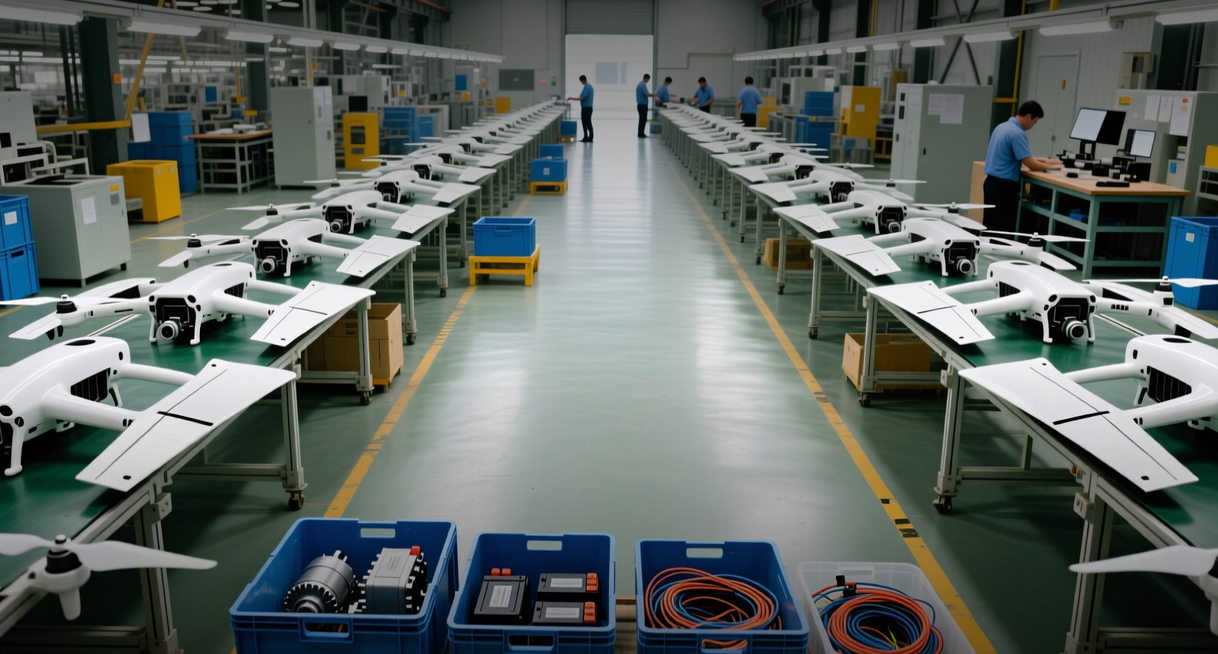
Japan's drone-defense push is colliding with a supply-chain reality: the Terra B1 interceptor that Terra Drone built for the defense ministry in three months under a fast-track program is only about 20% locally sourced, a gap the company's chief executive says Tokyo must close with procurement quotas.
"It is a massive waste to shoot down cheap drones with multimillion-dollar missiles," Toru Tokushige, founder and chief executive of Terra Drone, told the Wall Street Journal, arguing autonomous interceptors offer a cheaper answer to the one-way attack drones Russia has used in Ukraine.
Terra Drone, which trades under ticker 278A, entered the defense-equipment market in March after building a commercial drone business with customers including Saudi Aramco and Shell. Its Terra B1 uses radar, cameras and artificial intelligence to collide with hostile drones, minimizing the need for trained pilots. Two Ukrainian subsidiaries and the company's manually operated A1 drone, deployed on the front lines, give it direct exposure to the war's fast-evolving tactics.
The stakes extend beyond one startup. China dominates global drone supply chains from batteries and controllers to motors, and Western or Japanese alternatives can cost up to five times more than Chinese components. Tokushige warns that leaning on Taiwan, an electronics hub Beijing claims as its territory, carries its own risk. "If Taiwan gets encircled by fleets, no supplies will be able to get through," he said.
The mass-production award last month marked a turning point for a company that spent its early years on agricultural and industrial drones. Investors have priced the defense pivot aggressively, a move that reflects both the contract's value and a broader repricing of drone-defense names as Ukraine demonstrated the cost advantage of cheap unmanned systems over guided missiles.
A 20% local-content ceiling
Tokushige is urging Japan's defense ministry to require domestic production of key drone components, mirroring U.S. procurement rules that mandate 65% local content for many federally purchased manufactured products. Without government-set quotas, he argues, small local suppliers will never receive the orders needed to justify mass production. Chasing 100% domestic production is unnecessary, he said; the real goal is securing supply before a crisis hits. Terra Drone has partnered with Japanese precision manufacturers to develop batteries, the costliest part of a drone.
Ukraine's decentralized lesson
During 15 visits to Ukraine over the past year, Tokushige observed production spread across offices, apartments and shopping malls, with part-time workers assembling smaller drones using soldering irons. His takeaway was that traditional contractors excel at threat detection and tracking but move too slowly for the rapidly evolving drone field. The debate is no longer just about who builds the best drone, he said, but who can manufacture at scale, secure the supply chain and adapt fast enough to survive.
The concern echoes Washington's own effort to move off Chinese technology, where U.S. defense startups such as Anduril have drawn billions of dollars to build systems on home soil. Terra Drone hopes to follow a similar path, targeting defense opportunities in the U.S., Europe and the Middle East. "Once you establish a production line, scaling output by 10 times is not that difficult," Tokushige said.
This article is for informational purposes only and does not constitute investment advice.