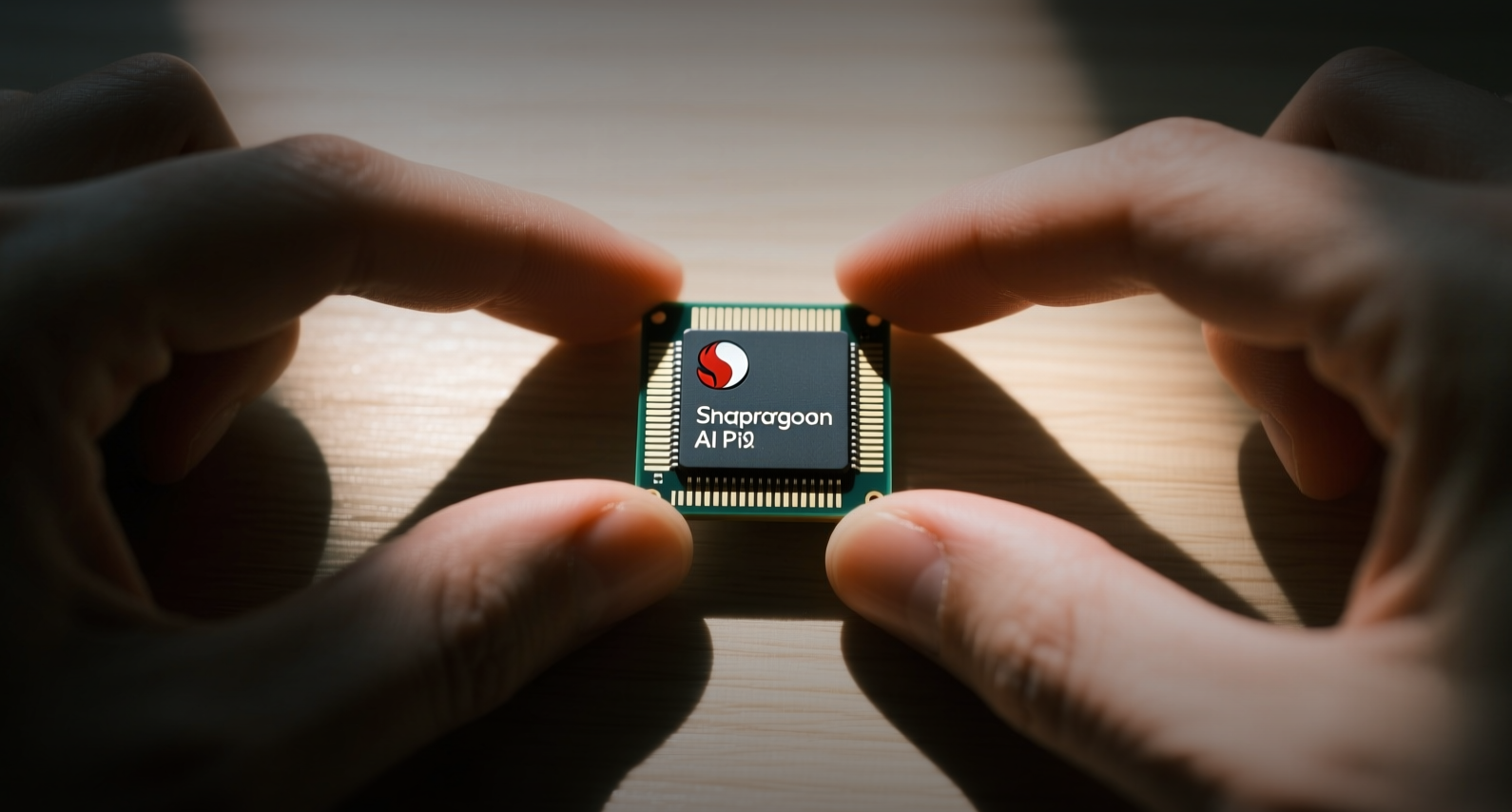
Qualcomm's push into AI factories marks a strategic bet that the next phase of chip demand will come from on-device intelligence, not just cloud GPUs.
Qualcomm announced plans to expand into AI factory infrastructure, a move that positions the mobile-chip giant to capture demand from on-device artificial intelligence as the broader semiconductor sector faces a 2026 downturn. The initiative targets facilities designed to produce and deploy AI-capable silicon at scale, broadening Qualcomm's reach beyond its handset core.
"The AI opportunity is moving from the cloud to the edge, and Qualcomm's architecture is built for exactly that shift," Cristiano Amon, Qualcomm's chief executive officer, said in a statement.
The AI factory initiative comes as Qualcomm trades at roughly 19 times trailing earnings and 16 times forward earnings, a discount to the semiconductor industry's average price-to-earnings multiple of about 50 times. The company is working on more than 40 designs for new AI-powered devices, Amon told CNBC in mid-June, describing AI agents as "the new apps."
The bet carries weight because Qualcomm is diversifying at a moment when the Philadelphia Semiconductor Index has fallen year to date, dragged down by slowing GPU demand growth and shifting AI infrastructure spending toward networking, memory, and cooling systems. Nvidia, Broadcom, and Qualcomm have all declined in the first half of 2026 as investors rotated into AI-adjacent infrastructure plays.
Competitive moves reshape the landscape
Qualcomm's Snapdragon X2 PC platforms, now in production, deliver up to 85 TOPS (trillion operations per second) via a Hexagon neural processing unit, enabling always-on agentic AI without cloud connectivity. The company also agreed to supply data center CPUs to Meta Platforms in late June, with the first product — Dragonfly C1000 — scheduled for production in 2028. The $2.3 billion Alphawave acquisition, completed in fiscal 2026, adds high-speed wired connectivity IP and custom silicon capabilities aimed at hyperscaler customers.
Nvidia's Vera Rubin superchip — a rack-scale system with 72 Rubin GPUs and 36 Vera CPUs delivering 10 times the performance per watt of Grace Blackwell — begins shipping in the second half of 2026. Broadcom expects AI semiconductor revenue to accelerate to $16 billion in the third quarter of fiscal 2026, up more than 200% year over year, driven by custom AI accelerators and networking products. The company also secured a multiyear, $30 billion-plus chip supply agreement with Apple running through 2031.
Valuation gap and investor calculus
Qualcomm's forward P/E of 16 times represents a steep discount to Nvidia at about 22 times and Broadcom at roughly 31 times, even as all three trade below the industry average. Nvidia CEO Jensen Huang, during a visit to Seoul last month, told investors to "buy their stock. It's good," referring to Qualcomm's mobile AI expertise.
For fiscal 2027, analysts project Qualcomm revenue of $43.6 billion, up 2% year over year, with earnings per share of $10.96. The modest growth reflects the handset market's maturity, meaning the AI factory and data center initiatives must deliver to justify valuation expansion from current levels. Qualcomm's return on equity of 42.11% far exceeds the industry average of 3.95%, but the stock's price-to-sales multiple of 4.18 times also sits below the sector's 7.59 times, suggesting the market has yet to price in a successful AI pivot.
This article is for informational purposes only and does not constitute investment advice.