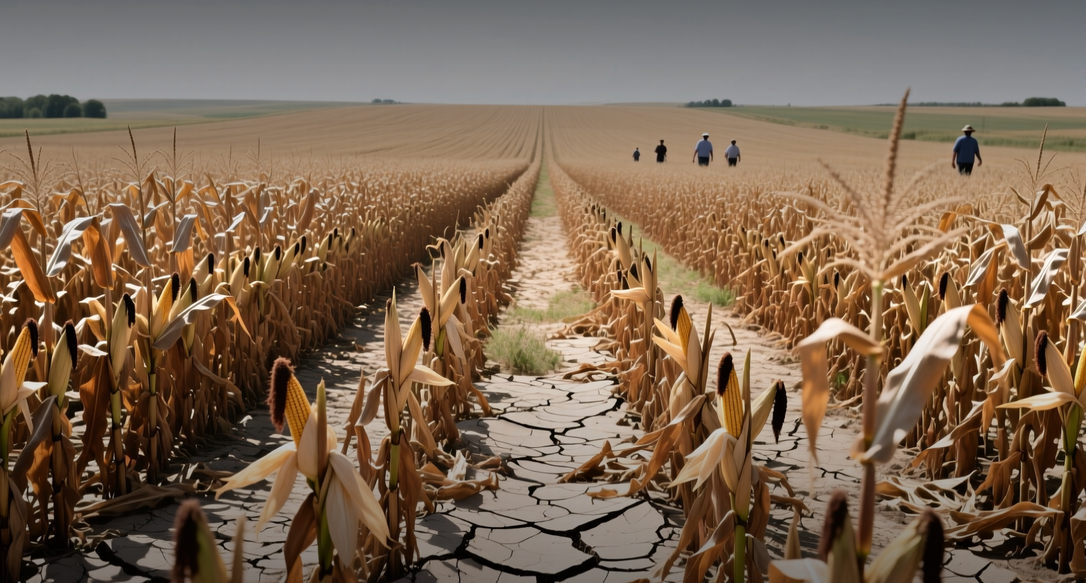
The Iran war and a Corn Belt drought have pushed US farmers into their worst financial crisis in four decades, with industry losses projected at $31 billion this year as diesel and fertilizer costs surge.
US farmers are facing their most severe financial downturn since the 1980s, according to new research from the American Farm Bureau Federation, as the Trump administration's military strike on Iran in February disrupted global energy and fertilizer supply chains and drought cut into yields across the Corn Belt. Without government assistance, growers of nine major crops including corn will lose $31 billion this year, widening to $32 billion in 2027, the AFBF estimates.
"This is the most severe financial downturn in agriculture since the 1980s," John Hansen, president of the Nebraska Farmers Union, said.
The squeeze is visible across the cost side of the ledger. National average diesel prices have climbed more than 43 percent to $5.45 a gallon from $3.81 before the war, according to US Energy Information Administration data, while the phosphorus-rich starter fertilizer "11-52-0" has doubled to more than $900 a ton from $470 a decade ago, farmer Matt Bailey of eastern Nebraska said. Corn growers are losing $131 an acre this year and soybean growers $80 an acre, with 2027 set to mark the sixth consecutive loss year for most major field crops, AFBF economist Faith Parum said.
The stakes extend well beyond the farm gate. Corn futures for December delivery have risen 10 percent this month to $5.15 a bushel, the highest since 2023, and corn is up nearly 20 percent year to date — a trajectory that threatens to push food inflation higher and complicate the Federal Reserve's path back to its 2 percent target. With 71 days until the midterm elections, the crisis has also become a political liability for Republicans, who control Congress.
Drought compounds the cost shock
Beyond input prices, extreme weather has tightened the revenue side. Nebraska, one of the hardest-hit states, received just 11.86 inches of precipitation from January through July — about 3.1 inches below normal and the 18th-driest such period since records began in 1895. Recent rainfall has offered some relief, but for many growers it came too late.
"Our droughts are more severe, our heavy rainfall events are more severe, and our high winds are more severe," said John Dittrich, who grows corn and soybeans near Meadow Grove, Nebraska, describing operating pressure "something I've never experienced in my 44-year career."
The 2026 Pro Farmer Crop Tour, which wrapped up in Rochester, Minnesota, this week, pegged the national corn yield at 173.2 bushels an acre — 7.5 bushels below the USDA's 180.7 projection — after a cold snap and one of the wettest Junes on record cut ear counts and grain length. Soybeans, by contrast, could deliver a record 53.3 bushels an acre if moisture holds, tour leaders said.
A fiscal and political squeeze
The crisis arrives as Washington's fiscal room narrows. Federal debt surpassed $40 trillion this week and long-term Treasury yields sit at 19-year highs, leaving the government stretched in responding. The administration's $11 billion emergency agricultural aid package, requested in June, covers barely a third of the projected $31 billion in losses, and farm groups call it inadequate.
Trade policy has deepened the discontent. Trump's 90-day tariff exemption on up to 300,000 tons of imported beef drew backlash from ranchers who called it a betrayal, while growers say tariffs have hurt soybean exports. "We currently have no positive message to deliver to agricultural states," Republican Senator Thom Tillis conceded, "and that has been the case since last year's so-called 'reciprocal tariff day.'"
The last comparable shock came after the 2022 Russia-Ukraine conflict, which disrupted global fertilizer supply and pushed input costs sharply higher before easing. This time the war and drought are hitting simultaneously, and the transmission to consumers is more direct: Food Institute chief executive Brian Choi said corn's cumulative gain "will eventually be passed through to consumers," warning that "this certainly means higher food prices."
For investors, the spreading crisis carries multiple implications. Rising grain prices feed into food inflation, which shapes the Fed's rate path, while volatility in corn, soybean, and wheat futures creates fresh trading opportunities. If drought persists into harvest, corn futures could extend gains; if the war de-escalates and fertilizer costs ease, the pressure could reverse quickly. The electoral stakes in agricultural states, meanwhile, could reshape farm and trade policy over the next two years.
This article is for informational purposes only and does not constitute investment advice.