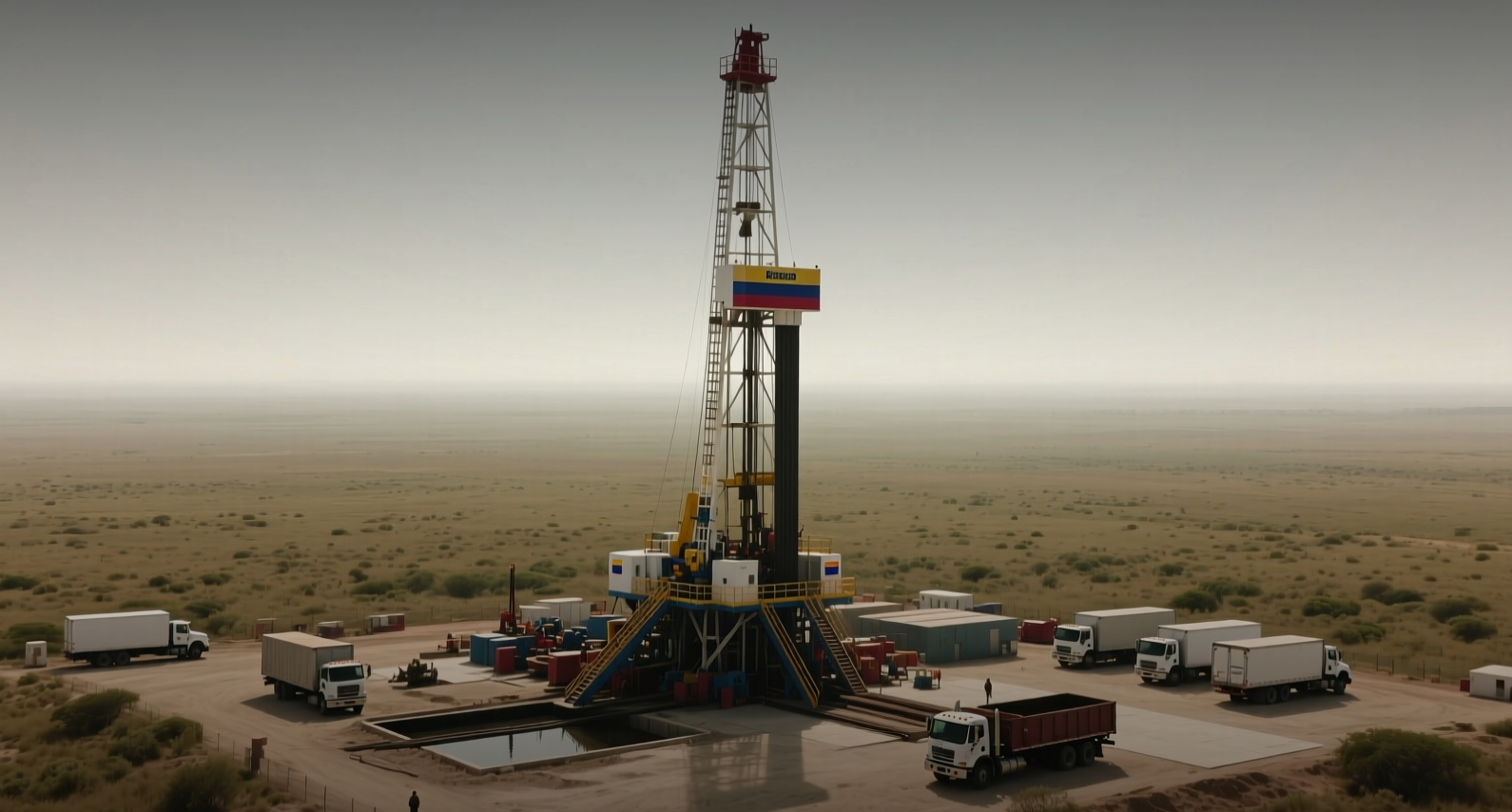
SLB secured access to Venezuela's prized oilfield data and may reactivate up to 15 rigs in a country that previously defaulted on billions owed to the company itself.
SLB has secured access to the reservoir and production data PDVSA needs to revive the world's largest proven crude reserves, and is discussing reactivating up to 15 Venezuelan drilling rigs — a bet that hinges on a debtor that once defaulted on billions owed to the oil-services giant itself.
"We have been working already in-country for the last two years," Olivier Le Peuch, chief executive officer of SLB, told analysts, describing a scaling of capabilities under Chevron's OFAC license ahead of a broader restart.
The contract, reported by Reuters this week, gives SLB access to reservoir and production data that years of neglect and a late-2025 ransomware attack had degraded. Separately, Reuters reported SLB has discussed reactivating up to 15 rigs, with four potentially returning by year-end. SLB closed Wednesday at $53.60, up 41.18 percent year to date.
The narrower question is whether a 97-year presence in-country gives SLB institutional reasons to accept collection risk that a shareholder, seeing only a spreadsheet, would not. Financial terms remain confidential, and PDVSA previously defaulted on billions owed to service companies, including SLB itself.
Why 97 Years in Country Reads Differently Than a Spreadsheet
Le Peuch reminded analysts that at its peak, SLB had more than 3,000 people in Venezuela and generated more than $1 billion there. Latin America produced $1.714 billion of Q2 revenue, up 15 percent year over year. Institutional memory of that scale reasonably shapes how management reads the risk — SLB has walked in and out of Venezuelan cycles before, and it built the current position slowly.
The last time Venezuela's oil sector collapsed into default, service companies carried unpaid receivables for years. The problem for shareholders is that management's memory is not their memory. Payment mechanics remain confidential, with crude payments discussed, as the United States controls Venezuelan oil export revenue. Le Peuch's own hedge was direct: growth depends on "the right condition," reinvestment, and international operators holding their positions. None of that is a payment guarantee.
What This Is Actually Worth to Shareholders
Net debt rose to $8.7 billion from $7.4 billion at year-end 2025, while Q2 free cash flow reached $716 million. Organic revenue still declined 5 percent excluding ChampionX. SLB trades at a forward P/E of 21 times against an analyst target of $61.93. Management still plans to return more than $4 billion to shareholders in 2026.
Venezuela is optionality layered atop the core thesis. Deepwater Brazil and Guyana, the Middle East recovery, and Data Center Solutions matter more to the 2027 story management is actually selling. Shareholders should be comfortable only if they treat the PDVSA work as a call option with a real chance of expiring worthless. Underwriting SLB because Venezuela will pay is a mistake that the company's own default history warns against.
This article is for informational purposes only and does not constitute investment advice.