
Key Takeaways: Semiconductor stocks opened sharply lower Monday, extending last week's selloff as rising bond yields and Nvidia earnings jitters weighed on the sector.
Key Takeaways: Semiconductor stocks opened sharply lower Monday, extending last week's selloff as rising bond yields and Nvidia earnings jitters weighed on the sector.
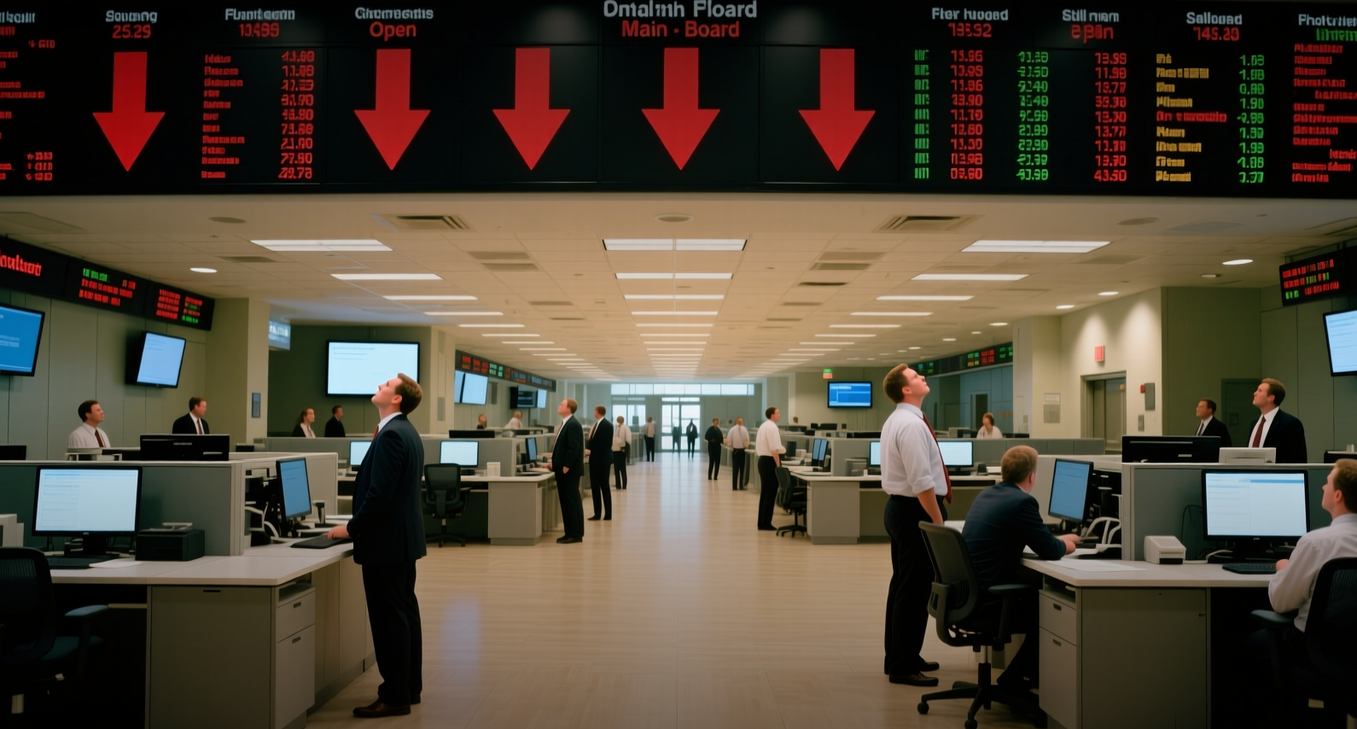
The Philadelphia Semiconductor Index opened down 2.33 percent at 11,467.11 Monday, extending a 5 percent weekly slide as Treasury yields pressured tech valuations.
"All eyes are going to be pointed towards Jackson Hole because there's still not a whole lot of clarity. You see that with the bond market today," said David Wagner, head of equities at Aptus Capital Advisors.
The decline follows a bruising week for equities. The S&P 500 fell 1.4 percent to 7,674.37, while the Nasdaq Composite shed about 2 percent to 26,180.45. The 30-year Treasury yield touched its highest level since 2007, and the 10-year yield stood at 4.713 percent, raising borrowing costs for the capital-intensive AI infrastructure buildout. The Philadelphia chip index had already dropped about 5 percent for the week through Friday, and the VIX closed Friday at 15.13.
The selloff sets up a critical stretch. Nvidia, whose chips underpin much of the AI infrastructure buildout, reports fiscal second-quarter results Wednesday, and Fed Chair Kevin Warsh delivers his first Jackson Hole keynote Friday. Markets are pricing a 35 percent chance of a September rate hike, rising to 66 percent by December.
Nvidia has been the S&P 500's biggest contributor to earnings growth in seven of the past 11 quarters, according to Seaport Research data. Its results will serve as a bellwether for the AI industry, which has faced concerns about excessive spending on data-center buildout. The company recently partnered with six major financial institutions on financing platforms targeting more than $500 billion for AI infrastructure.
"The market is so reliant on the AI trade today, and Nvidia is obviously the big boy in the room," said Erik Kratz, chief investment officer at Arena Private Wealth. "It's got implications across everything."
The stakes are unusually high because Nvidia's earnings have become a proxy for the broader AI trade spanning chip makers, cloud providers, and the financial institutions financing data center expansion. A miss could trigger a broader tech selloff, while a beat could restore confidence in the AI trade that has driven much of this year's equity gains.
The Fed chair has stepped back from traditional forward guidance, and investors see the symposium as another opportunity for him to articulate his longer-term policy framework. He rattled markets after the July meeting provided few hints about how policymakers might respond if inflation remains stubbornly elevated.
The policy backdrop is further complicated by the Treasury Department's surprise expansion of its bond buyback program, which pushed down long-dated yields before they rebounded Thursday. "We have the Fed and the Treasury basically working in sort of opposite directions," said Wil Stith, senior bond portfolio manager at Wilmington Trust.
Trade tensions add another layer. New 50 percent U.S. tariffs on about $20 billion in Canadian goods took effect Saturday, and Canada plans dollar-for-dollar retaliation starting Sept. 8. Crude oil settled Friday at $87.06 a barrel, up about 5 percent on the week, as the Strait of Hormuz stalemate continued.
Gold rose 5 percent last week to $4,696.60, and Bitcoin traded above $77,000, up more than 20 percent over five days, as investors sought alternatives to government debt.
This article is for informational purposes only and does not constitute investment advice.
