


Corning shares surged past $165 after Verizon committed to a multi-billion dollar, six-year fiber optic supply agreement, giving the optical components maker multi-year revenue visibility tied to AI data center buildouts.
Corning shares surged past $165 after Verizon committed to a multi-billion dollar, six-year fiber optic supply agreement, giving the optical components maker multi-year revenue visibility tied to AI data center buildouts.
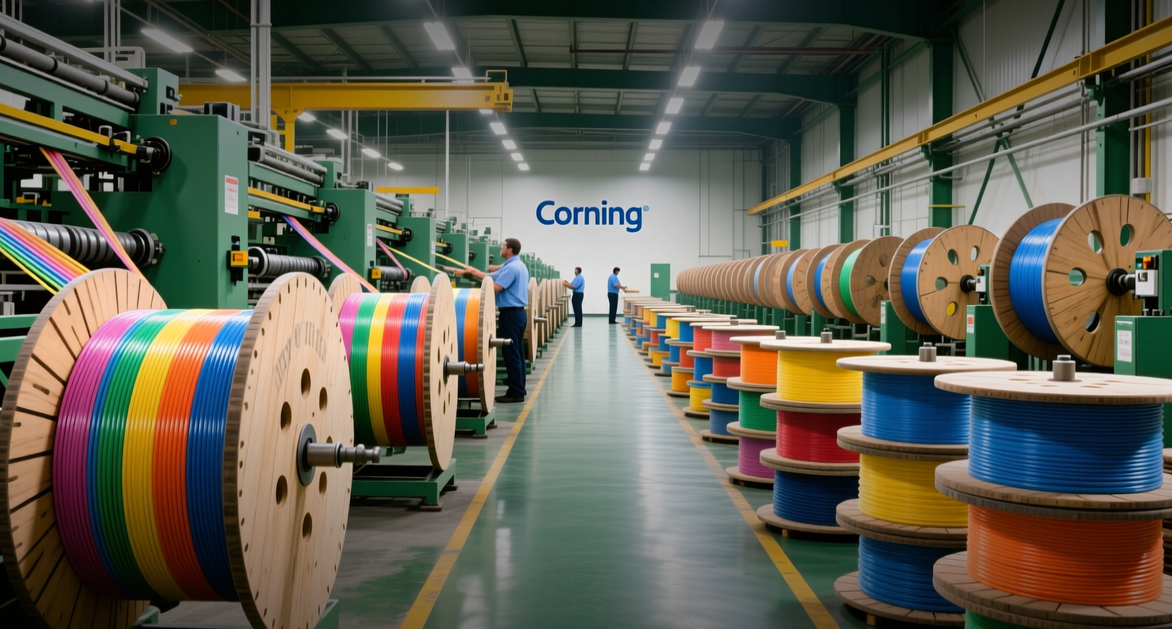
Corning shares jumped more than 7.5 percent to $165.88, their highest intraday level since Aug. 17, after Verizon signed a multi-billion dollar agreement to buy more than 80 million miles of high-density optical fiber and connectivity solutions from 2027 through 2032.
"Securing this volume of fiber allows us to continue building the network of the future at an unprecedented scale," Kyle Malady, CEO of Verizon Business, said. "We are deploying a single, converged architecture that unites mobile connectivity and broadband into one seamless experience for millions of families and businesses, while simultaneously building the high-capacity, low-latency backbone AI hyperscalers demand."
The supply agreement supports Verizon's push toward 40 million to 50 million broadband passings, expanding fiber-to-the-home and local business connectivity across U.S. communities. The same multi-use fiber foundation will carry AI traffic between data centers through Verizon's AI Connect strategy, which deploys ultra-dense cables across major long-haul corridors to directly connect data center facilities. The deal extends a roughly 30-year commercial relationship between the two companies and gives Corning's Optical Communications segment a defined multi-year revenue stream.
Corning will expand its U.S. manufacturing footprint to meet the supply requirements, deploying products including its Contour Flow Cable, which packs more optical fiber into existing conduit pathways and maximizes the value of Verizon's infrastructure investments. The agreement comes as hyperscalers including Amazon Web Services pour capital into AI infrastructure, driving demand for high-capacity, low-latency connectivity between data centers.
Converged Architecture Reshapes Fiber Demand
The Verizon deal reflects a structural shift in telecom infrastructure spending: the same fiber networks serving residential broadband are increasingly carrying AI traffic between data centers. Verizon's approach connects cell towers, enterprise data centers, and residential neighborhoods to the same high-capacity backbone, collapsing what were previously separate network builds into one converged grid. For customers, this means continuous connectivity whether at home or on the move, with the same infrastructure supporting consumer broadband, mobile backhaul, and AI data center interconnectivity.
For Corning, the contract provides a revenue anchor for its Optical Communications business, a key growth driver as telecom operators and cloud providers expand network capacity. Scaling U.S. manufacturing for the Verizon deal also positions Corning to serve other carriers pursuing similar converged architectures, potentially opening additional long-term supply opportunities.
Mike O'Day, senior vice president and general manager of Corning Optical Communications, said the partnership shows that generative AI and broadband expansion are part of the same opportunity. "Corning is proud to build on our 175-year legacy of supporting our customers' growth with breakthrough innovations that we manufacture at scale here in the United States," he said.
Revenue Visibility Through 2032
The agreement gives Corning investors a defined earnings trajectory through the end of the decade, with the deal structured to enable Corning to scale production capacity ahead of the 2027 delivery start date. The contract also signals that fiber optic suppliers stand to benefit from the convergence of consumer broadband expansion and AI data center interconnectivity — two demand streams previously viewed as separate markets.
For the broader fiber optic supply chain, the deal suggests sustained demand for high-density cable products as carriers upgrade networks to handle both consumer traffic and AI workloads. Corning shares, which had traded at their highest level since Aug. 17, now carry a revenue window from the Verizon contract running from 2027 through 2032. The deal's multi-billion dollar scale reflects the magnitude of infrastructure investment required to support the AI era, with fiber as the physical foundation connecting data centers, businesses, and homes.
This article is for informational purposes only and does not constitute investment advice.
