
Beijing's late-2023 mandate that worship venues adopt Xi Jinping Thought highlights a widening cultural chasm with Taiwan, where Buddhist and Taoist temples have flourished freely for seven decades.
Beijing's late-2023 mandate that worship venues adopt Xi Jinping Thought highlights a widening cultural chasm with Taiwan, where Buddhist and Taoist temples have flourished freely for seven decades.
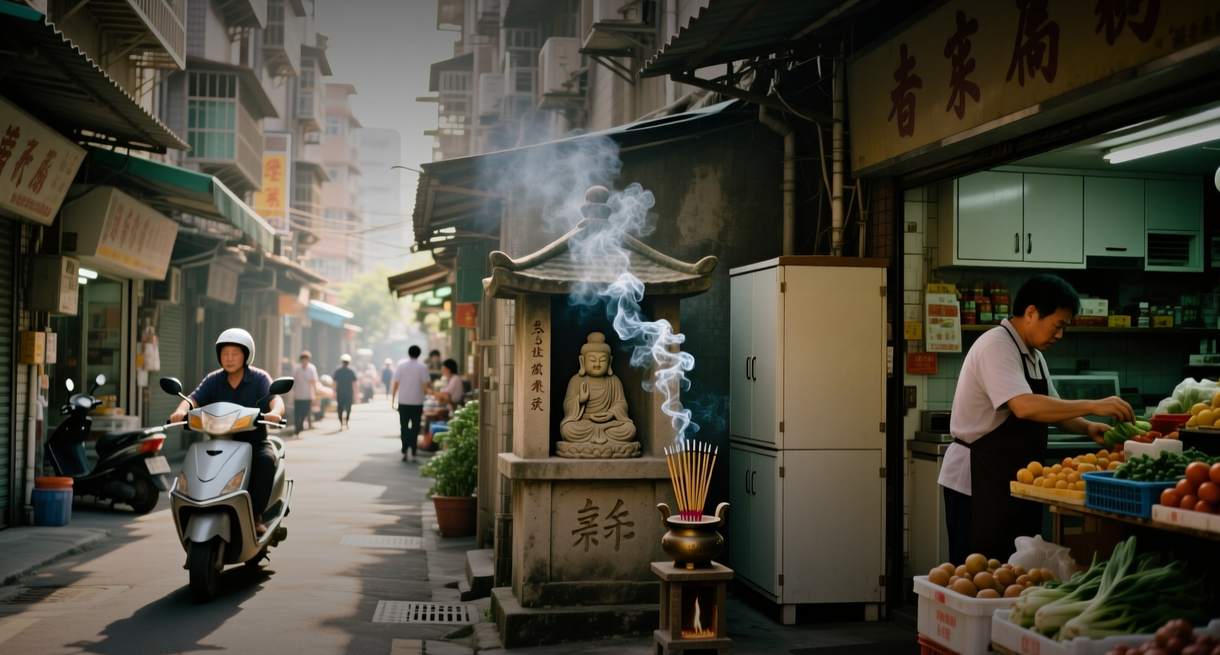
Beijing's late-2023 mandate that every place of worship implement Xi Jinping Thought marks the latest escalation of state control over religious life, a policy with no counterpart in Taiwan, where Buddhist and Taoist temples operate without government interference.
"Very good. Believe whatever you want. Christianity, Buddhism, Taoism. Any of them are fine," an octogenarian Buddhist practitioner from Keelung told Lingling Wei, chief China correspondent at The Wall Street Journal, during a visit to Taipei's Longshan Temple. "You just need a reverent heart."
The contrast is measurable. Freedom House's latest assessment scores China's religious freedom at zero out of four, describing a party-state apparatus that vets religious leaders for political reliability, limits the number of priests and imams, and installs security cameras inside places of worship. A 2023 law regulating religious venues requires groups to maintain files on staff activities, including contact with foreign entities. In February 2024, Beijing imposed additional rules in Xinjiang requiring religious structures to "reflect Chinese characteristics and style" and allowing party cadres to monitor for unauthorized activity.
The tightening traces a long arc. Under Mao Zedong, who founded the People's Republic in 1949, faith was classified as feudal superstition, temples were shuttered, and monks were sent to labor camps. Even after reforms reopened churches and temples in the 1980s, religion remained something the state permits and can always revoke. The late-2023 rules go further: places of worship must implement Xi Jinping Thought, some churches now use facial-recognition cameras to monitor congregations, and pastors are required to weave socialist doctrine into sermons. Portraits of Xi have gone up where crosses and images of Christ once hung.
Taiwan's religious environment could hardly be more different. The island's temples are woven into daily life — Buddhist, Taoist, and sometimes both — wedged between shops and apartment blocks, with incense smoke wafting into busy intersections. At Xingtian Temple, a Taoist shrine in north-central Taipei, volunteers manage religious-education classes with the efficiency of a well-run civic organization. Neighborhood earth god shrines, some no bigger than a kitchen cabinet, dot residential lanes. The same gods, the same rituals, and the same folk traditions exist on both sides of the strait, but seven decades of separation have produced populations with different inner lives.
The divergence carries no direct financial market transmission. No listed company, tradable asset, or macro indicator moves on religious regulation. But the structural gap matters for investors tracking cross-strait risk. Taiwan's religious freedom is one dimension of a broader social and political divergence that has widened since Beijing intensified ideological conformity under Xi. The mainland's overall Freedom in the World score stands at 9 out of 100, classified as "not free," with the party-state controlling media, civil society, universities, and religious practice.
The trajectory points to continued tightening. China's regulatory push on religion parallels broader efforts to enforce ideological conformity across all social institutions, from universities to businesses. The 2024 Xinjiang regulations explicitly reference "Sinicization," a policy by which authorities restrict religious freedom and directly influence the conduct of religious groups. As Beijing deepens its control over faith, the cultural distance between mainland China and Taiwan is likely to grow even as economic and political tensions fluctuate.
For investors, the implication is indirect but real: the social divergence between the two sides of the Taiwan Strait is a structural backdrop that shapes risk perceptions, even if it does not trigger specific market moves. The gap in religious freedom is one measurable indicator of how far the two societies have drifted since 1949 — and how difficult reunification would be to manage even if political obstacles were resolved.
This article is for informational purposes only and does not constitute investment advice.
