Nine months after Boeing folded Spirit AeroSystems back into its operations, the $8.4 billion deal is carrying roughly $1.9 billion more in liabilities than the value of the assets it brought in, according to an analysis of the manufacturer's SEC filings by The Wall Street Journal. The gap emerged as Boeing works to accelerate 737 MAX and 787 output, adding unexpected financial strain to its commercial aircraft division.
"Higher-than-expected costs associated with Spirit were among the factors behind the outlook," said Jay Malave, chief financial officer at Boeing, referring to the company's March guidance that pushed commercial aircraft profitability to 2027, a year later than previously anticipated.
The accounting burden is concentrated in several areas. Boeing provisionally assigned $10.28 billion in goodwill to the Spirit acquisition, up from an initial estimate near $10 billion. Accrued liabilities tied to Spirit rose from $1.78 billion in December to $2.20 billion by the end of June, including $1.52 billion attributed to "off-market customer contracts" — agreements whose terms are less favorable than current market conditions would command. The acquisition accounting period can extend up to one year after closing, meaning further adjustments remain possible.
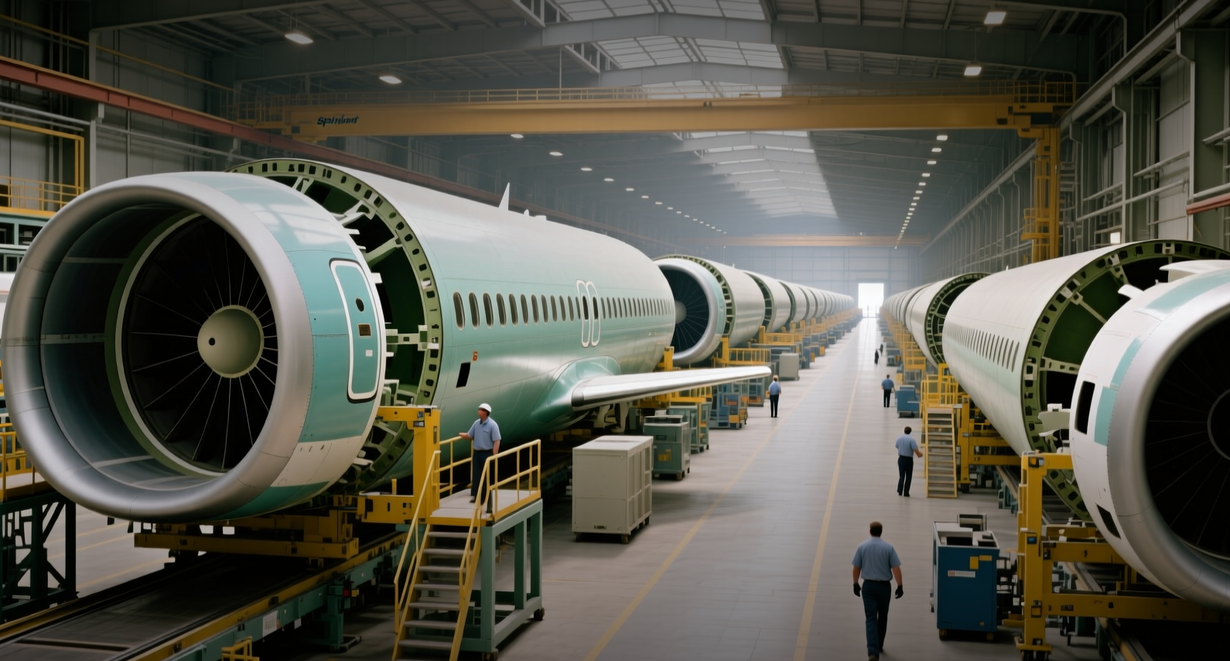
The financial fallout reaches directly into Boeing's aircraft programs because Spirit was deeply embedded in their supply chains. Its Wichita, Kansas, operation builds the 737 fuselage, making the former supplier essential to Boeing's MAX production ramp. Spirit also supplied major structures for the 787 Dreamliner. Before the acquisition, Spirit had repeatedly recorded forward losses on aircraft programs when estimated production costs exceeded expected contract revenue — $585 million in additional forward losses in the third quarter of 2025 alone, primarily involving the 737, 787, Airbus A220 and A350 programs.
Boeing's commercial aircraft division lost $632 million in 2025, after losing more than $2 billion the prior year. The company had sold its Wichita structures operation in 2005, creating the business that became Spirit AeroSystems. The decision to reverse that move came after the January 2024 Alaska Airlines 737 MAX 9 door-plug incident, when a panel separated from an aircraft that had left Boeing's factory without four required retaining bolts.
The timing compounds the challenge. Boeing needs substantially more aircraft moving through its factories to generate cash and reduce debt, but some of the work brought in-house operates under contracts Spirit had already flagged as economically unfavorable. Increasing production can therefore expand the volume of work performed under those conditions before efficiency improvements take effect. Higher volumes can also spread fixed costs across more units, and Boeing can now reorganize manufacturing and quality inspections without the commercial boundary that previously separated it from Spirit.
The 737 is particularly exposed because every increase in final assembly requires a corresponding increase in fuselage production at Wichita. Boeing is working toward higher MAX rates and has prepared an additional assembly line at its Everett, Washington, facility. The 787 presents a separate challenge: Spirit recorded $167 million in additional forward losses on the Dreamliner program in the fourth quarter of 2024 alone, while Boeing simultaneously increases 787 output at its North Charleston, South Carolina, plant.
The newly identified liabilities do not mean airlines should expect higher prices on the 737 MAX or 787. Thousands of aircraft in Boeing's backlog were sold under contracts negotiated years ago with pricing and escalation mechanisms already locked in. Unexpected manufacturing costs primarily reduce the margin Boeing earns from delivering those aircraft. The $1.52 billion valuation on off-market contracts does, however, show how unfavorable some inherited commercial arrangements have become relative to present market conditions, potentially giving Boeing incentive to exercise greater pricing discipline on future orders.
Both Boeing and Airbus hold extensive backlogs, with delivery positions for many models scarce for years, giving manufacturers some leverage in new negotiations. But the immediate question for Boeing is whether it can extract costs from the former Spirit operations without disrupting the production increases that motivated the acquisition in the first place.
This article is for informational purposes only and does not constitute investment advice.