

A miner's decision to quit crypto mining for a $1.2 billion AI hosting contract, expandable past $3 billion, crystallizes the sector's broader shift to data-center revenue as hashprice sits near record lows.
A miner's decision to quit crypto mining for a $1.2 billion AI hosting contract, expandable past $3 billion, crystallizes the sector's broader shift to data-center revenue as hashprice sits near record lows.
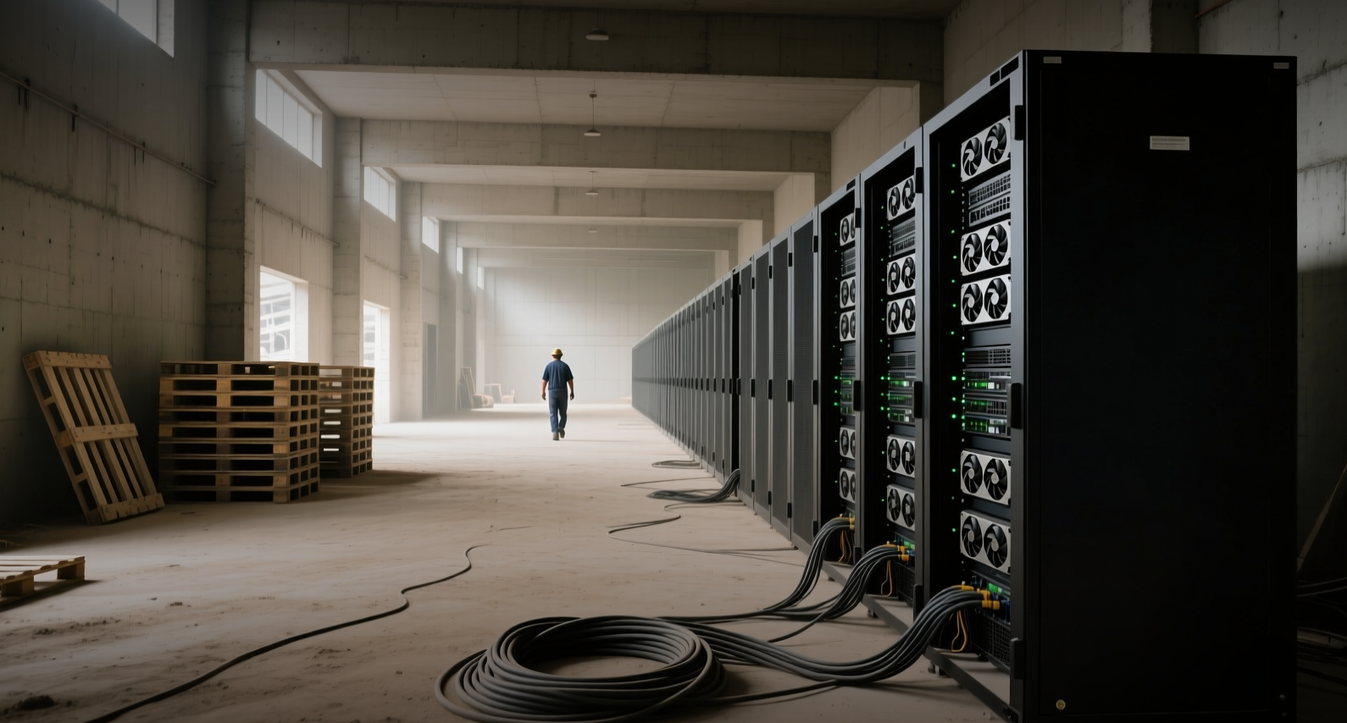
A Bitcoin miner abandoned its mining site to host AI under a $1.2 billion contract, the latest sign of the sector's pivot to data centers.
"The current situation is more accurately interpreted as a bifurcation phase among mining companies based on power rates and equipment efficiency, rather than a uniform industry-wide downturn," BitPlanet Research Lab said in a report published Sept. 2.
The miner's projected revenue requires two contract extensions, while an option for additional computing capacity could bring the total above $3 billion. Hashprice — the expected daily mining revenue per petahash of computing power — posted its three lowest monthly averages on record this year, with June's $30.37 the all-time low, roughly 20 percent below last year's monthly floor of $37.89, BitPlanet data show.
The economics explain the shift. At a $30 hashprice, legacy machines with 25-38 J/TH efficiency break even only at power rates near 3.9 cents per kilowatt-hour, while the newest rigs below 14 J/TH stay profitable up to 10.1 cents, BitPlanet calculated. Miners holding AI and high-performance computing contracts traded at 12.3 times forward sales in the fourth quarter, more than double the 5.9 times multiple of pure-play miners, according to CoinShares.
The deal is the latest in a wave of repurposing. CleanSpark entered a 20-year data center lease valued at $6.6 billion for its Georgia facilities, while MARA sold 2,213 of the 2,422 Bitcoin it mined in the second quarter as revenue fell 27 percent year over year to $174.9 million. IREN, TeraWulf and Riot Platforms have all announced similar compute-hosting plans.
Cumulative announced AI and HPC contract value among listed miners has surpassed $70 billion through the first quarter, CoinShares tallied. That figure is not realized revenue — most contracts assume new data center construction, and the share actually generating income has not been disclosed. CoinShares cautioned that elevated valuations will only be justified if contract execution follows.
The capital burden is steep. Mining infrastructure costs $700,000 to $1 million per megawatt, versus $8 million to $15 million per megawatt for AI facilities, CoinShares estimated. None of the pivoting miners generates positive free cash flow, with buildouts financed through GPU-backed debt, customer prepayments and equity, according to Seeking Alpha analysis. The demand pull is real: Nvidia's data-center revenue reached $89 billion in its latest quarter, up 106 percent year over year, though Wall Street forecasts for AI electricity demand run well ahead of the International Energy Agency's more conservative projections.
Hashprice climbed 20.4 percent over four days from $31.80 on Aug. 18 to $38.29 on Aug. 22, reaching $39.36 by Aug. 31, Hashrate Index data show. The 30-day average of $34.63 still sits below last year's floor of $37.89, and BitPlanet said sustained levels above that threshold for more than two months would be needed to signal a durable recovery. The forward market implied a six-month average hashprice of $37.59 as of Aug. 31, up from $30.67 before the rebound but still shy of last year's floor.
For investors, the divergence in valuations rewards miners that convert capacity to AI hosting while punishing those that keep mining at a loss. The risk is that announced contracts outpace actual buildout — a gap that will show up in whether energized capacity converts into signed leases over the coming quarters.
This article is for informational purposes only and does not constitute investment advice.
