Key Takeaways: CCSH Corporation, parent of China's top NAND flash maker YMTC, filed for a 33 billion yuan Shanghai IPO that would rank among the STAR Market's largest ever.
Key Takeaways: CCSH Corporation, parent of China's top NAND flash maker YMTC, filed for a 33 billion yuan Shanghai IPO that would rank among the STAR Market's largest ever.
CCSH Corporation, parent of China's top NAND flash maker YMTC, filed for a 33 billion yuan Shanghai IPO that would rank among the STAR Market's largest ever.
CCSH, parent of China's top NAND flash maker YMTC, filed for a 33 billion yuan Shanghai IPO, betting the AI memory supercycle that pushed its net margin above 70 percent will outlast the next downturn.
"The next two years represent a window of opportunity for China's memory industry, with clear volume and price advantages — not just for market share expansion but also for product mix upgrading and customer loyalty enhancement," Zhang Lin, deputy dean of Fareast Credit Rating's research institute, said.
The Shanghai Stock Exchange accepted CCSH's application on Aug 21, with CITIC Securities and CSC Financial as joint sponsors. The prospectus shows first-quarter revenue of 47.04 billion yuan and net profit of 33.38 billion yuan — more than double the 14.21 billion yuan earned in all of 2025. NAND factories ran at 98.02 percent capacity, average selling prices rose 172.72 percent from the 2025 average, and gross margin widened to 76.8 percent from 35.3 percent.
CCSH plans to issue 1.98 billion to 2.43 billion new shares, implying a post-listing valuation of roughly 275 billion to 330 billion yuan ($41 billion to $49 billion). Proceeds of 20.8 billion yuan will upgrade production lines and 12.2 billion yuan fund next-generation NAND research. The deal would rank as the STAR Market's third-largest IPO, after DRAM maker CXMT's 66.6 billion yuan float last month and foundry SMIC.
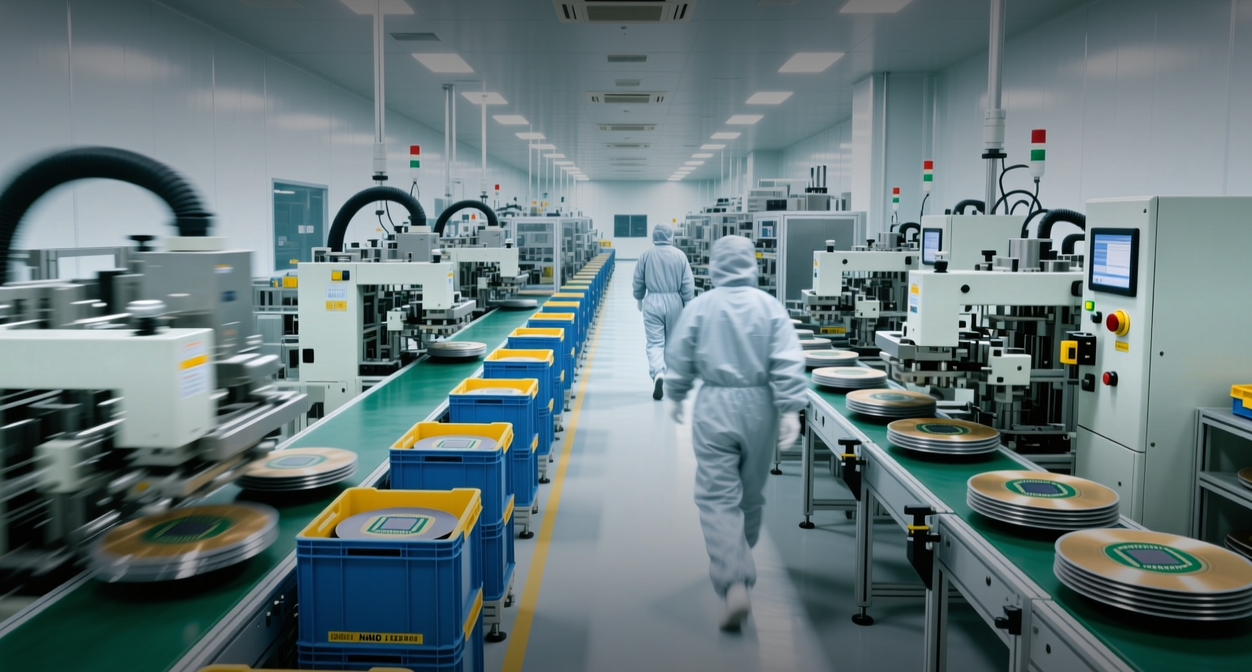
YMTC, which accounts for more than 90 percent of CCSH's revenue, makes NAND flash chips that store data in smartphones, solid-state drives, and data-center servers. The company ranked third globally and first in China by NAND shipments and sales in the first quarter, according to TrendForce, behind Samsung Electronics' 25 percent and SK Hynix's 22 percent share. Counterpoint Research put YMTC at 14 percent of global NAND shipments in the second quarter, ahead of Kioxia, Micron, and SanDisk.
The surge reflects demand from cloud providers building AI data centers, which need fast storage for training data, model updates, and backups. YMTC has begun mass production of 267-layer 3D NAND chips on its proprietary Xtacking 4.0 architecture and is developing products beyond 300 layers, according to Counterpoint. The company holds 5,611 granted invention patents as of March 31.
The prospectus flags three risks that could undo the windfall. First, capital intensity: cumulative research spending reached 159.53 billion yuan and long-term asset purchases 963.90 billion yuan, while depreciation and amortization totaled 509.49 billion yuan — a fixed cost that amplifies losses when prices fall. Second, cyclicality: TrendForce expects NAND supply to loosen by the second half of 2027 as new capacity comes online, though it added that a breakthrough in AI agents could sustain high-speed SSD demand. Third, geopolitics: YMTC sits on the U.S. Entity List and the Pentagon's Section 1260H list, limiting access to U.S.-origin equipment and complicating overseas expansion.
Customer concentration adds another constraint. The top five customers accounted for 55.73 percent, 64.62 percent, 51.65 percent, and 54.34 percent of revenue across the reporting periods, and the company's enterprise-grade products still trail overseas rivals in high-margin markets. CCSH also carries 34.04 billion yuan in cumulative unrecovered losses, which must be cleared before it can pay dividends.
CCSH has no controlling shareholder — Hubei Changsheng holds 26.54 percent and Xinfei Technology 25.35 percent, with Big Fund I and II, Optics Valley, and Guoxin Fund holding smaller stakes — a structure that spreads decision-making but could slow capital allocation. The company is also fighting an ongoing patent dispute with Micron. For investors, the question is whether YMTC can convert this quarter's windfall into durable capacity before the memory cycle turns; the 76.8 percent gross margin is unlikely to persist once Samsung, SK Hynix, and Micron redirect capacity back to NAND.
This article is for informational purposes only and does not constitute investment advice.
