

Uber launched autonomous rides in London using Wayve's AI Driver, making the British capital the second European city after Zagreb to offer robotaxi service.
Uber launched autonomous rides in London using Wayve's AI Driver, making the British capital the second European city after Zagreb to offer robotaxi service.
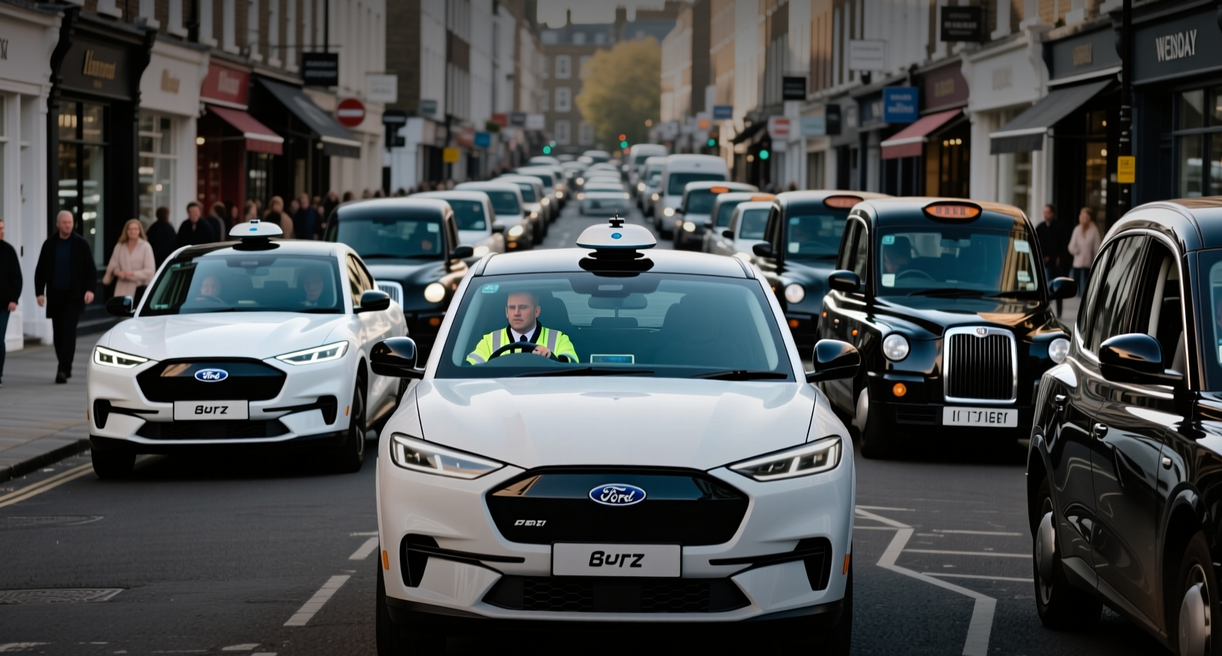
Uber began offering autonomous rides in London on Thursday using AI technology from British firm Wayve, making the capital the second European city after Zagreb where the ride-hailing giant operates robotaxis.
"Autonomous driving technology will complement the city's rich transport network, and we're excited for Londoners to experience it first as we begin our global rollout with Uber," Alex Kendall, CEO and co-founder of Wayve, said.
Fewer than 20 all-electric Ford Mustang Mach-E vehicles are available at launch, each outfitted with cameras and radar that give Wayve's AI Driver 360-degree visibility. A safety operator will remain in the driver's seat during the initial phase, with fully driverless operations planned for a later stage. Riders requesting UberX, Uber Comfort or Uber Electric trips can be matched with an autonomous vehicle at no additional cost, and can opt in through the app's ride preferences to increase their chances of receiving one.
The launch positions Uber to compete directly with Waymo, which aims to debut its own robotaxi service in London this year pending regulatory approval. Uber already operates autonomous fleets in Dallas, Las Vegas, Atlanta and Austin, with expansion planned for Los Angeles and the Bay Area. Wayve and Uber also plan to bring self-driving Nissan Leaf vehicles to Tokyo later this year.
Wayve's AI-first approach vs. map-dependent rivals
Wayve's technology differs fundamentally from competitors such as Waymo, which rely on high-definition maps and hand-coded rules for perception and navigation. Wayve says its foundational AI models learn from real-world driving experience and can apply those skills to unexpected scenarios without prior training exposure. The company claims this allows the AI Driver to adapt to new roads, vehicles, weather conditions and cities more quickly than map-based systems.
Founded in 2017, Wayve began operating on London's public roads in 2020 — around the time Uber abandoned its own self-driving ambitions and opted instead to partner with established players. Uber and Wayve announced their collaboration in 2024, including an investment from Uber, with plans to deploy Wayve-powered vehicles across multiple markets.
London presents particular challenges for autonomous driving. The city's narrow one-way streets, assertive pedestrians and dense traffic patterns test even the most sophisticated AI systems. The launch also arrives as London's black-cab industry, which has already weathered the arrival of ride-hailing apps, faces another potential shift in urban transport.
London's regulatory path to full driverless operations
Uber received its license to operate autonomous vehicles in London last month, and the current permit mandates that a human driver remain present in a supervisory capacity. Transport for London, the city's authorisation body, has faced delays in processing full driverless approvals, meaning fully autonomous operations could take time to materialise.
Wayve will manage the fleet initially, while Otto Car, a private car rental provider, oversees the trained onboard safety drivers. Uber will eventually take over day-to-day fleet operations alongside Otto Car. The companies will run a depot in London for vehicle maintenance, servicing and charging, with additional charging stops throughout the operating area to maximize vehicle uptime.
Uber's Global Head of Autonomous Mobility, Sarfraz Maredia, said the launch would "build credibility with consumers as well as with the government." British Transport Secretary Heidi Alexander called it "a major milestone for the future of transport in London."
The robotaxi rollout comes as Uber announced layoffs of roughly 10 percent of its staff on Wednesday, eliminating several management roles as part of a restructuring. CEO Dara Khosrowshahi said the company plans to invest more heavily in ride-hailing, delivery and robotaxi operations.
For investors, the London launch marks a concrete step in Uber's autonomous vehicle strategy, which has shifted from building self-driving technology in-house to partnering with multiple AV developers including Wayve, Waymo, Zoox, Nuro and Avride. Uber's approach spreads technological risk across several platforms while allowing it to deploy AVs in whichever cities each partner can navigate most effectively. Wayve's expansion from London to Tokyo within the same year suggests the AI-first approach may scale faster than map-dependent systems, though the company has yet to demonstrate fully driverless operations in a major city.
This article is for informational purposes only and does not constitute investment advice.
