
SpaceX's plan to deploy up to 1 million AI data center satellites in orbit could bypass the power and cooling constraints strangling terrestrial infrastructure.
SpaceX's plan to deploy up to 1 million AI data center satellites in orbit could bypass the power and cooling constraints strangling terrestrial infrastructure.
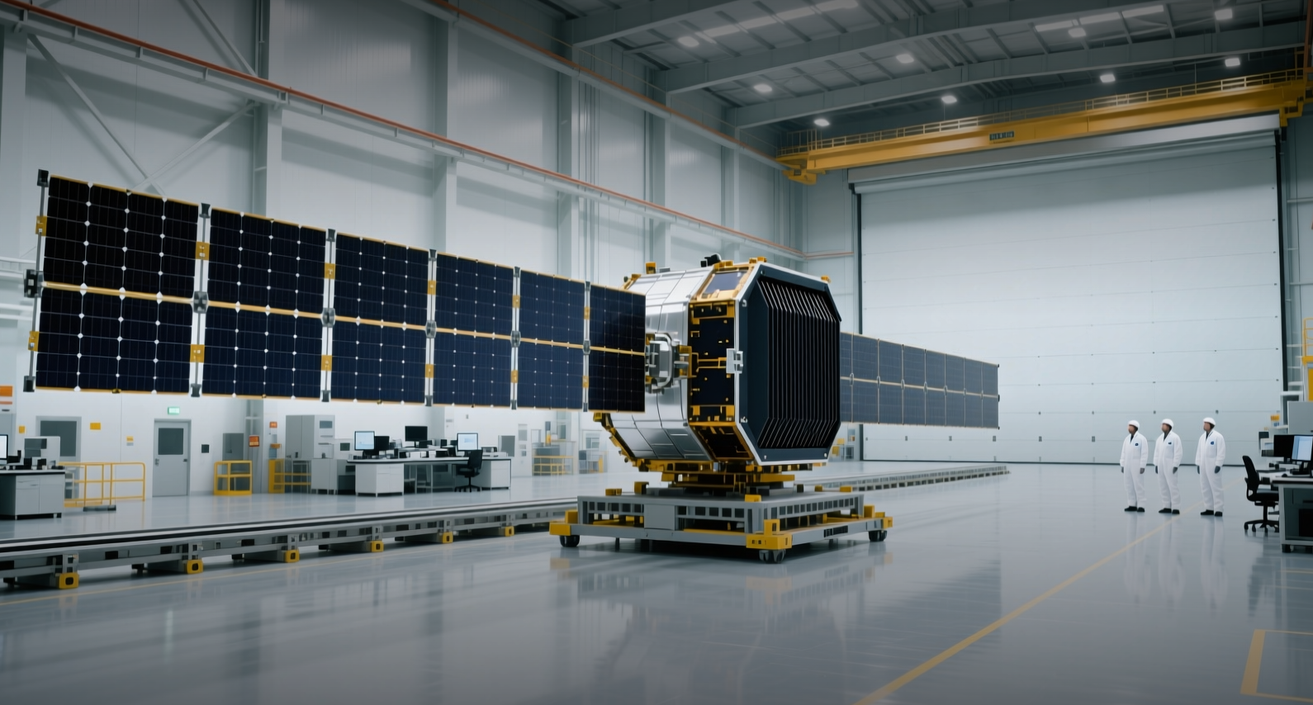
SpaceX's plan to deploy up to 1 million orbital AI data center satellites, each packing 250 kilowatts of Nvidia-powered compute, could bypass the power and cooling limits constraining terrestrial data centers.
"The Starmind satellites are essentially an optimized Vera Rubin NVL72," Elon Musk, chief executive officer of SpaceX, said during the company's Aug. 4 earnings call. The first-generation AI1 satellite carries Nvidia's Rubin GPU and Vera CPU, with 75-meter solar panels and 30-meter deployable radiators delivering 175 kilowatts average and 250 kilowatts peak computing power.
The design was enlarged from June's initial spec of 120/150 kilowatts on a GB300 rack as processor selection crystallized. Satellites will operate in 600-800 kilometer sun-synchronous orbits, connected to ground stations via Starlink optical links. SpaceX filed its FCC application Jan. 30 and positioned Starmind as an "AI compute" business at its June IPO.
SpaceX's AI-related capital expenditure reached $15.8 billion in Q2 2026, while AI segment revenue was only $2.56 billion, suggesting investment recovery will take time. The company targets mass launches beginning in 2027 via Starship, but FCC authorization for the full 1 million satellites remains uncertain, with Amazon among operators filing negative comments.
Nvidia's exposure to orbital computing goes beyond its SpaceX partnership. The chipmaker holds nearly 123 million Class A SpaceX shares worth about $21 billion as of June 30, following an earlier investment in xAI. Nvidia also backs Starcloud, which raised $250 million in a Series A extension led by Manhattan West, doubling its valuation to $2.3 billion. Starcloud's first satellite, launched by SpaceX in November, was the first to run Nvidia's H100 GPU in low Earth orbit. The company plans a 200-kilowatt-class Starcloud-3 spacecraft as part of filings for up to 88,000 satellites.
Nvidia's Space-1 Vera Rubin Module, unveiled in March, delivers up to 25 times more AI compute than the H100, making it the compute platform of choice for orbital data center startups. Cowboy Space raised $275 million at a $2 billion valuation to develop rockets with orbital compute upper stages. Cisco also joined Starcloud's funding round. The race is intensifying as terrestrial data center power constraints push hyperscalers and startups to look skyward.
The scale of Starmind raises orbital safety questions. A July paper on the preprint server arXiv by University of Birmingham researcher Hugh G. Lewis modeled collision probabilities for 16 large satellite constellations and identified Starmind, along with Blue Origin's Project Sunrise and China's Guowang constellation, as exceeding the threshold for uncontrolled debris proliferation — the so-called Kessler Syndrome. SpaceX's collision avoidance expertise from operating roughly 11,000 Starlink satellites may mitigate some risk, and Starmind satellites are designed for safe atmospheric re-entry at end of mission.
The broader context: the International Energy Agency estimates global data center power consumption will exceed 1,000 terawatt-hours in 2026, comparable to Japan's entire electricity use. Orbital computing sidesteps terrestrial power and cooling constraints by generating solar power in space and dissipating heat through vacuum radiation. But the economics remain unproven — SpaceX's AI segment revenue of $2.56 billion against $15.8 billion in quarterly AI capital expenditure shows the gap between ambition and returns.
For investors, the Starmind plan extends Nvidia's AI chip market into a new frontier, potentially supporting its valuation as terrestrial data center growth faces power bottlenecks. SpaceX's proprietary data advantage — 25 years of rocket, satellite, and factory records feeding Grok 5 training — creates a moat that OpenAI and Anthropic cannot replicate. Test satellite launches are expected before the 2027 mass production target, with in-orbit liquid cooling and radiator deployment demonstrations as key milestones.
This article is for informational purposes only and does not constitute investment advice.
