
Kioxia's CM10 Series marks the industry's first PCIe 6.0 enterprise SSD deployment, delivering up to 92% faster sequential reads than its predecessor for AI inference workloads.
Kioxia's CM10 Series marks the industry's first PCIe 6.0 enterprise SSD deployment, delivering up to 92% faster sequential reads than its predecessor for AI inference workloads.
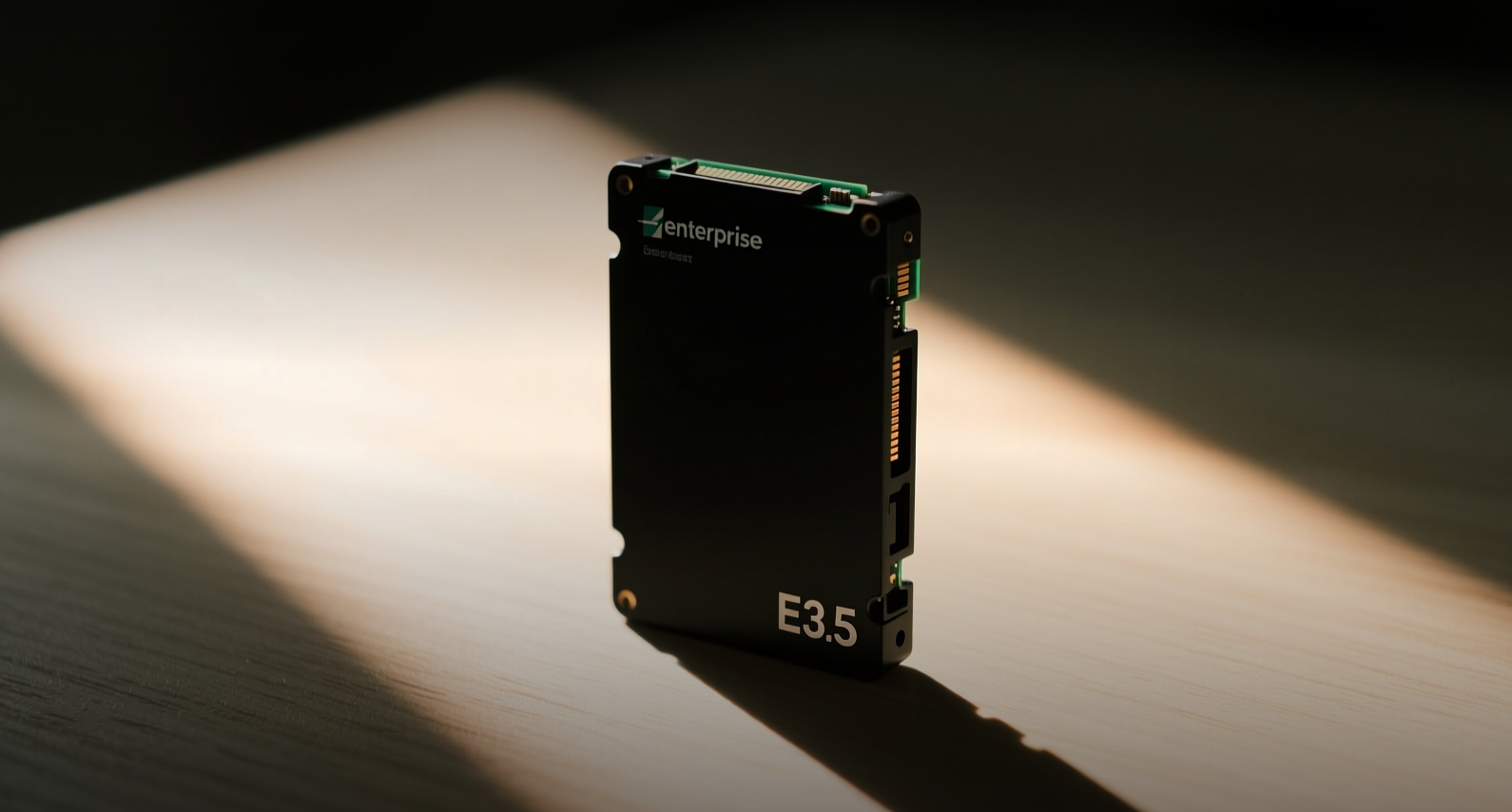
Kioxia's CM10 Series marks the industry's first PCIe 6.0 enterprise SSD deployment, delivering up to 92% faster sequential reads than its predecessor for AI inference workloads.
Kioxia Corp.'s first PCIe 6.0 enterprise solid-state drive delivers up to 92% higher sequential read performance and 85% higher random reads versus the prior generation, targeting the surging demand for context cache storage in AI models scaling toward trillions of parameters.
"As AI models continue to scale toward trillions of parameters and context windows expand to millions of tokens, the demand for high-performance context cache storage is growing rapidly," Kioxia said in its announcement. The drives support the NVIDIA CMX architecture, which extends the memory hierarchy beyond GPU memory by using flash storage as a cache layer for large language model inference.
The CM10 Series uses Kioxia's BiCS Flash generation 10 (332-layer) TLC memory and is available in capacities from 1.60 TB to 61.44 TB across E3.S, E1.S, and 2.5-inch form factors. The E3.S and E1.S 9.5mm variants include direct-cold-plate liquid cooling capability, while all form factors support traditional air-cooled environments. Endurance options include 1 drive write per day for read-intensive workloads and 3 DWPD for mixed-use applications. The drives comply with NVMe 2.1 and the Open Compute Project Datacenter NVMe SSD Specification v2.7, including support for Flexible Data Placement.
Security features include self-encrypting drive options, FIPS 140-3 certification planned for a later date, post-quantum cryptography aligned with CNSA 2.0 recommendations, and SPDM 1.4 attestation support. The 2.5-inch variant uses PCIe 5.0 with BiCS Flash generation 8 TLC, reflecting a transitional approach for data centers not yet ready for the new interface standard. The drives are currently sampling to select customers and will be showcased at the Future of Memory and Storage conference in Santa Clara, Calif., from Aug. 4-6.
The launch positions Kioxia against Samsung, Solidigm, and Micron in the enterprise SSD market, where PCIe 6.0 doubles the bandwidth of PCIe 5.0 to 256 GB/s in each direction across 16 lanes. For AI data centers running inference workloads, the higher throughput reduces the time needed to load model parameters and context data from storage to GPU memory, directly affecting response latency and cost per query. Kioxia's 61.44 TB maximum capacity in the E3.S form factor means a single drive can hold multiple large language model checkpoints, simplifying storage architecture for hyperscale deployments.
The NVIDIA CMX compatibility is a strategic differentiator. CMX allows GPU clusters to treat flash storage as a cache layer, reducing reliance on expensive high-bandwidth memory for large context windows. As context windows expand to millions of tokens — a trend driven by models from OpenAI, Google, and Anthropic — the cost of storing context in HBM becomes prohibitive, creating a market opportunity for high-capacity, low-latency SSDs. Kioxia, which was spun off from Toshiba in 2017 and remains one of the world's largest NAND flash producers, is betting that PCIe 6.0 adoption in data centers will accelerate as AI inference workloads scale. The company did not disclose pricing for the CM10 Series or provide a timeline for mass production.
The enterprise SSD market, valued at roughly $30 billion annually, is dominated by Samsung with about 35% share, followed by Solidigm and Kioxia. PCIe 6.0 adoption is expected to ramp through 2027 as hyperscale data centers upgrade their storage infrastructure to match the throughput of newer GPU clusters. Kioxia's early move to market with a PCIe 6.0 product could help it gain share in the AI storage segment, where latency and bandwidth are the primary purchasing criteria.
This article is for informational purposes only and does not constitute investment advice.
