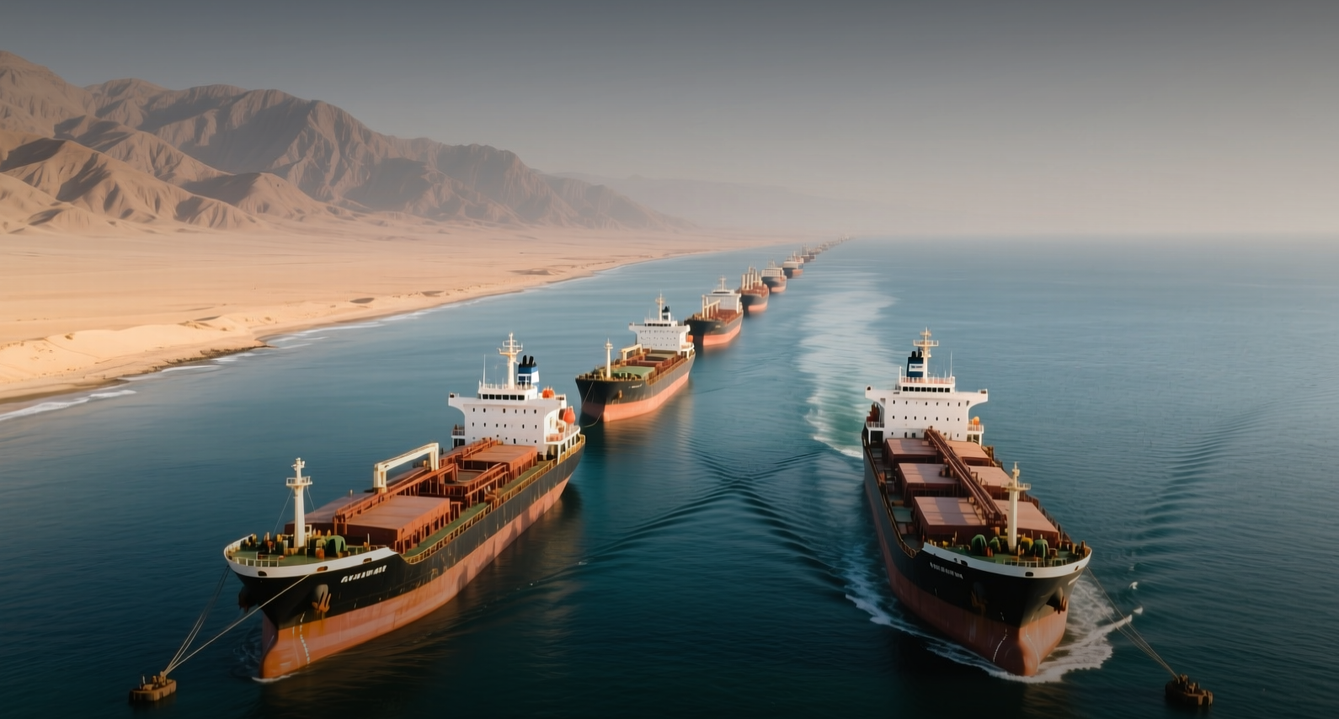
Brent crude closed above $100 a barrel for the first time since July after Iran said it struck 10 ships near the Strait of Hormuz in retaliation for the U.S. sinking five Iranian oil tankers, the largest declared exchange of shipping attacks in the six-month war. The average U.S. retail price of diesel rose above $5.94 a gallon, according to the source material.
"Continuous construction at the site, among other factors, suggests it is not yet capable of enrichment work, if that is the intended purpose," analysts at the Center for Strategic and International Studies wrote in the satellite-imagery assessment shared with CNN, referring to the Pickaxe Mountain complex.
The escalation has two fronts. At sea, Iran said it attacked 10 vessels after U.S. forces sank five Iranian oil tankers, and separately fired ballistic missiles at a base used by U.S. forces in Jordan. On land, President Donald Trump said last week that "we may hit Pickaxe very soon," adding that "we know everybody that's moving" at the site, a granite mountain about 140 miles south of Tehran and roughly two kilometers from the Natanz enrichment complex.
CSIS reviewed six years of imagery and found a "clear surge in construction activity" in 2026, with more road activity at the site than at any point in its history. Work has shifted from excavation toward probable internal construction, including raised and hardened tunnel portals, paved internal roads and removal of excavated soil. Open-source estimates place parts of the facility 80 to 100 meters underground, deeper than Fordow or Natanz, both of which the U.S. has bombed.
The bomb that may not reach
The GBU-57 Massive Ordnance Penetrator, the heaviest conventional bunker-buster in the U.S. arsenal at about 13,000 kilograms, is reported to penetrate 18 meters of concrete or 61 meters of earth. Against 100 meters of granite, CSIS said it may not reach and destroy the complex. A strike could instead collapse tunnel entrances, degrading the facility without destroying it.
The Pentagon has prepared for exactly that problem. Four days before the war began on February 28, the Defense Threat Reduction Agency signed an emergency $1.2 million contract justification to repair a "unique subterranean test facility at White Sands Missile Range" in New Mexico for a "live-fire test designed to validate classified capabilities against rapidly emerging threats." The memo cited a "time-sensitive national security directive" requiring completion within two to three weeks. Three sources told CNN the work was connected to the Iran war and involved simulating strikes on specific nuclear sites. The Air Force is separately developing a next-generation penetrator to succeed the MOP, with prototype work commissioned in September 2025.
The constraint matters for pricing. CSIS concluded that military strikes might delay work at Pickaxe Mountain but would not offer a sustainable solution, arguing any lasting resolution requires a verifiable diplomatic agreement. The IAEA has requested access to the site; Iran has not responded.
A second chokepoint opens
The Strait of Hormuz carries roughly a fifth of global seaborne oil, and the war has already pushed the risk premium into refined products faster than into crude. Diesel above $5.94 a gallon feeds directly into freight and industrial costs, the channel through which an energy shock becomes an inflation shock.
That channel is now widening. Yemen's Houthis struck four southern Saudi cities with missiles and drones, targeting a Saudi airbase in Khamis Mushait and Aramco assets in Abha, Najran and Jazan, setting oil installations ablaze. Saudi authorities said 73 people were wounded. Brent briefly touched $99.46 on Tuesday, its highest since July 24, before the shipping exchange pushed it through $100.
The diplomatic track is narrowing rather than opening. The IAEA's 35-nation Board of Governors voted to report Iran to the UN Security Council over breaches of its non-proliferation obligations, the first such referral since 2006. The agency said it has lost track of Iran's stockpile of uranium enriched to 60% purity, which stood at 440.9 kilograms before the strikes. China and Russia joined Iran in opposing the resolution, calling it "politically motivated and far-fetched."
For traders, the arithmetic is straightforward. Every sustained $10 move in Brent adds roughly 25 to 30 cents to U.S. pump prices within a few weeks, and diesel is already the tighter market. Gold and the dollar are catching the safe-haven bid that equities are losing, and the longer Hormuz stays contested, the more the inflation impulse from energy complicates rate-cut expectations into the fourth quarter. The next scheduled catalysts are the IAEA's quarterly safeguards reporting and any U.S. decision on the Pickaxe target package, which a source familiar with the matter said was considered earlier this summer.
This article is for informational purposes only and does not constitute investment advice.