

Key Takeaways: Taiwan is betting its defense on a "hellscape" of drones and unmanned boats to deter a Chinese invasion, a strategy tested in the island's 10-day Han Kuang exercises.
Key Takeaways: Taiwan is betting its defense on a "hellscape" of drones and unmanned boats to deter a Chinese invasion, a strategy tested in the island's 10-day Han Kuang exercises.
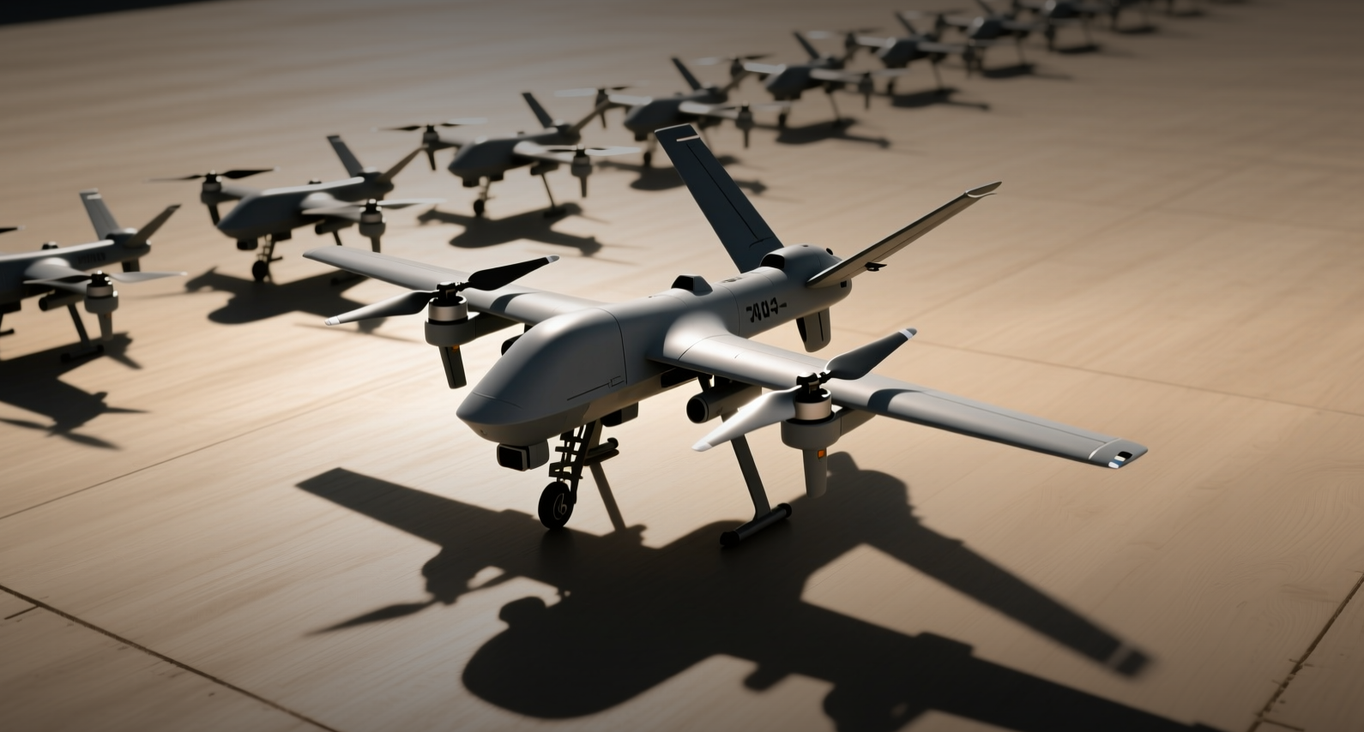
Taiwan is building fleets of flying drones and unmanned attack boats to deter a Chinese invasion, a strategy U.S. commanders call a "hellscape," showcased during the island's 10-day Han Kuang exercises that began Wednesday.
"Our drone and counter-drone efforts started relatively late, and initially we were trying things out as we went along," Lt. Gen. Huang Wen-chi, director general of strategic planning for the Taiwanese Defense Ministry, told lawmakers Wednesday.
The exercises, running through mid-August, train troops to use drones for reconnaissance and to shoot down enemy aircraft. Maj. Gen. Lu Wen-yuan, who helped plan the drills, said they would also practice counter-drone operations. Taiwan's approach draws directly on lessons from Ukraine, where cheap AI-enabled drones have come to dominate the battlefield.
The strategy carries direct market consequences. A credible deterrence posture could lower the geopolitical risk premium on Taiwan-exposed assets, including TSMC and the broader semiconductor supply chain, while a failure to deter would raise it sharply.
Why Ukraine's drone war matters
In Ukraine, the shift to autonomous drones has been dramatic. The Hornet, an AI-enabled fixed-wing strike drone from Perennial Autonomy, the U.S. defense firm founded by former Google chief executive Eric Schmidt, costs less than $10,000 a unit and has become a key weapon against Russian logistics. Ukrainian developers have pushed costs lower still: The Fourth Law's TFL-1 autonomy module, built around a $15 Raspberry Pi Zero computer, sells for as little as $150 and lets frontline units add AI targeting to existing drones.
The results are measurable. In one Ukrainian brigade, mission success rates rose to 71 percent from about 20 percent after adopting the module, while the effective kill zone expanded to 10 kilometers from three, according to Yaroslav Azhnyuk, founder of The Fourth Law. Drone costs rose only about 10 percent, to roughly $550 from $500.
"Anything radio-controlled is largely obsolete in those environments," said Bryan Pickens, a former U.S. Army Green Beret who fought in Ukraine. "Autonomous systems or satellite communications enabled systems are the future." Danylo Tsvok, head of Ukraine's Defense AI Center A1, said the contest has become a "competition of operating systems" as Russia deploys electronic warfare and camouflages equipment to defeat drone computer vision.
The market stakes for Taiwan
For Taiwan, the stakes extend beyond the battlefield. The last time cross-strait tensions escalated sharply, in August 2022 after then-House Speaker Nancy Pelosi's visit, investors sold Taiwan-exposed equities and the Taiwan dollar weakened as conflict risk was repriced. A credible drone deterrent could compress that risk premium, supporting Taiwan's domestic defense industry and suppliers of unmanned systems and maritime technology.
The question is whether Taiwan can scale the technology fast enough. Ukraine's experience shows adoption spreads quickly once units see results, but standardization remains a hurdle. "Units don't all have the same systems," Pickens said. "There's no universal operating environment." Taiwan's military said its drone and counter-drone programs have accelerated over the past two years, with the Han Kuang exercises serving as a proving ground.
For investors, the risk is asymmetric. A successful deterrent lowers the probability of a blockade or amphibious assault, supporting valuations across Taiwan's tech complex, where TSMC alone accounts for a large share of global advanced-chip output. A miscalculation, by contrast, would hit semiconductor supply chains worldwide, given the island's concentration in leading-edge fabrication. The exercises, which run through mid-August, will offer an early read on whether Taiwan's drone bet is credible enough to shift that calculus.
This article is for informational purposes only and does not constitute investment advice.
