
Samsung has locked roughly 70 percent of its memory production capacity into long-term agreements through 2031, yet even its largest customers cannot secure full contracted HBM volumes.
Samsung has locked roughly 70 percent of its memory production capacity into long-term agreements through 2031, yet even its largest customers cannot secure full contracted HBM volumes.
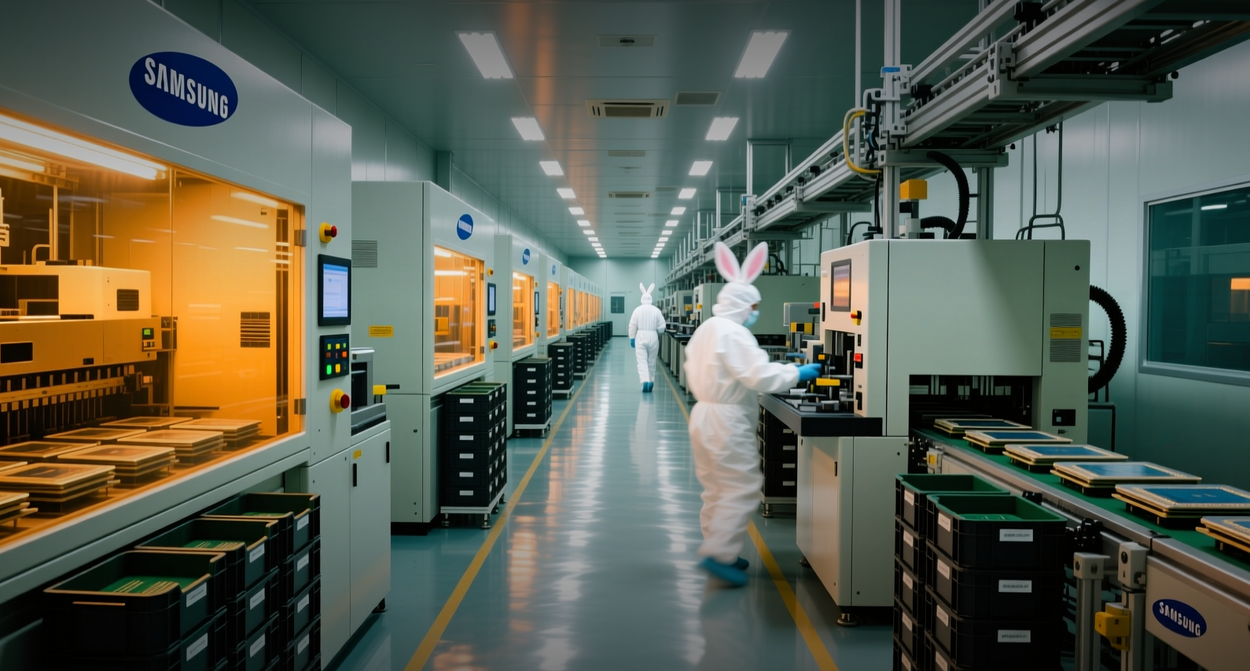
Samsung has committed roughly 70 percent of its memory capacity to long-term agreements through 2031, yet even Nvidia, Microsoft, and Google cannot secure full contracted HBM volumes as AI demand outstrips supply.
"HBM4 prices are roughly double those of the previous generation, so as memory companies ramp up production, the amount of DRAM consumed in the process also increases, ultimately reducing overall export volumes," Ahn Ki-hyun, executive director of the Korea Semiconductor Industry Association, said.
The squeeze is visible in South Korean trade data. DRAM export volumes fell 13.2 percent from about 681.7 million units in May to 591.74 million in July, while total export value rose 18.5 percent to $13.55 billion, according to the Korea International Trade Association. Unit prices climbed 36.6 percent to $22.90. On the spot market, a 36GB HBM3E product trades at $2,100 — roughly four to five times the $510 LTA price — while a 16-layer HBM4 product in production coordination costs about $3,500 without a contract, according to memory research firm Megagrid Supply.
The pricing power is flowing straight to the bottom line. Samsung's Q3 consensus estimates stand at ₩206.6 trillion in revenue and ₩116.4 trillion in operating profit, while SK Hynix is projected to post ₩101.8 trillion in revenue and ₩79.2 trillion in operating profit, according to the latest one-month consensus.
HBM4 Transition Deepens the DRAM Crunch
The shift to HBM4 is compounding the shortage. Each successive HBM generation has lower production yields, meaning HBM4 — still in early mass production — consumes more DRAM wafers than HBM3E to produce the same finished output. That dynamic is crowding out conventional DRAM production, pushing prices higher across the memory stack.
Gartner projects global semiconductor revenue will reach $1.56 trillion in 2026, with memory revenue hitting $837 billion. DRAM revenue alone is forecast to surge 246.6 percent this year as AI servers pack more memory per unit. Memory's share of total semiconductor revenue is expected to rise to 54 percent in 2026 from 27 percent in 2025, according to the research firm.
Capacity Expansion Underway
Both Samsung and SK Hynix are responding with capacity additions. Samsung's Device Solutions division is reviewing a plan to convert the S5 foundry line at its Pyeongtaek campus to memory production as early as next year. SK Hynix is expanding production bases in Yongin and South Korea's Honam region while exploring a joint-venture fab in Japan with a local partner, potentially deepening cooperation with Kioxia, the NAND flash maker in which SK Hynix is the largest shareholder.
The shortage is unlikely to resolve quickly. "To resolve the semiconductor supply shortage, more production facilities must be built," Ahn said. "Even when planned new fabs come online, the shortage will be alleviated rather than eliminated."
For investors, the memory upcycle benefits Samsung and SK Hynix directly, along with Micron Technology, which is also ramping HBM production. The Defiance Memory & Photonics ETF (PRAM), launched in August, tracks 20 memory and photonics companies including SK Hynix, Micron, and Nanya Technology, giving investors a targeted way to access the AI memory trade. But for AI infrastructure builders and hyperscalers, rising memory costs are squeezing procurement budgets — Gartner notes that tight supply-demand conditions will increase the cost of servers and infrastructure components through 2027.
This article is for informational purposes only and does not constitute investment advice.
