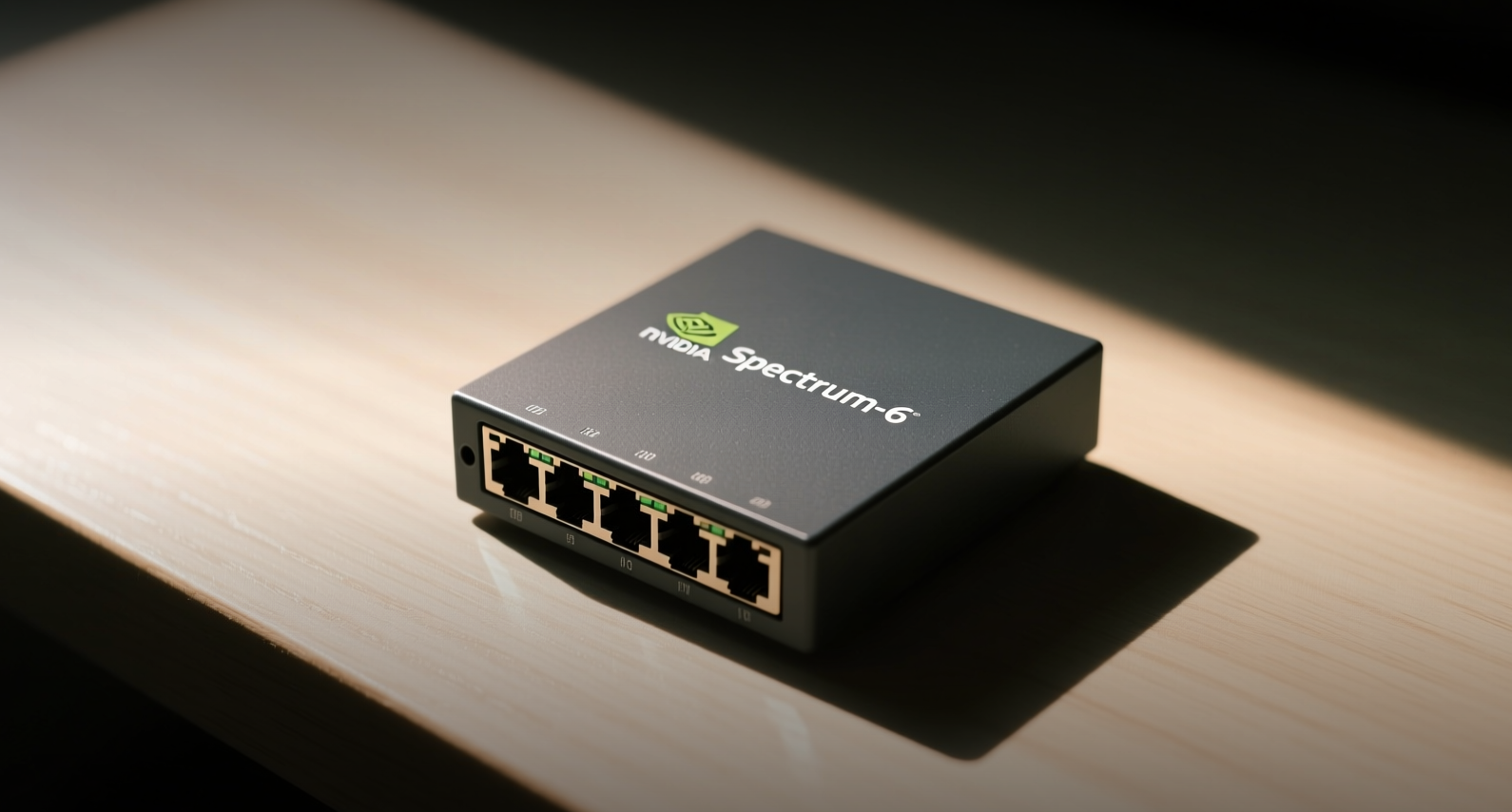
Nvidia's networking business, which generated $11 billion in revenue last quarter — up 263 percent from a year earlier — now faces its biggest test: proving Ethernet can match InfiniBand for AI workloads at scale. The company's answer is Spectrum-6, a 102.4-terabit-per-second Ethernet switch system that doubles the capacity of its predecessor and forms the networking backbone of the Vera Rubin AI platform.
"At gigascale, performance comes down to coordination: keeping every GPU in lockstep so one slow link does not stall an entire job," Laurelle Roseman, vice president of global partnerships at Nebius, said. "That is what Nvidia Spectrum-6 goes after and why we brought it in early."
The switch line comes in two configurations. The SN6810 offers 128 ports at 800 Gb/s, while the SN6800 delivers 409.6 Tb/s of aggregate bandwidth across 512 ports at 800 Gb/s — both liquid-cooled and designed for deployment in AI factories exceeding 100,000 GPUs. Nvidia claims Spectrum-X Ethernet fabric delivers up to 1.6 times the AI networking performance of standard Ethernet, sustaining 95 percent network efficiency at that scale. The company also said its silicon photonics integration provides five times higher power efficiency and 10 times better mean time between incidents compared with conventional optical networking.
The stakes extend beyond a single product launch. Spectrum-6 is one of six components in Nvidia's Rubin architecture, alongside the Vera CPU, Rubin GPU, NVLink 6 switches, ConnectX-9 SuperNICs, and BlueField-4 DPUs — a vertically integrated stack designed to operate an entire AI factory as one computing system. CoreWeave, Microsoft, Nebius, SpaceX AI, and Tesla are among the first operators to deploy the switches, signaling that hyperscale AI builders view networking as a bottleneck that can no longer be solved with off-the-shelf gear.
Why networking became the bottleneck
Large AI models require thousands of accelerators to exchange data constantly during training, generating east-west traffic patterns that traditional Ethernet — designed for north-south enterprise traffic — handles poorly. A single slow link can stall an entire training run, wasting millions of dollars in GPU time. Nvidia's hardware-accelerated Spectrum-X multi-plane topology reduces the number of switches needed by 40 percent, according to the company, while the CPO (co-packaged optics) variant — expected to ship later this year — further cuts power consumption.
"Bringing Nvidia Spectrum-6 and liquid-cooled Spectrum-X Ethernet infrastructure into our AI factories will help us deliver the bandwidth, resilience and efficiency customers need to train frontier models and deploy inference faster," Min Jun, director of product for networking at CoreWeave, said.
What it means for investors
Nvidia's push into Ethernet networking puts it in direct competition with Broadcom and Arista Networks, which dominate the data center Ethernet switch market. Broadcom's Tomahawk 5 and Jericho3-AI chips target similar AI workloads, while Arista's 7800R4 series offers 800 Gb/s ports for cloud providers. Nvidia's advantage lies in integration: Spectrum-6 is designed from the start to work with its own GPUs, NVLink fabric, and BlueField DPUs, creating a lock-in effect that rivals cannot easily replicate.
Nvidia shares trade at roughly 35 times forward earnings, reflecting investor expectations that data center revenue — already the company's largest segment — will continue growing as AI factories scale from megawatt to gigawatt power consumption. The Spectrum-6 launch reinforces that thesis, though the CPO variant's second-half shipping timeline means the revenue impact will not materialize until late 2025 or early 2026. For Broadcom and Arista, the risk is that Nvidia's integrated stack convinces hyperscalers to buy networking from the same vendor supplying their GPUs, compressing margins for standalone switch makers.
This article is for informational purposes only and does not constitute investment advice.