
Key Takeaways: Tesla's robotaxi footprint in Nevada grew roughly 500-fold in a single regulatory vote.
Key Takeaways: Tesla's robotaxi footprint in Nevada grew roughly 500-fold in a single regulatory vote.
Tesla's robotaxi footprint in Nevada grew roughly 500-fold in a single regulatory vote.
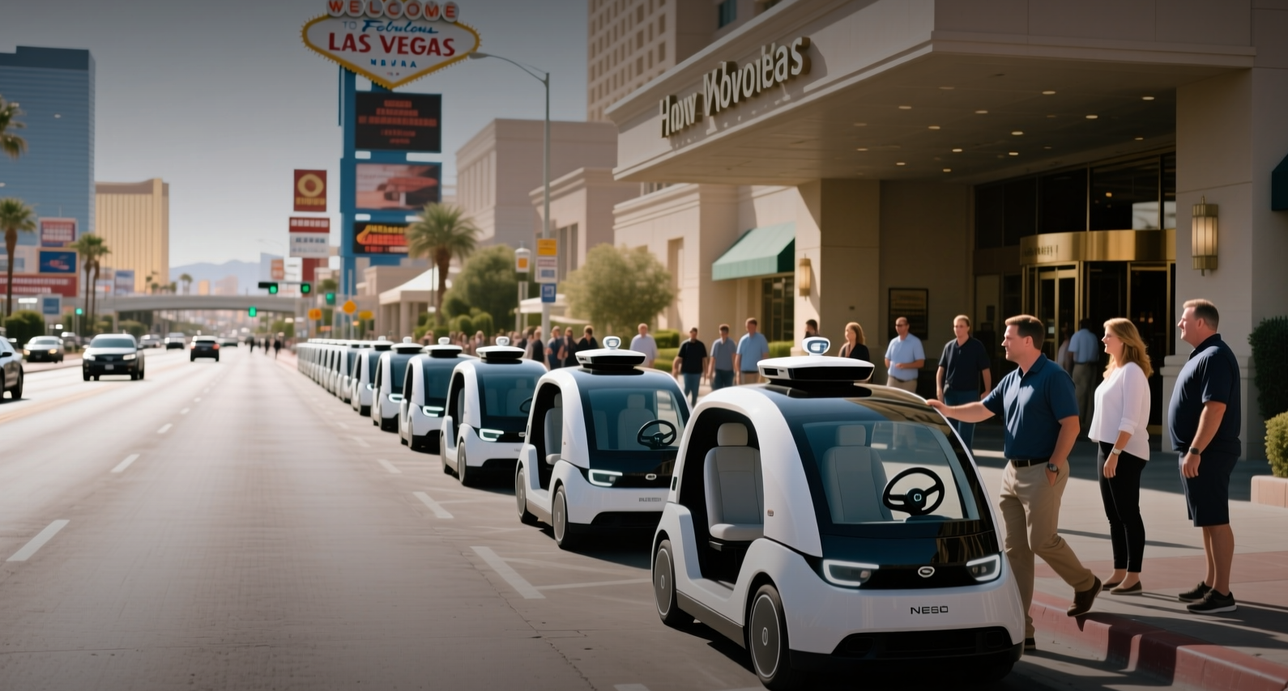
Nevada regulators approved Tesla's full Autonomous Vehicle Network Company permit Thursday, clearing up to 5,000 paid robotaxis across Clark County — a 500-fold expansion from the 10-vehicle interim cap issued in July.
Eric Early, chief engineer of the Tesla Cybercab, said at the hearing that 5,000 is the ceiling regulators allow and the company would be "extremely happy and satisfied" to reach about 2,500 vehicles within a year.
The permit covers all of Clark County, including Harry Reid International and Henderson Executive airports, replacing the July interim order that confined Tesla to the Las Vegas Strip corridor with a 45 mph speed ceiling and no airport pickups. Commercial rides are expected to begin within 30 days, pending vehicle inspections, insurance filings, and fare approval. Tesla must mark vehicles "Robotaxi" and report crashes or system failures to the Nevada Transportation Authority within five working days.
The approval lands as Tesla prepares to open Cybercab rides to the public in Austin and scales production at Gigafactory Texas, where annual capacity exceeds 125,000 units. JPMorgan's Rajat Gupta, who maintains a Neutral rating and $445 price target, expects Tesla revenue to grow from about $95 billion in 2025 to $203 billion by 2030, with autonomy and services contributing nearly half of the incremental growth.
Cybercab Ramp Depends on FSD V15
Tesla is prioritizing the purpose-built Cybercab — a two-seat vehicle with no steering wheel or pedals — over retrofitting Model Y crossovers into its fleet. The company told JPMorgan it is intentionally holding back Model Y additions because it expects to scale Cybercab in the near term. Tesla currently operates about 186 Model Y robotaxis in Austin, according to fleet tracking, and has begun employee rides in production Cybercabs on public roads.
Mass production is only the hardware prerequisite. Tesla describes Full Self-Driving V15 as a "step-change in performance," with about 40 percent of its seven core technologies already undergoing robotaxi testing and early feedback "encouraging," according to JPMorgan. The company calls V15 the "primary gateway to scaling unsupervised FSD." Active FSD subscriptions reached about 1.28 million in the first quarter, up 51 percent year over year, while Tesla's fleet crossed 10 billion cumulative FSD miles in May.
The Nevada ceiling puts Tesla well ahead of rivals on paper. Uber and Waymo each received approval for 1,000 vehicles, while Amazon-owned Zoox, which has operated in Nevada since 2025, was capped at 100 vehicles before Thursday's decision. Tesla's actual fleet size will depend on how quickly FSD V15 rolls out, executives said.
Musk Sees Growth Beyond Wall Street Forecasts
Musk responded on X to a post from financial commentator Jon Erlichman forecasting Tesla revenue growth of 119 percent over five years and a 2,090 percent surge at SpaceX. "I know it sounds crazy right now, but I think both SpaceX and Tesla will exceed these estimates," Musk said.
JPMorgan's Gupta maintained a Neutral rating with a $445 price target, implying nearly 29 percent upside from current levels. Morgan Stanley's Andrew Percoco holds a $415 target and a Hold rating, writing that Tesla must show "clearer evidence that Robotaxi is scaling" to justify elevated capital spending. Tesla shares fell 2 percent Thursday but remain up 1 percent for the week; the stock is down about 23 percent year to date, the worst performer among the Magnificent Seven.
The regulatory breakthrough gives Tesla a commercial foothold in a major tourism market as it races to prove the economics of driverless ride-hail. Whether the company can scale toward the 5,000-vehicle ceiling — and whether FSD V15 delivers the step-change executives promise — will determine how quickly the autonomous driving business moves from pilot to profit center.
This article is for informational purposes only and does not constitute investment advice.
