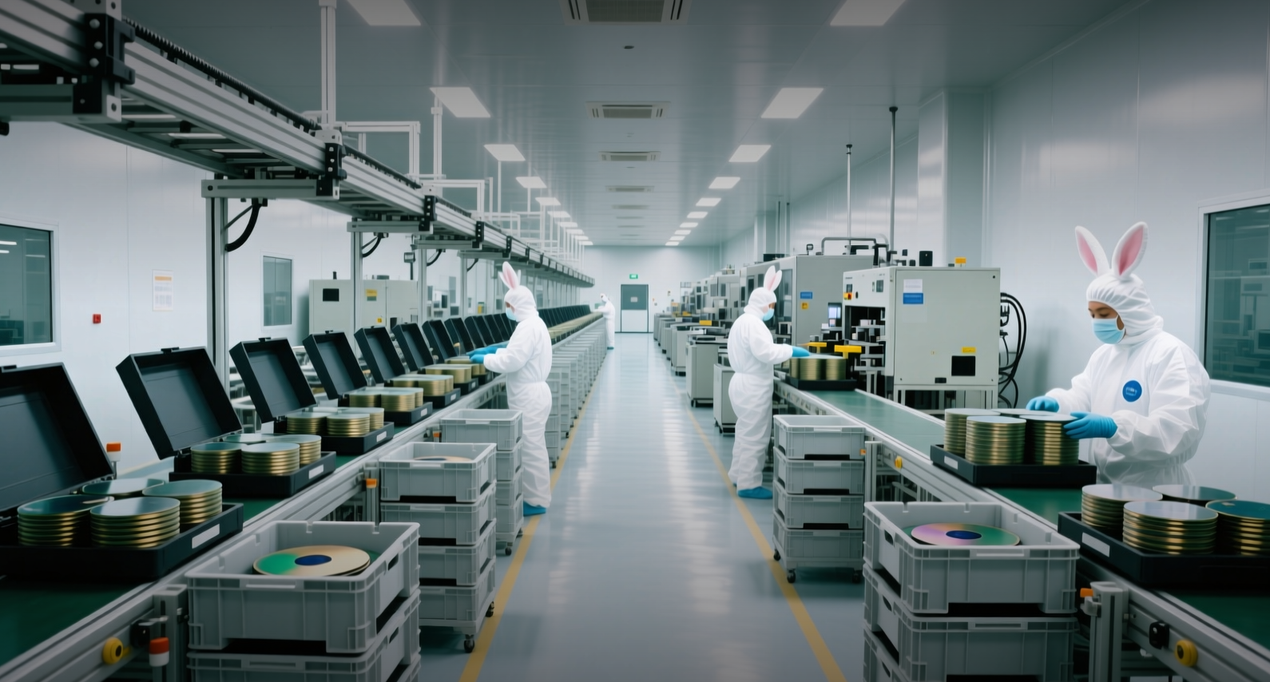
Micron Technology is racing to nearly double its high-bandwidth memory output by year-end, adding as many as 60,000 wafers a month to reach roughly 100,000 as it tries to close a capacity gap with SK Hynix and Samsung Electronics that has left it a distant third in the AI memory market. The U.S. memory maker is shifting its product mix toward 12-layer HBM4, the memory used in Nvidia's Vera Rubin accelerator, with that generation's share of output targeted to climb from 20 percent to 30 percent early this year to as much as 50 percent by December.
"Micron's HBM4 production is scaling up twice as fast as HBM3," Chief Executive Sanjay Mehrotra said on the company's fiscal third-quarter earnings call in June, citing cumulative HBM4 revenue that has already topped $1 billion. The faster ramp reflects demand that has Micron's HBM sold out for calendar 2026, with a significant portion of 2027 capacity reserved under long-term customer agreements.
The expansion is backed by increased equipment orders flowing into Micron's packaging hubs in Taiwan's Tongluo and Singapore's Woodlands, with investment at its Hiroshima, Japan fab also in preparation. Last year the company produced roughly 40,000 to 50,000 HBM wafers a month, according to industry sources cited by ETNews, meaning the new capacity will more than double its prior base. HBM4 12-layer, which began mass production in the second quarter, is set to overtake the 12-layer HBM3E that currently dominates Micron's output.
The push matters because Micron's scale lags its Korean rivals by a wide margin. SK Hynix and Samsung each run about 150,000 to 200,000 HBM wafers a month, three to four times Micron's current level, and Counterpoint Research data for the second quarter put Micron's HBM market share at 18 percent versus SK Hynix's 50 percent and Samsung's 32 percent. If Micron hits its year-end target, the capacity gap with both competitors would narrow to roughly half its current size, setting up a potential redistribution of share.
Samsung is not standing still. The Korean giant is devoting about half of its roughly 150,000 monthly HBM wafers to HBM4, ramping output after first shipments in February, and its HBM4 yield has climbed to near 80 percent from around 60 percent six months ago, according to industry reports. SK Hynix, meanwhile, is building out its first U.S. AI memory hub in Indiana, with next-generation HBM supply to American customers planned from the second half of 2029.
For investors, the competitive stakes are concentrated in who captures Nvidia's shifting HBM demand. Nvidia is diversifying its memory configurations, with Samsung and SK Hynix planning to raise shipments of 8-layer HBM4 in the second half of this year as the chip designer balances thermal management against supply-chain stability. Micron, which flagged HBM4E as the start of a custom HBM era and expects to begin ramping that generation in 2027 on its 1-gamma process node, is betting its faster production learning curve will let it win a larger slice of that business. The memory shortage that has lifted conventional DRAM and NAND prices is expected to persist into 2027 and 2028, giving whichever supplier scales fastest the clearest path to locking in multiyear revenue.
This article is for informational purposes only and does not constitute investment advice.