

Memory now accounts for roughly half the value of AI systems, up from 10 percent three decades ago — a shift Deutsche Bank says makes Micron's current cycle structurally different from every prior memory boom.
Memory now accounts for roughly half the value of AI systems, up from 10 percent three decades ago — a shift Deutsche Bank says makes Micron's current cycle structurally different from every prior memory boom.
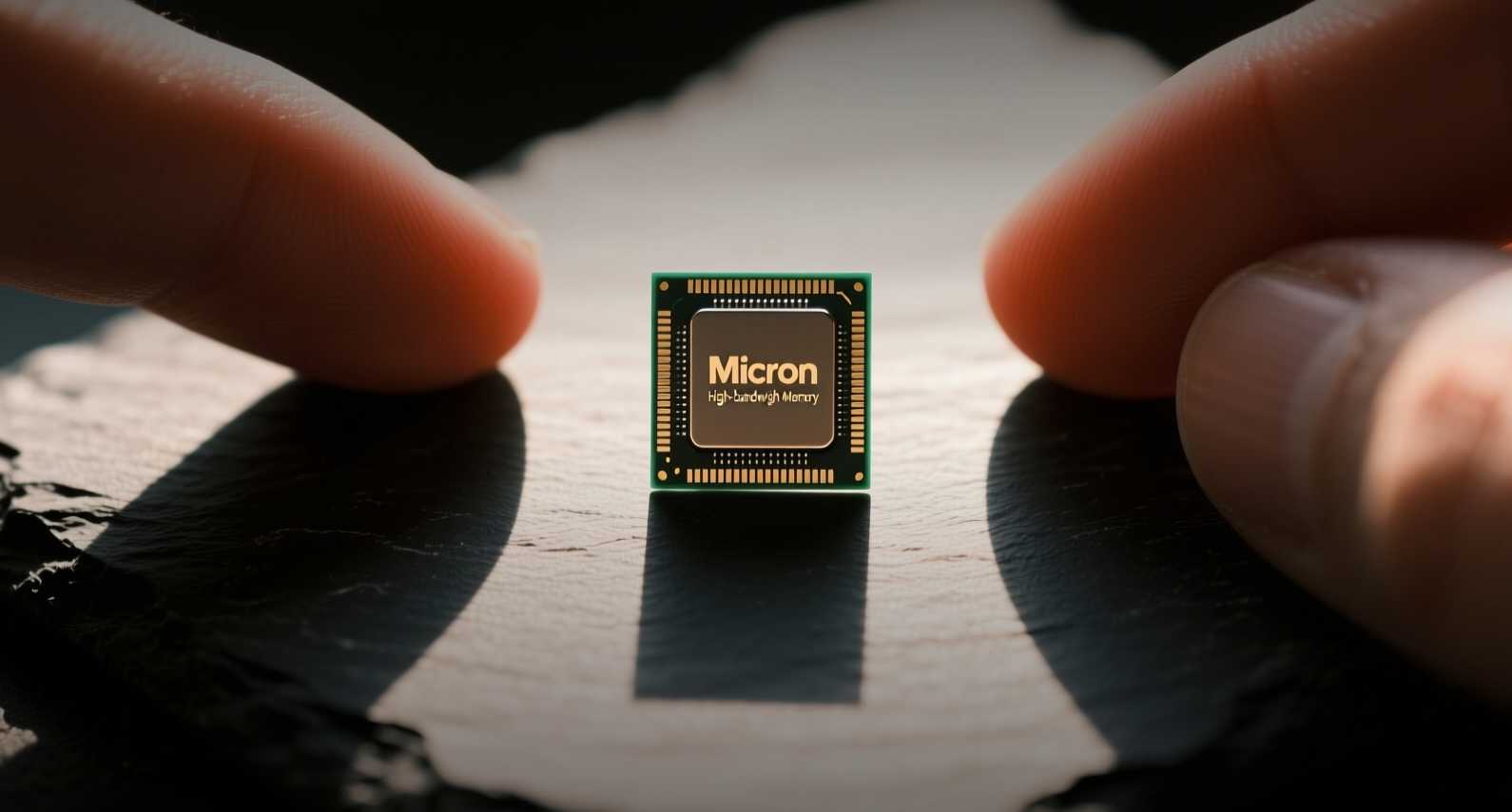
Deutsche Bank maintained its Buy rating on Micron Technology after meeting management at the FMS 2026 flash memory summit on Aug. 6, citing memory's rise to roughly 50 percent of system value and structural DRAM and NAND undersupply driven by AI workloads.
"Micron's record fiscal Q3 financial results and even stronger outlook for Q4 reflect the strategic value of memory in the AI era," CEO Sanjay Mehrotra said in the company's earnings release. Deutsche Bank analyst Melissa Weathers, who met with Micron's Jeremy Werner, senior vice president and general manager of core data center business, and Satya Kumar, investor relations and finance vice president, said the company holds a "luxury advantage" — the ability to grow without sacrificing profitability.
Micron's fiscal Q3 revenue hit $41.4 billion, up 346 percent year over year, with GAAP gross margin expanding to 84.6 percent from 37.7 percent. Management guided fiscal Q4 revenue to roughly $50 billion, with HBM4 qualification samples still rationed across lead customers. A single Nvidia H200 GPU consumes 141GB of HBM3e, and hyperscaler buildouts have pulled HBM bookings into multi-year strategic customer agreements that lock in pricing visibility.
The report strengthens the bull case for Micron and the broader memory complex. Strategic customer agreements are expected to cover about 40 percent of sales volume, providing price floors and ceilings that reduce the severity of supply shocks. Deutsche Bank also flagged an emerging demand signal: hyperscaler capital expenditure has concentrated on GPU infrastructure, but CPU-side AI agent workloads — which are far more compute-intensive than human-driven tasks — are starting to surface, though management described adoption as "pre-season warmup" limited to the most technically capable hyperscalers.
Management told Deutsche Bank that memory's share of total system value has climbed from roughly 10 percent about 30 years ago to nearly 50 percent today, with AI accelerating this multi-decade revaluation. The technical driver: KV cache management. If KV caches are mishandled, GPUs are forced to recompute results rather than advance new tasks, inflating utilization metrics without producing output.
Micron addresses this with a multi-tier memory architecture — HBM for hot-path compute, SOCAMM2 main memory for KV cache overflow, decentralized DDR5 resource pools for long-tail demand, and orchestration software to manage data swapping. Weathers said she is tracking whether expanding context windows will continue to increase per-GPU memory intensity, or whether KV cache orchestration software can absorb some demand growth through optimization.
Deutsche Bank identified CPU-side AI agent demand as an "incremental pillar" for AI-driven memory growth. As workloads shift from human-driven to agent-driven — with significantly higher compute-call density — hyperscalers' historical underinvestment in CPU infrastructure is being revisited. Management was cautious about the current stage, describing agent resource adoption as "pre-season warmup" with deployment limited to leading hyperscalers.
The report also addressed emerging memory alternatives. About 5 percent of systems currently run inference workloads that favor SRAM over DRAM due to high DRAM prices, but SRAM's scalability limits make it an on-chip solution rather than an HBM replacement. CXL and HBF technologies drew discussion at FMS 2026 but face questions on practical value and commercialization, according to Micron management.
Micron shares have surged more than 100 percent over the trailing 12 months, with the VanEck Semiconductor ETF (SMH) up roughly 54 percent year to date. The Roundhill Memory ETF (DRAM), the only pure-play memory vehicle on US exchanges, has gained more than 97 percent since its April debut, holding Samsung Electronics at 25 percent, SK Hynix at 24 percent, and Micron at nearly 24 percent. Deutsche Bank's Buy rating implies the market has not fully priced in the earnings revision potential from structural undersupply and the emerging CPU-side demand pillar. The key risk remains the historical pattern of memory cycles rolling over when capital expenditure guidance softens — but with SCAs covering 40 percent of volume and HBM4 ramping into 2027, the current cycle has more contractual support than any prior memory boom.
This article is for informational purposes only and does not constitute investment advice.
