

Intel fell about 6% to $99.67 on Thursday, ending a five-session streak in which the stock gained more than 20% and slipping back below the $100 level.
Intel fell about 6% to $99.67 on Thursday, ending a five-session streak in which the stock gained more than 20% and slipping back below the $100 level.
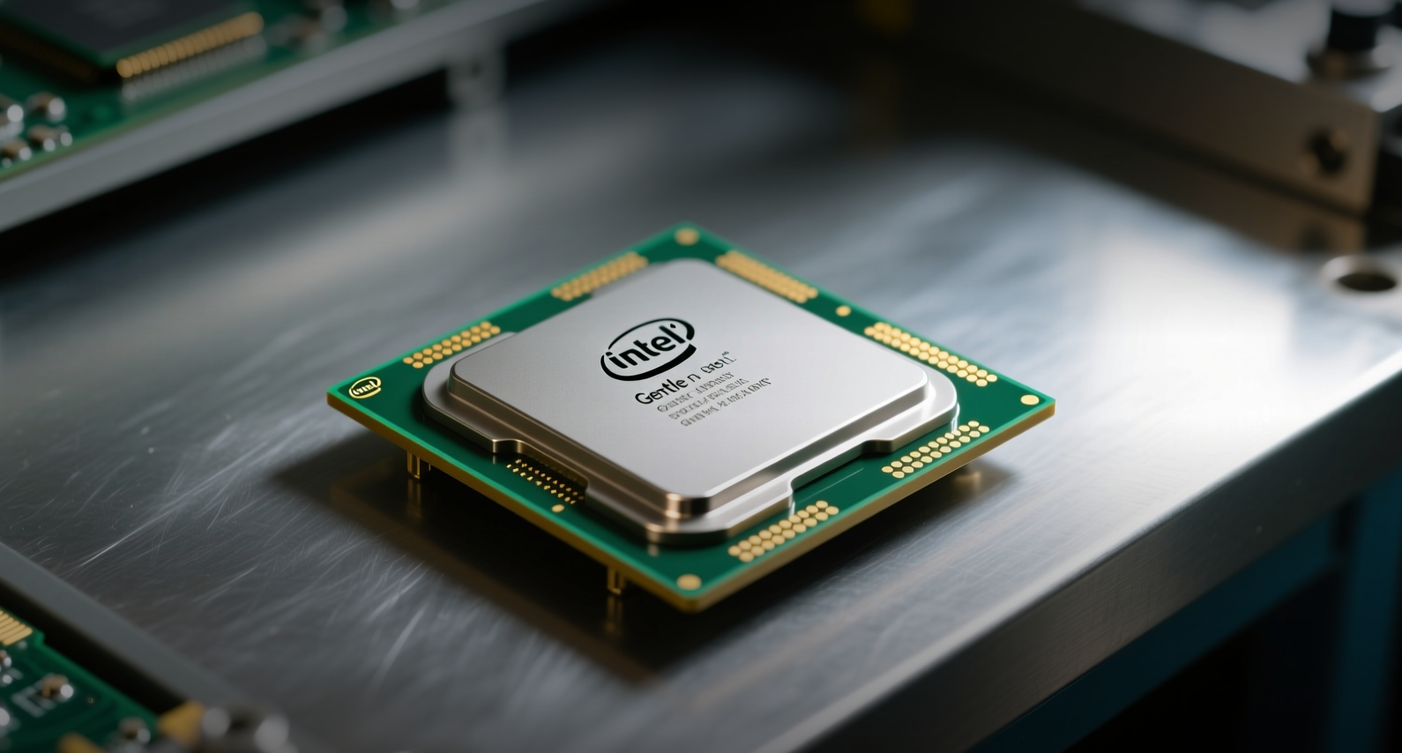
Intel shares fell about 6% to $99.67 in early Thursday trading, ending a five-session winning streak that had added more than 20% and pulling the stock back below the $100 level that had anchored the run.
The decline arrived without a company-specific catalyst. Intel's last material news was an unconfirmed report earlier in the week that the chipmaker could raise selected PC processor prices by 10% — a report that was never confirmed as company policy, and one that the sell side never validated. The stock's ratings cluster remains at Hold, with an average analyst price target of $115.88, above where shares now trade.
"The move reads as mechanical rather than fundamental — a rotation out of a name that had run up sharply into a suddenly defensive tape," said Priya Mehta, equity market strategist covering flows and positioning. "When a stock adds more than 20% in five sessions on an unconfirmed report, the marginal buyer is a momentum account, and momentum accounts leave faster than they arrive."
The reversal was not confined to Intel. Nvidia fell 3% to $214.55 and AMD dropped 3% to $505.66, while the iShares Semiconductor ETF (SOXX) lost 3% and sat below the sector's late-summer highs. The Invesco QQQ Trust slipped 1.14%, so chips fell harder than large-cap technology generally — the signature of a sector-wide de-risking rather than a single-stock event.
The $100 level is now the pivot. Intel closed Wednesday's session having gained 188% year to date, and Thursday's open put the stock roughly 6% below that peak. For traders who chased the breakout, the round number is the first place where the rally either reasserts itself or turns into something longer.
The macro backdrop explains why the exit door was crowded. The 10-year Treasury note closed at 4.84%, the highest in almost three years, with crude pushing above the $100 mark on renewed Middle East fighting and inflation data due ahead of a Federal Reserve meeting. Higher long-term yields compress valuation multiples on richly priced growth names, and semiconductors have been the market's most crowded trade — AMD and Nvidia both entered the session with large year-to-date gains and each gave ground alongside Intel.
Intel's own fundamentals still support a constructive read. Q2 FY2026 revenue was $16.13 billion, up 25.4% year over year, with Data Center and AI revenue rising 59%. CEO Lip-Bu Tan called it Intel's "strongest revenue growth in more than fifteen years." Nvidia's Q2 FY2027 revenue was $96.22 billion, up 105.85% year over year, with Q3 guidance of $108 billion. AMD's Q2 FY2026 revenue was $11.54 billion, with Data Center revenue up 107% on Instinct and EPYC momentum.
The bear case is equally straightforward: all three trade at premium multiples on peak-cycle expectations, and rising real yields hit long-duration equities first. The bull case remains the AI infrastructure buildout, which management commentary from each of the three chipmakers describes as still accelerating.
Today's price action shows a lack of conviction among buyers at these levels. Intel's next scheduled catalyst is its Q3 2026 report, with guidance for revenue of $15.8 billion to $16.8 billion — a range whose midpoint implies sequential deceleration from the $16.13 billion posted in Q2. Until that print, Intel's price action will likely track the broader semiconductor sector and the direction of long-term Treasury yields rather than anything the company says.
For investors weighing new exposure, the Hold-heavy ratings mix argues for modest position sizes, and the $100 level gives a clean reference for where the profit-taking stops and the correction begins.
This article is for informational purposes only and does not constitute investment advice.
