
Canada's dollar-for-dollar retaliation escalates the North American trade war into its most acute phase since NAFTA negotiations collapsed.
Canada's dollar-for-dollar retaliation escalates the North American trade war into its most acute phase since NAFTA negotiations collapsed.
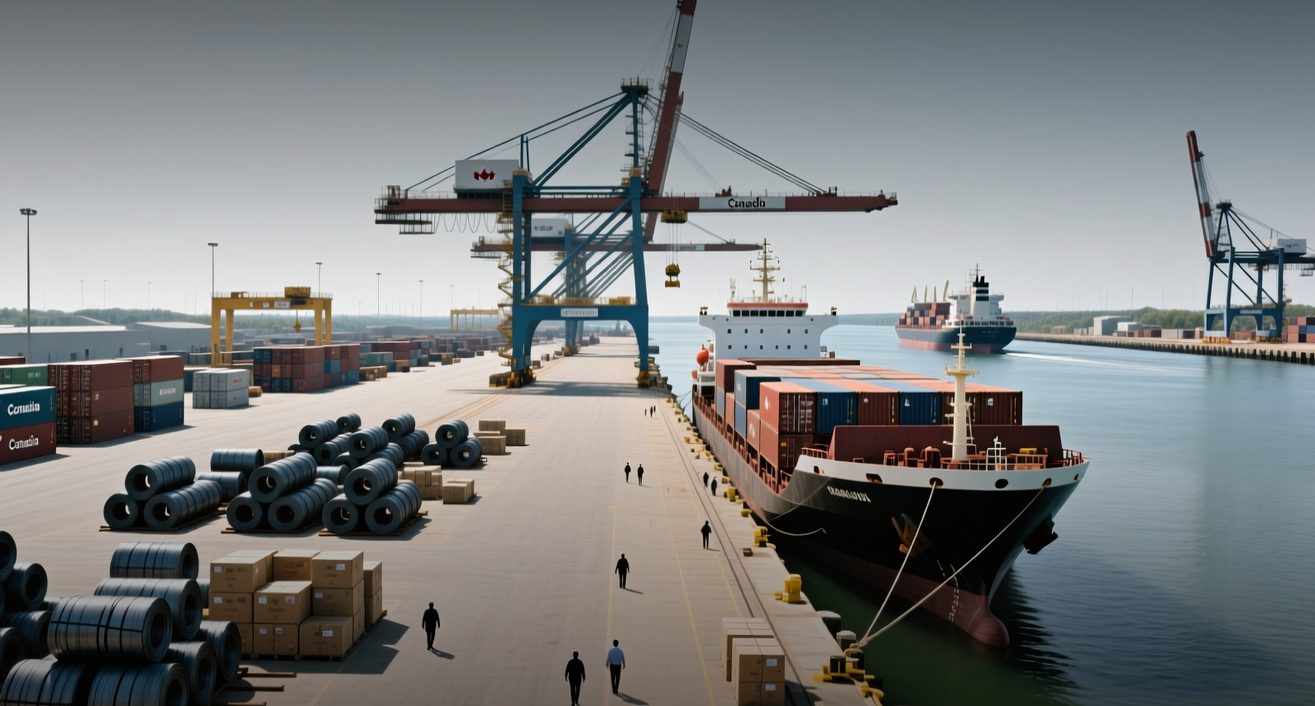
Canada will impose counter-tariffs of up to 50 percent on roughly $20 billion of U.S. imports starting Sept. 8, matching President Donald Trump's levies dollar-for-dollar after trade talks collapsed over the weekend.
"For each product, our tariff would match the American tariff on the same type of Canadian goods," Finance Minister François-Philippe Champagne said Tuesday in Ottawa. "When the United States asked too much and offered too little, we chose to stand up for Canadians."
The countermeasures target more than 700 U.S.-made products across three tiers — 15 percent, 25 percent, and 50 percent — including steel, aluminum, motorcycles, washers and dryers, chain saws, processed cheese, clams, and frozen octopus. The tariffs cover roughly 7 percent of total U.S. imports to Canada, which totaled $872.3 billion in bilateral trade in 2025.
The escalation follows Trump's 50 percent tariffs on about $20 billion of Canadian exports that took effect Saturday, covering alcoholic beverages, dairy products, motor vehicles, and a broad range of goods from hockey equipment to textiles. Trump has threatened to raise tariffs on all Canadian cars, trucks, automotive parts, and steel to 50 percent starting Jan. 1, 2027.
Prime Minister Mark Carney said Monday that U.S. negotiators raised the discoverability of French-language content on streaming platforms and French labeling rules as trade irritants during the failed talks. "For the Americans, French language, francophone culture, Quebec culture, and Canadian culture, for them these are irritants. Here in Quebec, here in Canada, they are rights — fundamental rights," Carney said in French at an event in Lévis, Quebec.
Trump denied the accusations, calling them a "lie" by Carney to gain political support in Quebec. "I would never interfere with Canadians speaking French! In fact, I have never even thought of doing such a stupid thing," he posted on Truth Social Tuesday.
Quebec implemented a law last year requiring streaming giants to add French-language content and make it more accessible to users. The province also enforces strict labeling rules requiring packaging to include French.
The tariff announcement came hours after Trump said his administration is considering renaming Lake Ontario to "Lake America," the latest in a series of cultural swipes at Canada. "The United States is giving serious consideration to changing the name of Lake Ontario to Lake America in that we don't expect to be doing much business with Ontario any longer," Trump posted Tuesday morning.
Trump also repeated his accusation that Canada has been "ripping off" the U.S.A. for decades and compared the country to a U.S. state. Vice President J.D. Vance referred to Canada as a "state" during a rally in Maine on Monday, which he claimed was a "Freudian slip."
Canadian officials said the counter-tariffs are designed to protect domestic industry rather than raise revenue. "It's all about fairness. It's all about level playing field. It's all about supporting Canadian workers and Canadian businesses," Champagne said.
The U.S. tariff lists are broader than their category names suggest. The alcohol list includes beer made from malt, sparkling wine, and various spirits, alongside wood-based goods such as kitchenware and hockey equipment. The dairy list covers powdered milk, milk protein concentrates, whey protein concentrates, and lactose. The motor-vehicle list extends from vehicles to natural honey, feathers, plant extracts, salt, and baking mixes, plus textiles, clothing, smartphones, video recorders, and video game consoles.
The last time the U.S. and Canada engaged in a tariff standoff of this magnitude was in 2018, when Trump imposed 25 percent steel and 10 percent aluminum tariffs on Canadian imports, prompting Ottawa to retaliate with duties on U.S. goods. Those measures were lifted in 2019 after the USMCA agreement was reached, but the current dispute has no comparable resolution timeline.
With the next escalation scheduled for Jan. 1, 2027, when the additional 50 percent auto and steel tariffs would take effect, both economies face mounting pressure across trade-sensitive sectors including automotive, agriculture, manufacturing, and materials. Commodity prices, particularly oil and lumber, could see volatility given the bilateral trade exposure.
This article is for informational purposes only and does not constitute investment advice.
